
Gross Margin vs. EBITDA in Manufacturing M&A

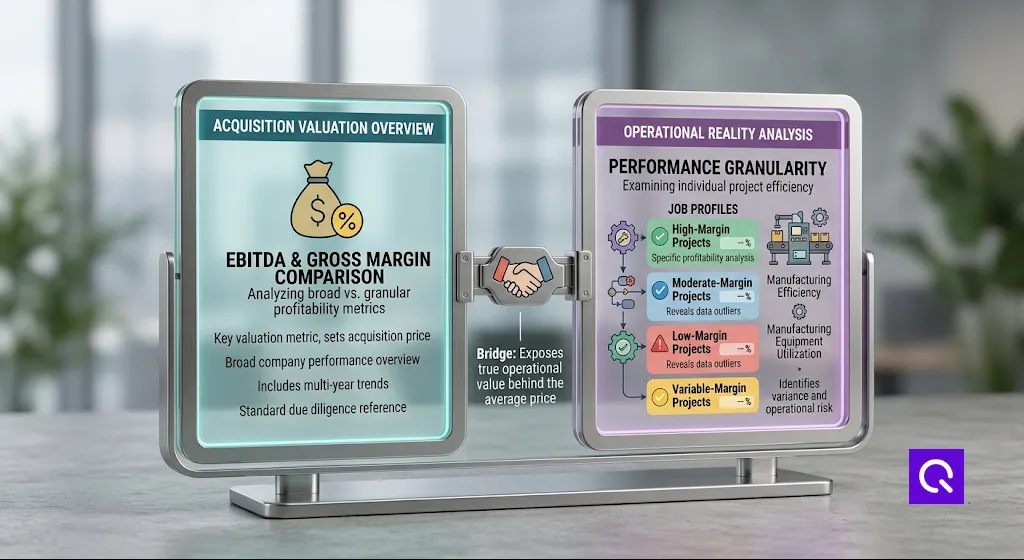
Our complete guide to gross margin touches on how EBITDA margin differs from gross margin. In a manufacturing acquisition, that difference stops being an academic distinction and starts being the thing that either gets a deal renegotiated after the letter of intent or gets it protected before it ever reaches diligence.
Why Private Equity Prices Deals Off EBITDA, Not Gross Margin
Valuation in a private equity transaction is typically built as a multiple applied to EBITDA, earnings before interest, taxes, depreciation, and amortization. EBITDA strips out financing structure and capital intensity, which makes it far more useful than gross margin for comparing businesses that carry different amounts of debt or own versus lease their equipment. A multiple of 6x or 7x gets applied to that EBITDA number to arrive at enterprise value, which is why buyers and sellers spend so much of a deal negotiating what actually counts inside EBITDA in the first place.
This is the entire purpose of a quality of earnings (QoE) review, now standard on the vast majority of middle-market deals. A QoE walks reported EBITDA through a series of add-backs, an owner’s above-market salary, one-time legal or consulting fees, above-market related-party rent, personal expenses run through the business, to arrive at an adjusted EBITDA figure the buyer is actually willing to pay a multiple on. Because every dollar of defensible add-back gets multiplied by the deal multiple, a single supportable adjustment can be worth several times its face value at closing, which is exactly why this process gets so much scrutiny from both sides.
Why Gross Margin Still Matters Even Though EBITDA Sets the Price
A rigorous QoE does not stop at the EBITDA bridge. Standard due diligence scope also includes a direct look at revenue and gross margin broken out by product line, customer, or distribution segment, precisely because a clean, normalized EBITDA at the company-wide level can still be built on top of gross margin that varies wildly, and sometimes unsustainably, underneath it.
This is the exact blind spot covered in Quanzar’s research into operational due diligence for industrial acquisitions: a target can present a consolidated EBITDA margin that looks perfectly healthy while individual jobs, product lines, or customer relationships underneath it are running at gross margins the acquirer never sees until after the deal has closed and the company’s own reporting starts surfacing them. EBITDA is a company-wide, backward-looking summary. Gross margin, examined at the job or customer level, is where the operational reality of how the business actually makes money lives, and that reality is what an acquirer inherits regardless of how clean the EBITDA bridge looked in the data room.
Gross Margin Red Flags That Show Up in Manufacturing Diligence
A margin built on a pricing tailwind that won’t repeat. A price increase pushed through during a supply-constrained year, or a temporary surcharge that customers accepted under pressure and will push back on the moment conditions normalize, inflates trailing gross margin without reflecting a sustainable baseline. A careful buyer normalizes gross margin to a longer-term average rather than taking the most recent, most favorable period at face value.
Margin propped up by one customer at a rate the relationship won’t sustain. If a single large customer is being run at an unusually favorable margin because of a legacy pricing arrangement, a personal relationship with the outgoing owner, or simple inertia, that margin is at real risk the moment the relationship gets renegotiated post-close, and consolidated company-wide gross margin gives no visibility into which customer that is.
Margin distorted by a shift in customer-furnished material mix. As covered in our guide to good gross margin for contract manufacturers, a swing toward more customer-furnished-material work mechanically inflates reported gross margin percentage without reflecting any real operational improvement. A target whose margin has been trending up because of a mix shift like this, rather than genuine efficiency gains, is presenting a misleading trend line even with entirely accurate underlying numbers.
Inconsistent COGS classification across product lines or facilities. A target that has grown through acquisition, or that has multiple facilities with different accounting habits, sometimes shows a blended gross margin that isn’t actually comparing like to like across its own business units, which makes both the trend and any peer benchmarking unreliable until the classifications are normalized.
What This Means If You’re Preparing to Sell
A sell-side QoE, commissioned before a business goes to market, exists specifically so a seller finds these issues on their own timeline rather than having a buyer’s diligence team find them first and use them to justify a lower price after a letter of intent is already signed. Job-level and customer-level gross margin visibility is a meaningful part of that preparation, since it lets a seller explain, with real data, exactly why a given period’s margin looked the way it did, rather than getting caught flat-footed when a buyer’s analyst asks the same question during diligence.
What This Means If You’re the Buyer, or the Operating Partner After Close
EBITDA and its multiple get you to a closing price. They do not, by themselves, protect the investment thesis afterward. The job-level and customer-level gross margin visibility that a target may not have had in place before the deal is exactly what an operating partner needs immediately after close, both to confirm the diligence findings were accurate and to catch the same kind of drift the seller’s own reporting never surfaced. This is the practical follow-through to the execution gap concept: closing the deal on a clean EBITDA number and then continuing to manage the business on that same company-wide, lagging view is how the gap between paper performance and operational reality reappears a year or two into the hold period.
Frequently Asked Questions
Is EBITDA margin the same as gross margin?
No. Gross margin subtracts only the direct cost of production from revenue. EBITDA margin starts from operating profit and adds back depreciation and amortization, after already subtracting cost of goods sold and operating expenses. A business can have a healthy EBITDA margin while carrying gross margin problems at the job or customer level that EBITDA, as a company-wide summary figure, doesn’t reveal on its own.
Why do private equity firms use EBITDA multiples instead of gross margin for valuation?
EBITDA strips out the effects of financing structure, tax position, and capital intensity, which makes it more useful for comparing businesses that carry different levels of debt or own versus lease their equipment. Gross margin doesn’t serve that comparative purpose, since it only reflects production economics rather than the full capital and operating structure of the business.
What is an EBITDA add-back?
An add-back is an expense removed from reported earnings because a new owner would not incur it, such as an owner’s above-market salary, a one-time legal settlement, or personal expenses run through the business. Add-backs raise adjusted EBITDA, and because the deal price is a multiple of that number, each defensible add-back is worth several times its value at closing.
Can a company have a strong EBITDA margin and still have a gross margin problem?
Yes, and this is one of the more common findings in manufacturing acquisition diligence. A well-controlled overhead structure can produce a healthy consolidated EBITDA margin even while specific jobs, product lines, or customers underneath it are running at gross margins well below what the company-wide number suggests.
What is a quality of earnings review?
A quality of earnings (QoE) review is a due diligence process, standard on most middle-market deals, that tests whether a target’s reported earnings are real, recurring, and likely to continue under new ownership. It covers the EBITDA add-back bridge, revenue and gross margin analysis by segment, working capital normalization, and revenue quality, and it goes considerably deeper than a standard financial statement audit.
The Bottom Line
EBITDA decides the price. Gross margin, examined at the level of an actual job or customer rather than a company-wide average, decides whether that price was based on a business that will keep performing the way its summary numbers suggested. Both sides of a manufacturing deal benefit from getting that visibility before the deal closes rather than discovering it afterward, whether that means a seller getting ahead of the questions a buyer’s diligence team will eventually ask, or a buyer building the operational visibility that EBITDA alone was never going to provide.
If you’re heading into a process on either side of the table and want a clearer picture of job-level and customer-level margin before the data room opens, Quanzar’s free 10-minute margin audit is a fast way to see what’s actually underneath the company-wide number.