
AI Without Execution Architecture:
Why Enterprise Intelligence Consistently Fails at the Last Mile
A research-grounded analysis of the structural gap between AI insight and operational enforcement — and the five-pillar framework that converts analytical output into compounding operational returns.
Capital expenditure on Artificial Intelligence across the global industrial sector has reached historic highs. The boardroom mandate is clear: deploy AI to reduce variance, increase throughput, and capture gross margin. Yet the most rigorous independent research available — including a July 2025 study by MIT's Project NANDA covering more than 300 enterprise deployments and 150 executive interviews — finds that 95 percent of integrated AI pilots deliver no measurable P&L impact, despite collective annual investment of $30–40 billion.
The common failure point is not algorithmic fidelity. It is not poor data quality or insufficient computing power. It is a fundamental, structural absence of execution architecture. Organizations generate accurate predictive insight but critically lack the topological structures required to enforce that insight automatically. Intelligence without an enforcement mechanism is an advisory signal — and advisory signals cannot compound operational returns. This whitepaper details the mathematical, economic, and structural prerequisites for converting AI insight into sustained business impact.
1. The Macro-Economic Paradox of Industrial AI
The enterprise mandate over the past thirty-six months has been unambiguous: use artificial intelligence to reduce variance, increase throughput, and protect margin. Boards are aggressively funding demand-forecasting models, predictive-maintenance systems, quality-control engines, and intelligent procurement assistants. By 2024, corporate AI investment exceeded $252 billion globally, with enterprise generative AI spending alone growing sixfold year-over-year. Organizations appear digitally mature from the outside.
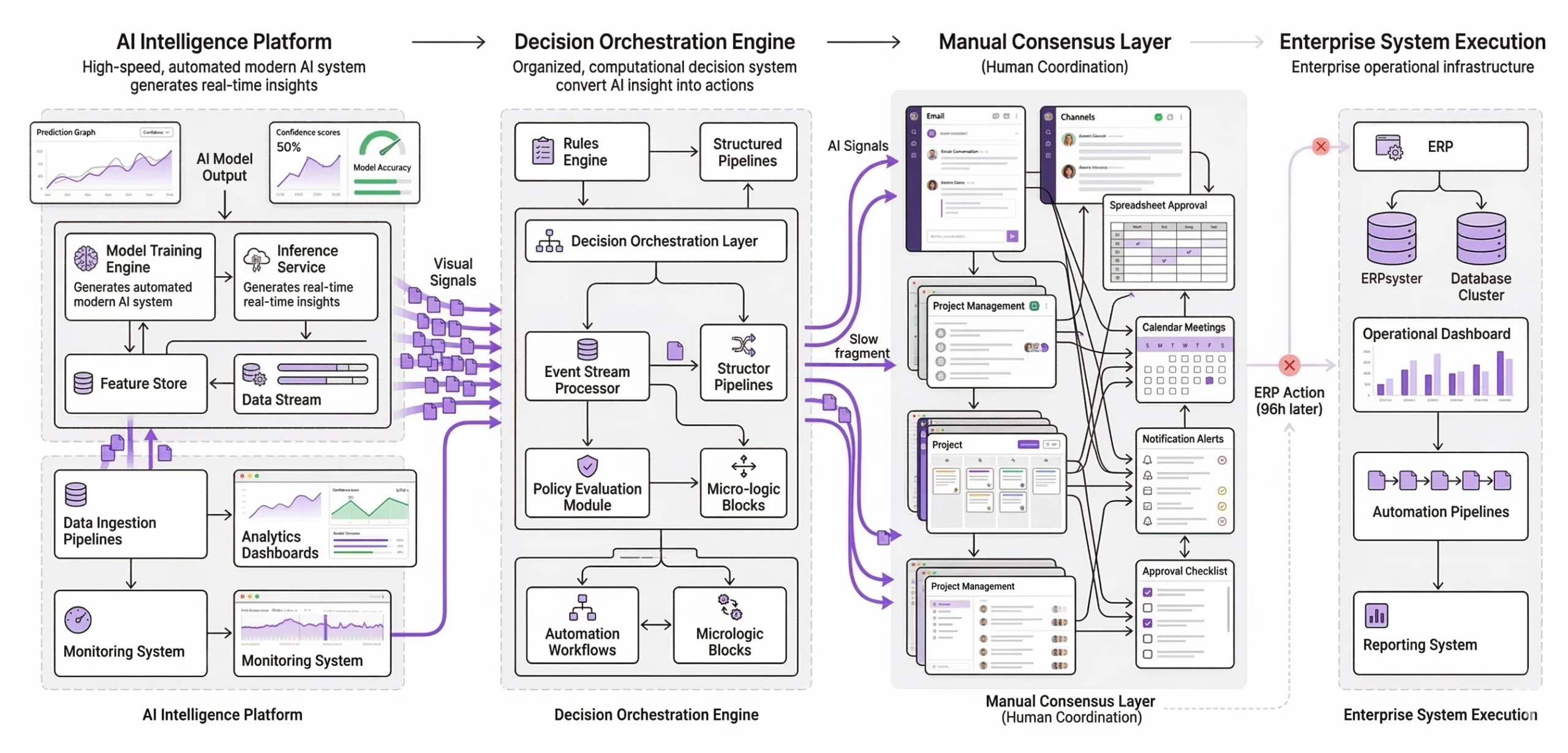
A diagnostic review of post-deployment operations tells a different story. When an AI forecasting model accurately identifies a 14 percent demand spike for a critical component, the output typically routes to a business intelligence dashboard. A supply chain manager reviews that dashboard, starts an email thread with procurement, waits for confirmation from finance, and potentially updates a shadow spreadsheet before triggering a purchase order in the ERP. The time elapsed between the AI signal and physical execution routinely exceeds 72 to 96 hours.
In that window, the market moves. Alternate allocations are consumed by faster-acting competitors. Spot freight rates spike. The margin opportunity evaporates. The AI model performed flawlessly. The algorithm was accurately calibrated. The operation failed — not because the intelligence was wrong, but because the organization had no structural mechanism to enforce it.
This is not an edge case. McKinsey's 2025 State of AI survey found that only 6 percent of organizations achieve "high performer" status — defined as generating 5 percent or more EBIT impact from AI. The remaining 94 percent are investing in insight without building the execution infrastructure required to realize its value.
Dashboards are monuments to operational hesitation. They observe instability rather than preventing it. AI systems operate on signals — but execution systems operate on authority. When authority logic is undefined, AI output cannot be enforced and cannot compound.
Of every 100 enterprise AI initiatives studied, the following attrition pattern is documented across deployment stages.
2. What the Research Actually Shows: The Evidence Behind the Diagnosis
Before prescribing architecture, we must confront the evidence. The failure pattern of enterprise AI is not anecdotal or sector-specific — it is structurally documented by independent research institutions spanning MIT, McKinsey, and others.
The MIT NANDA Finding
In July 2025, MIT's Project NANDA published The GenAI Divide: State of AI in Business 2025 — the most comprehensive independent study of enterprise AI outcomes available. The methodology covered over 300 publicly disclosed AI initiatives, 52 structured interviews, and 153 survey responses from senior leaders. The headline finding was stark: despite $30–40 billion in annual enterprise investment, 95 percent of organizations see no measurable financial return from their AI pilots.
Critically, MIT's analysis identified the root cause as structural: generic tools "stall in enterprise use since they don't learn from or adapt to workflows." Enterprise-grade custom solutions fail because of "brittle workflows, lack of contextual learning, and poor alignment with actual operations." The problem is not the model. It is the missing enforcement layer between the model's output and the organization's workflows.
The budget misallocation finding is equally significant. MIT found that approximately 70 percent of enterprise AI budget is allocated to sales and marketing — yet this is precisely where measured ROI is lowest. The highest returns emerge from back-office automation and operational execution: eliminating manual process overhead, cutting friction costs, and enforcing workflow compliance.
The McKinsey Confirmation
McKinsey's 2025 State of AI survey corroborates and extends the MIT diagnosis. Only 6 percent of respondents qualify as "AI high performers." The study identified the single most predictive differentiator: high performers are approximately three times more likely to have fundamentally redesigned end-to-end workflows before deploying AI tools. The technology choice was secondary. The workflow redesign — the execution architecture — was primary.
Enterprise budgets concentrate in sales and marketing (≈70%). Yet measurable ROI is highest in back-office automation and operational execution — the functions that benefit most from execution architecture.
The operational implication is clear: the functions that generate the highest AI returns — supply chain execution, back-office automation, predictive maintenance — are precisely those where AI insight must be enforced through workflow architecture. They reward structural integration, not passive dashboard observation.
3. The Physics of the Bottleneck: The State-Translation Problem
In mid-sized and enterprise industrial organizations, software capability expands in rapid, siloed phases — but execution mechanisms remain stubbornly static. Leadership deploys advanced machine learning models while the actual mechanisms of operational execution — approvals, escalations, exception handling, and ownership transfer — still rely on uncodified human behavior. We define this structural gap as the State-Translation Problem.
The problem is definitional: when an AI model detects an anomaly and generates an insight, what entity has the authority to act on that insight, under what conditions, within what time window, and with what consequences for non-action? In most enterprises today, the answer is: it depends on who reads the email.
What "Insight Without Authority" Looks Like
AI forecasting model detects a 14% demand spike → alert routes to BI dashboard → supply chain manager reads the alert 6 hours later → opens email thread with procurement → director replies the next morning → consensus call scheduled Thursday → PO raised Friday. The insight window expired Monday.
What "Insight With Architecture" Looks Like
AI forecasting model detects a 14% demand spike → system evaluates against encoded threshold → decision gate activates → Procurement Director receives binary approval prompt with 4-hour SLA → if no action in 4 hours, system escalates to VP Supply Chain automatically → outcome logged immutably.
Undefined Trigger Thresholds
The AI alerts users to a problem, but no systemic rule defines what specific metric variance mandates an intervention. Action depends on individual operator judgment — making compliance voluntary rather than structural.
Ambiguous Escalation Paths
When a Tier 1 operator ignores an AI prompt, the system does not revoke authority and route the decision upward. The alert ages in a queue until it is manually closed — typically after the opportunity window has closed.
Optional Compliance
Because AI tools are deployed as "overlays" rather than embedded infrastructure, operators can ignore model outputs without leaving any auditable trace. Non-compliance has no structural consequence.
Data Fragmentation Over Enforcement
Teams debate which dashboard is correct rather than executing the workflow required to resolve the underlying operational condition. The argument consumes the very time window the AI insight was designed to capture.
4. The Mathematics of Operational Absorption Capacity (OAC)
To transition from an advisory AI posture to a mandatory execution posture, organizations must engineer their Operational Absorption Capacity (OAC): the quantifiable degree to which an enterprise can convert an analytical insight into a structured, enforceable action without latency loss.
The governing variable is Ea. When Execution Authority equals zero — when the organization relies on email, Slack messages, or committee review to validate AI findings — the integral collapses. High insight multiplied by zero execution yields zero value. The formula cannot be escaped by improving the model. Architecture must precede acceleration.
5. Shadow Governance: The Anti-Architecture of Email and Spreadsheets
In the absence of encoded execution architecture, organizations do not remain ungoverned — they invent informal governance structures, primarily executed via email and spreadsheets. We term this Shadow Governance: a parallel operational layer that masquerades as authority while providing none of the structural properties that authority requires.
The mechanism is consistent across industries. When an AI system suggests a change in safety stock levels, the ERP does not automatically update. Instead: an analyst exports ERP data to a spreadsheet, manually applies the AI's recommendation, emails the file to a director for review, waits 24–72 hours, receives approval in a reply email, and then manually re-enters the approved figures into the ERP. This workflow is fundamentally unscalable, completely un-auditable, highly prone to version-control failures, and entirely dependent on individuals remembering to complete steps that no system enforces.
MIT's research explicitly identified this dynamic as a core contributor to AI's failure to generate enterprise returns. The "shadow AI economy" — where employees bypass stalled enterprise systems and rely on personal AI tools — is a direct consequence of organizations failing to embed AI into governed workflows. Employees get things done in spite of the system, not because of it.
| Dimension | Shadow Governance (Email / Spreadsheet) | Execution Architecture (System-Enforced) |
|---|---|---|
| Authority Location | Inbox / spreadsheet — whoever holds the latest version | System decision gate — role-bound, version-locked |
| Compliance | Voluntary — can be ignored without consequence | Mandatory — workflow locks until decision is logged |
| Audit Trail | Informal — reconstructed from email threads after the fact | Immutable log — timestamped, authority-attributed, tamper-proof |
| Escalation | Personality-driven — relies on individual initiative | Threshold-triggered — automatic SLA-based routing |
| Override Handling | Invisible — no record of why AI output was ignored | Forced justification code — permanently logged |
| ERP Integration | Manual re-key — error-prone, version conflicts common | API-enforced write — direct system-to-system, validated on entry |
| Scalability | Linear — headcount must grow with operational complexity | Non-linear — encoded logic scales without human bottlenecks |
| Regulatory Exposure | High — approvals not traceable, decisions not attributable | Low — every decision, approval, and override is governance-ready |
6. The Five Pillars of Execution Architecture
To achieve an Ea value of 1, an enterprise must deploy five structural pillars. Each is a prerequisite — removing any single one collapses the system's enforcement capacity. These are not software features; they are organizational design decisions encoded into system behavior.
Pillar I — Terminology Discipline: The SOP Genome
AI models require strict semantic consistency to function as execution systems. Without shared definitional constants, an AI cannot accurately interpret state changes, trigger the correct decision path, or route the appropriate authority tier. Terminology must be encoded as micro-rules — shared constants that every system layer reads identically — before any AI-driven decision gate can function reliably. This is the foundational capability delivered by Quanzar's AI Ops Layer.
Pillar II — Decision Gate Architecture
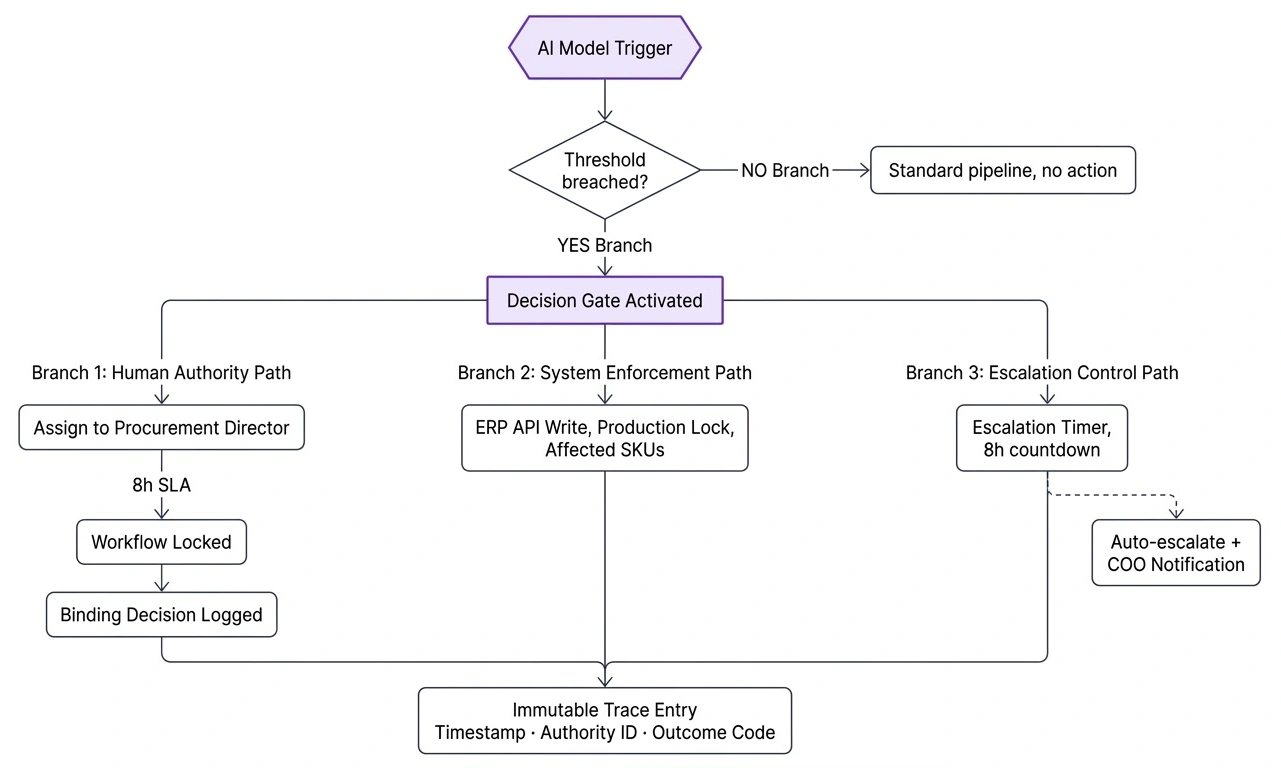
A Decision Gate is a hard, system-enforced structural checkpoint that removes the option of inaction. When an AI forecast variance exceeds a defined threshold, the system must not simply notify a user — it must lock the downstream workflow until a binding decision is logged with an authorized identity and a timestamp. Below is a reference architecture for encoding AI variance triggers directly into the execution layer:
{
  "architecture_layer": "Decision_Gate_Enforcement",
  "version": "2.4.1",
  "trigger_node": {
    "telemetry_source": "supplier_lead_time_variance_model",
    "threshold_days": 14,
    "operator": ">=",
    "confidence_floor": 0.85
  },
  "execution_routing": [
    {
      "action": "enforce_alternate_sourcing_review",
      "assigned_tier": "Procurement_Director",
      "auth_token_required": true,
      "sla_hours": 8,
      "workflow_lock": true
    },
    {
      "action": "trigger_production_capacity_lock",
      "target_system": "ERP_Planning_Module_API_v2",
      "lock_scope": "affected_skus_only"
    },
    {
      "action": "initiate_escalation_timer",
      "timeout_action": "route_to_VP_Operations",
      "timeout_hours": 8,
      "log_failure_event": true
    }
  ],
  "governance": {
    "override_permitted": false,
    "override_requires_justification_code": true,
    "trace_logged": true,
    "immutable_ledger_write": true
  }
}
Pillar III — Algorithmic Escalation Logic
Escalation must be threshold-driven, not personality-driven. When a Tier 1 operator fails to respond within the defined SLA window, the system automatically revokes their authority over that specific decision node and routes it upward to the next authority tier. No alert can simply "age out" — it escalates until an authorized decision is made or the system activates a predefined safe-state response. Quanzar's AI Ops Layer encodes this escalation logic directly into your existing workflows without replacing any systems.
Pillar IV — Structural Ownership Encoding
In un-architected environments, tasks route to "team queues" — which is operationally equivalent to assigning them to no one. Structural ownership encoding binds every AI-triggered action to a specific named user ID, with a defined accountability window, based on role, capacity, and risk tier. Ownership becomes a structural absolute. Non-compliance is architecturally prevented rather than culturally discouraged.
Pillar V — Immutable Trace Logging
Every AI-triggered action must be timestamped, version-locked, and authority-attributed inside a central, tamper-proof ledger. When an operator overrides an AI recommendation, the system forces selection of a root-cause justification code from a controlled vocabulary, permanently logged against the relevant transaction. Over time, this trace log becomes a complete, auditable record of where AI guidance was followed, where it was overridden, by whom, and with what outcome. This is the foundation of Quanzar's Margin Intelligence audit trail.
7. Vertical Case Analysis: Where the Architecture Gap Costs Most
The following case analyses examine the transformation achievable when execution architecture replaces advisory AI. The core symptom is always the same: accurate insight, absent enforcement.
The organization deployed an AI forecasting model to identify viable component substitutes during acute market shortages. The model was technically sound, operating at high confidence. Despite this, the deployment yielded less than 2 percent gross margin improvement. The measured insight-to-action gap was 9.4 days: sales and procurement debated the AI's findings in email chains before executing any inventory commitment. By the time consensus was reached, faster-moving competitors had consumed the available allocation.
The organization implemented a Tiered Review Architecture using Quanzar's AI Ops Layer. When the AI identified a high-confidence alternate component above the 85 percent confidence threshold, the system bypassed email debate entirely. It pre-committed a conditional capacity lock and routed a binary Approve/Reject prompt directly to the Procurement Director with a hard 4-hour SLA. If the Director failed to respond within the SLA window, the system automatically escalated to the VP Supply Chain and the COO simultaneously — with no human initiation required.
Signal-to-action latency dropped from 9.4 days to under 4 hours. The organization recaptured margin on spot buy opportunities that had previously expired before manual consensus was achieved. Working capital tied up in precautionary buffer inventory was substantially reduced.
Predictive maintenance models were generating spindle failure forecasts at 92 percent precision. However, the execution path required manual sign-off via disconnected interfaces. Line managers regularly overrode or simply did not act on AI alerts, citing experiential judgment that contradicted the model's output. Catastrophic unplanned downtime events continued at historical rates, each costing between $180,000 and $320,000 in lost production. The AI was accurate. The execution was absent.
The facility implemented a governed execution layer — the equivalent of Quanzar's AI Ops Layer — directly integrated with its CMMS and ERP. When the AI detected a vibration anomaly exceeding the encoded threshold, the system automatically generated the work order, confirmed spare part availability via ERP API, locked the affected machine out of the production schedule, and assigned the maintenance task to a specific named technician. If the technician failed to confirm receipt within two hours, the maintenance supervisor was automatically alerted.
Unplanned catastrophic downtime events decreased by 88 percent in the first operating year. Work order compliance moved from approximately 30 percent to effectively 100 percent. Model accuracy remained unchanged at 92 percent. The execution architecture was the variable.
AI-driven BOM change detection was correctly identifying specification deviations from engineering releases. Routing these deviations to the configuration management team, however, occurred via email notification — with no workflow lock, no SLA enforcement, and no escalation path. Average resolution time exceeded 22 days. Three formal audit findings in 18 months were traced directly to AI-flagged, unresolved deviations that had simply aged out in email queues.
Execution architecture embedded the AI deviation model directly into governed workflows with hard decision gates linked to ERP change-order workflows. Each flagged deviation automatically generated a disposition record, required a mandatory technical review within 48 hours by a named engineer, and locked affected part numbers from production release until disposition was formally closed. Any override required dual-authority approval with mandatory justification codes — the core governance principle behind Quanzar's Margin Intelligence audit trail.
Average deviation resolution time dropped from 22 days to 3.4 days. Zero formal audit findings related to AI-flagged deviations occurred in the 24 months following deployment.
| Metric | Pre-Architecture State | Post-Architecture State | Mechanism |
|---|---|---|---|
| AI Signal-to-Action Latency | 3–10 days, consensus-driven | < 4–8 hours, SLA-enforced | Decision gate with hard SLA timer |
| Escalation Compliance | Informal, personality-dependent | 100%, threshold-triggered | Automatic authority revocation on SLA breach |
| Override Visibility | Invisible, no audit trail | Mandatory justification code, immutably logged | Forced root-cause selection before override completes |
| Work Order Compliance | ~30%, voluntary | ~100%, structurally enforced | System-generated orders, named ownership, no opt-out |
| Regulatory / Audit Exposure | High, decisions untraceable | Low, governance-ready by default | Immutable trace log with authority attribution |
8. The Execution Maturity Index: Where Does Your Organization Stand?
Execution maturity is not binary. Organizations occupy a position on a spectrum from fully manual to fully architected. The following index provides a diagnostic framework for locating your organization's posture and identifying the structural investments that will move it most efficiently toward maximum OAC.
Decision chain is entirely human. ERP is driven by intuition and email. No predictive or prescriptive capability. Maximum variance, maximum latency. Ea = 0 by definition.
AI generates insight delivered to BI dashboards. No automatic enforcement. Insight-to-action gap typically 3–10 days. Model ROI near zero regardless of model quality. Ea = 0. This is where the MIT 95% failure figure is concentrated.
AI alerts trigger automated notifications with defined SLAs. Compliance is higher for high-visibility alerts, lower for routine ones. No downstream workflow locks; non-compliance is still possible. Partial Ea.
AI triggers lock downstream workflows. Escalation is automatic. All overrides require logged justification. Insight-to-action under 8 hours. Ea transitions toward 1. This is where measurable ROI begins to compound — the level Quanzar's Margin Intelligence and AI Ops Layer are designed to reach.
AI actions execute directly into ERP, MES, and CMMS without human approval for within-threshold events. Human authority is reserved for genuine exceptions only. Full immutable trace. Ea = 1. Compounding operational returns are structurally guaranteed.
🔎 Diagnostic Phase I — Latency Audit
Measure the exact time elapsed between an AI-generated alert and the final, logged execution of that alert within your ERP or operational system. The gap — in hours — is your execution deficit. Multiply by the number of AI alerts generated per month and your average transaction value to produce a first-order annual margin leakage estimate. Quanzar's free 10-minute Margin Audit surfaces this number immediately.
📋 Diagnostic Phase II — Governance Audit
Calculate what percentage of critical operational approvals currently occur in email or Slack versus hard system decision gates. Any percentage above zero represents active, quantifiable structural risk. In regulated environments, this percentage is simultaneously a compliance liability — every email-based approval is an approval that cannot be reliably produced in an audit.
9. The Quanzar Transformation Doctrine: Architecture Before Acceleration
Enterprise growth cannot be scaled on top of structural fragility. Deploying sophisticated AI onto a fragmented, manual execution topology is the operational equivalent of installing a high-performance engine into a chassis built without load-bearing structure. The power of the insight layer will not compensate for the absence of the execution layer — it will expose the gap more dramatically with every dollar invested.
The organizations in the top 6 percent — those generating measurable, compounding AI returns — share a consistent structural characteristic. They did not simply choose better models. They redesigned workflows, encoded authority, and built enforcement infrastructure before optimizing insight. The McKinsey analysis is explicit: workflow redesign has the single strongest contribution to achieving meaningful AI business impact of all factors tested.
The implication for executive decision-making is direct. Before your next AI investment — before the next model upgrade, the next data science hire, the next vendor contract — conduct the two diagnostic assessments outlined in Section 8. Measure your insight-to-action latency. Audit your governance compliance rate. If the latency exceeds 24 hours on time-sensitive operational decisions, or if more than zero percent of critical approvals occur in email, the constraint is not your AI capability. The constraint is your execution architecture.
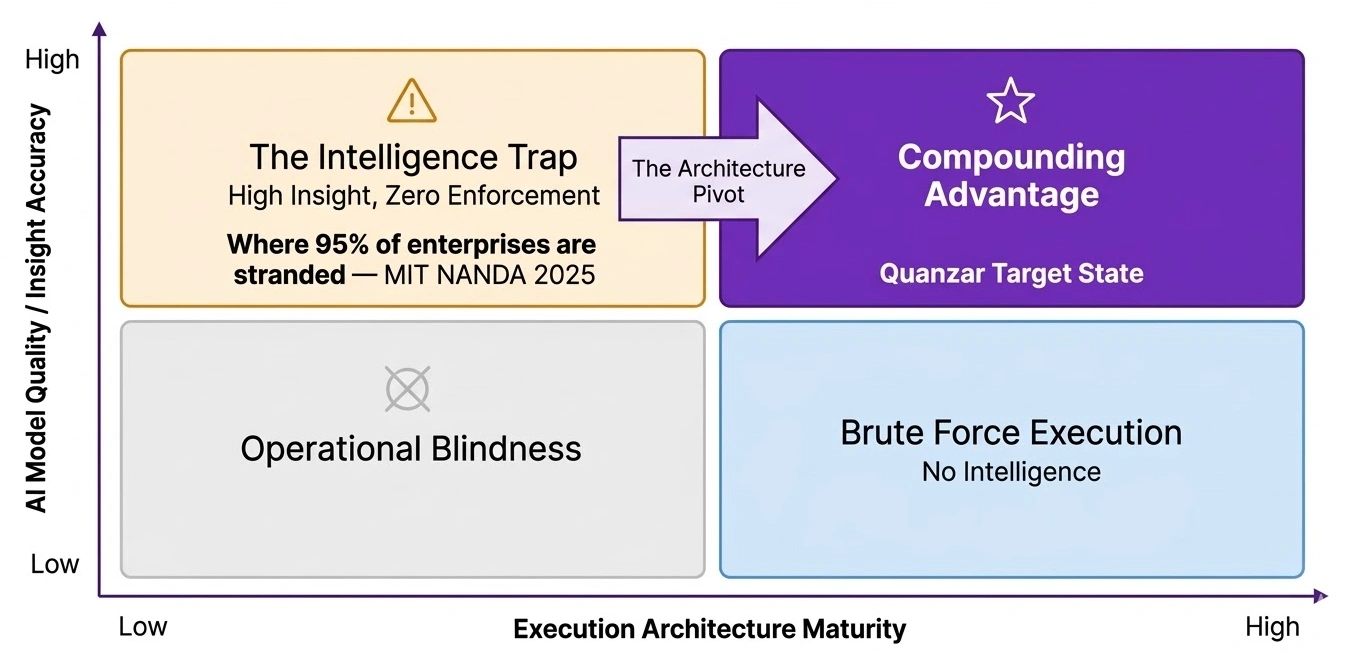
Quanzar's mandate is direct: architecture precedes acceleration. Stabilize the execution topology before attempting to optimize the insight layer. This requires systematic dismantling of informal workflows, shadow spreadsheets, and email approvals — replacing them with encoded operational logic through Decision Gate Architecture, Algorithmic Escalation Logic, Structural Ownership Encoding, and Immutable Trace Logging.
Quanzar's Margin Intelligence dashboard, Quote Intelligence engine, and AI Ops Layer operationalize each of these pillars within a governed, unified execution environment — designed around your existing P21, NetSuite, SAP, or Epicor stack, without replacing any systems your teams already use.
The window for establishing this architectural advantage is not indefinitely open. As McKinsey notes, organizations locking in learning-capable, workflow-integrated AI systems over the next 18 months will establish durable operational moats. Organizations still funding dashboards will fund dashboards for the years it takes to reverse the cultural and structural inertia that dashboards create. The choice is a strategic one — and it is available now.
Stop Funding Insight You Cannot Enforce.
Enterprise AI does not fail because models are inaccurate. It fails because organizations build insight capability without building execution infrastructure. The diagnostic takes 10 minutes. The architecture pivot takes 60 days. Quanzar engineers both — within your existing technology stack, without replacing the systems your teams already use.
References & Data Sources
- Challapally, A., Pease, C., Raskar, R., & Chari, P. (July 2025). The GenAI Divide: State of AI in Business 2025. MIT Project NANDA. Methodology: 300+ public AI deployments reviewed, 52 structured organizational interviews, 153 senior leader survey responses.
- McKinsey & Company. (March 2025). The State of AI: How Organizations Are Rewiring to Capture Value. QuantumBlack. Key findings: 6% of organizations qualify as "AI high performers" (≥5% EBIT impact); workflow redesign is the single strongest predictor of AI business impact across 25 attributes tested.
- McKinsey & Company. (November 2024). Harnessing the Power of AI in Distribution Operations. Advanced Industries. Findings include 20–30% inventory reduction potential and 5–20% logistics cost reduction where AI is embedded in execution workflows.
- McKinsey & Company. (2025). AI in the Workplace: Superagency. Cited: 78% of organizations report using AI in at least one business function; only 1% of leaders describe their organizations as "mature" on the AI deployment spectrum.
- Fortune / Challapally, A. (August 18, 2025). "MIT Report: 95% of Generative AI Pilots at Companies Are Failing." Fortune.
- Fortune (August 19, 2025). "The Shadow AI Economy Is Booming." Fortune.
- Virtualization Review (August 19, 2025). "MIT Report Finds Most AI Business Investments Fail, Reveals 'GenAI Divide'."
- Quanzar Technologies. (2026). Margin Intelligence. quanzar.com/margin-intelligence.
- Quanzar Technologies. (2026). AI Ops Layer. quanzar.com/ai-ops-layer.
- Quanzar Technologies. (2026). How It Works. quanzar.com/how-it-works.
Note on case data: Case studies A, B, and C present operational archetypes constructed from documented implementation patterns in Quanzar's engagement portfolio. Specific financial figures are representative of observed outcome ranges and are not attributable to named client organizations. Research statistics are cited with full source attribution and should be independently verified against the primary source documents referenced above.