
What Is Margin Intelligence? (The Only Guide You Need in 2026)

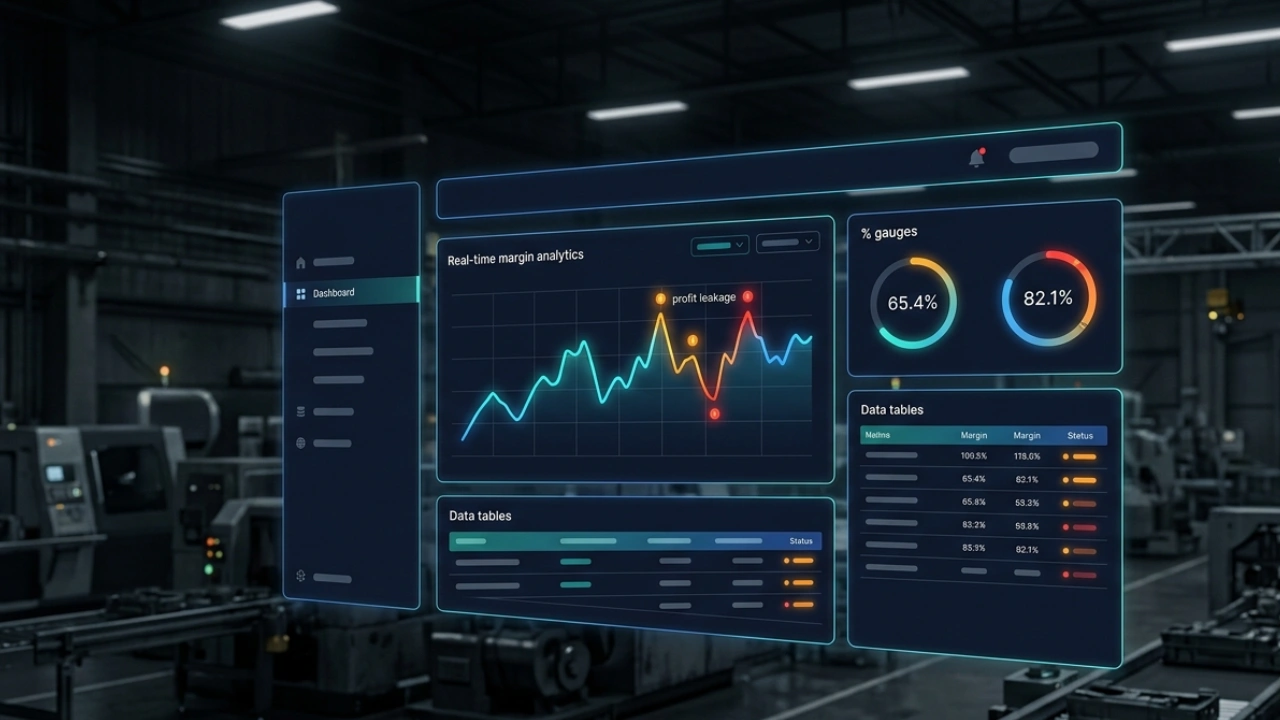
Margin intelligence is an always-on capability that connects your ERP, CRM, and finance systems to show, in real time, exactly where margin is leaking: by job, by customer, and by sales rep, and then drives action to fix it before the month closes. Unlike traditional margin analysis, which is typically a periodic, backward-looking accounting exercise, margin analysis follows the structure of the income statement and measures profitability after the fact. Margin intelligence instead monitors live transactions continuously, flags deviations from target, and routes alerts to the people who can still intervene while the job is open.
Table of Contents
- What is margin intelligence?
- Why traditional margin analysis falls short
- How margin intelligence works in manufacturing and distribution
- Core capabilities of a margin intelligence system
- Real-world results: what margin intelligence actually delivers
- How to implement margin intelligence in 60 days
- Who should own margin intelligence in your organization
- Frequently asked questions about margin intelligence
- Conclusion: from margin guessing to margin intelligence
What is margin intelligence?
In practice, margin intelligence means:
- You see quoted versus realized margin for every job as it happens.
- You know which customers are quietly drifting below target.
- You catch systemic quoting errors before they become large leaks.
- You replace month-end fire drills with daily, actionable intelligence.
At Quanzar, Margin Intelligence was built specifically for contract manufacturers and distributors because standard ERPs like Prophet 21, NetSuite, SAP, and Epicor capture the data but do not flag margin drift in real time. Case studies published on the Quanzar Case Studies page show that manufacturers using margin intelligence have recovered six-figure sums within 60 days.
Why traditional margin analysis falls short
Margin analysis is backward-looking by design
Most finance teams run margin analysis at month-end. They compare quoted margins to realized margins for closed jobs, summarize the results in a spreadsheet, and report what happened. That is useful, but it is fundamentally reactive. By the time the report lands, the customer has already been underpriced for months, the job has shipped, and the cost variance is locked in.
ERPs track transactions; they do not alert on drift
Modern ERPs such as Prophet 21, NetSuite, SAP, and Epicor are excellent at recording what happened. They store quotes, orders, costs, and invoices. But they are not built to continuously compare live job costs against the original quote, alert operations the moment a job crosses below a target margin threshold, or show customer-level margin trends day by day.
That gap is exactly what a Houston contract manufacturer on Prophet 21 ran into. The company had strong revenue but could not identify which customers were responsible for slipping margins, because the ERP’s job costing was backward-looking, with no visibility while jobs were still open. Full details are in the Quanzar case study library.
Spreadsheets and BI dashboards are not margin intelligence
Many manufacturers patch the gap with manual spreadsheet reconciliation, BI dashboards that show last week’s or last month’s numbers, or ad-hoc reports requested from IT. These approaches still leave operators asking, “Which jobs are at risk right now?” and waiting days for an answer. The core problem is not data scarcity. It is fragmentation and latency: core systems capture transactions in silos, and reporting cycles prioritize accuracy over immediacy.
Margin intelligence solves this by connecting data sources in real time, applying rules and models that flag exceptions instantly, and delivering alerts and next-best-actions instead of static tables.
How margin intelligence works in manufacturing and distribution
The margin intelligence loop
Margin intelligence runs as a continuous loop: sense, interpret, act, verify.
- Ingestion. Margin intelligence connects, often read-only, to your ERP and adjacent systems. Quanzar’s dashboards integrate with Prophet 21, NetSuite, SAP, and Epicor through APIs.
- Normalization. Definitions of “margin,” “cost,” “quote,” and “realized” are aligned across systems so you are comparing like for like.
- Analysis. Quoted margin is compared to live costs for open jobs, and deviations are ranked by dollars at risk.
- Alerting. Alerts push to in-app, email, or Slack/Teams whenever a job or customer drifts below a configurable threshold.
- Action routing. In advanced setups, often called AI Ops Layers, exceptions route to specific tiers of reviewers with defined SLAs.
- Feedback loop. Outcomes such as renegotiations, quote revisions, and process changes are logged to refine rules and models.
Where margin hides (and how intelligence finds it)
Research with manufacturers and distributors shows margin typically leaks in four places:
- Quotes priced on gut feel. Jobs quoted at one margin, delivered at another.
- Slow quote cycles. Three to five days to quote while competitors respond in hours.
- Silent customer churn. Best accounts quietly reduce orders, and you find out months later.
- Disconnected ERP, CRM, and finance. Teams fill the gaps with spreadsheets and emails.
Margin intelligence attacks each of these by supplying historical benchmarks at quoting time, flagging quote-to-realized gaps as they develop, and trending customer margin over time so drift is visible early.
Core capabilities of a margin intelligence system
To be useful, and not just another dashboard, margin intelligence should include these capabilities:
1. Real-time, job-level margin monitoring
This is non-negotiable. The system must show quoted versus realized margin for every open job, variance analysis (for example, -15% versus quoted), and a health status such as Critical, Monitor, or Nominal to guide prioritization.
2. Customer- and rep-level margin trending
Margin is not just a job problem. It is a relationship problem. Customers can drift slowly below target, and reps can unknowingly underprice certain segments. In one contract manufacturer engagement, a daily customer-level margin trending view revealed that three customers had drifted 8 to 15 points below quoted margin over six months, a pattern that was invisible in any existing report.
3. Early warning alerts while jobs are still open
A defining feature of margin intelligence, compared with margin analysis, is the ability to intervene in time. The system should trigger alerts the moment active jobs cross below a threshold, allow configurable thresholds by customer or job type, and provide enough context, including root-cause hints and comparable jobs, so the team can act.
4. Integration with quoting and workflows
Margin intelligence is stronger when it plugs into the quote-to-cash workflow: showing historical margin on similar jobs at quoting time, routing quotes to the right review tier based on risk, and closing the loop after shipment with realized margin data that updates the models. Quanzar’s full suite combines Margin Intelligence with Quote Intelligence, the AI Ops Layer, and the Revenue Leak Tracker.
5. Secure, non-destructive integration
Because margin intelligence sits on top of your ERP, security and data ownership matter. Best-in-class approaches connect read-only and never modify ERP transactions, use role-based access and audit trails, and ensure everything built during a pilot remains yours to keep, with no lock-in.
Real-world results: what margin intelligence actually delivers
Across published case studies in manufacturing, distribution, and enterprise, margin intelligence has delivered:
- $2.1M+ in total margin leakage identified to date
- 18.4% average margin gap between quoted and realized
- 60% average percentage of identified leakage recovered within 60 days
- 100% of pilots delivered measurable ROI within the 60-day window
Case study: Houston contract manufacturer on Prophet 21
Situation: The VP of Operations could not pinpoint where margin was leaking across 12 active customers. Month-end reports showed slippage, but not which customers or job types were responsible, since P21’s job costing was backward-looking.
Audit findings: 7 of 12 jobs were flagged. Three customers had quietly drifted 8 to 15 points below quoted margin. Estimated annual leakage reached $284,000.
What was built: A Margin Intelligence Dashboard connected read-only to P21, with real-time alerts, customer-level margin trending, and a daily digest that replaced manual spreadsheet reconciliation.
Outcome: $170,000 in margin recovered in 60 days, three high-drift customers renegotiated within 30 days, and two days per month of admin work eliminated.
Case study: Multi-department contract manufacturer using the full intelligence suite
Situation: Multiple management tiers were re-verifying the same quotes, pricing relied on gut feel, margin was tracked only at month-end, and there was no alert when jobs drifted while still open.
What was built: The full four-product suite, Margin Intelligence, Quote Intelligence, AI Ops Layer, and Revenue Leak Tracker, deployed over Prophet 21.
Outcome: $170,000 recovered, redundant review cycles down 22%, quote accuracy improved by 6.2 margin points, quotes delivered three times faster, and two days per month of admin work eliminated.
Read the full write-ups on the Case Studies page.
How to implement margin intelligence in 60 days
You do not need a multi-year transformation. The most effective implementations follow a tight, outcome-focused cycle, outlined in full on the How It Works page.
Step 1: Run a free Margin Leak Audit (10 minutes)
Enter data from 5 to 15 recent jobs (customer, job value, quoted margin, realized margin, date). A margin intelligence engine analyzes the gap and outputs a one-page report with estimated annual leakage, jobs flagged by severity, and next steps. Try it with the free Margin Leak Audit, which delivers a red, amber, or green health score without a sales call.
Step 2: Diagnostic call (30 minutes)
Review audit results with the margin intelligence provider to confirm the scope and root causes, align on target customers, job types, and systems, and define what “good” looks like in 60 days.
Step 3: 60-day pilot inside your existing systems
The provider builds the margin intelligence layer, dashboard plus alerts, on top of your ERP, with no rip-and-replace. Key activities include connecting read-only to ERP, CRM, and finance systems, configuring thresholds and routing rules, integrating daily digest and in-app alerts, and measuring results at day 30 and day 60. Quanzar’s pilots are scoped at $15,000 to $25,000, and if measurable ROI does not appear, they do not ask you to scale. Manufacturers often recover the pilot cost within the first 30 days.
Step 4: Scale what works
Once the pilot proves the model, expand to additional plants or business units, layer in Quote Intelligence and AI Ops workflows, and institutionalize governance and review cadences.
Who should own margin intelligence in your organization?
Margin intelligence works best with clear ownership:
- Sponsor (Executive/Owner): Sets the target, for example “recover $X in 60 days,” and removes blockers. In many engagements, the VP of Operations or CFO sponsors the pilot.
- Process owner (Operations/Finance): Defines margin definitions, thresholds, and escalation paths.
- Power users (Pricing/Quote desk/Sales ops): Use the system daily and refine rules.
- IT/ERP team: Manages integrations and access, typically light-touch when the margin intelligence layer is API-based and read-only.
The goal is to avoid adding headcount. As one contract manufacturer’s executive takeaway put it: the business did not add headcount. It recovered margin that was already being lost to structural execution gaps.
Frequently asked questions about margin intelligence
What is the difference between margin analysis and margin intelligence?
Margin analysis is a periodic, retrospective process for calculating and evaluating profit margins, such as gross margin and operating margin, after the fact. Margin intelligence is an always-on, forward-looking system that monitors live transactions, flags deviations, and drives action while jobs are still open. In short, margin analysis explains what happened. Margin intelligence helps you change what happens next.
Do I need to replace my ERP to use margin intelligence?
No. Margin intelligence connects to your existing ERP, for example Quanzar integrates with P21, NetSuite, SAP, and Epicor, and builds on top of it rather than replacing it. Most implementations use read-only integrations that do not disrupt current workflows.
Is margin intelligence only for large manufacturers?
Not anymore. The strongest early use cases are in mid-sized contract manufacturers and distributors, where even a few points of margin leakage represent hundreds of thousands of dollars. Quanzar’s Founders 30 Program, for instance, gives 30 manufacturers, distributors, and startups 12 months of full access with the opportunity to recover approximately $60,000 in margin within 90 days.
How secure is my data in a margin intelligence system?
Reputable providers operate on secure-by-design architectures with role-based access, no public model training, and full audit trails. Everything built during a pilot should remain your property, with no lock-in. See Quanzar’s approach on the FAQ page.
What does a margin intelligence pilot typically cost?
Most providers scope pilots based on the number of integrations and complexity. Quanzar’s 60-day pilots typically range from $15,000 to $25,000, and many manufacturers recover that cost within the first 30 days.
Conclusion: from margin guessing to margin intelligence
If you are a contract manufacturer or distributor, margin leakage is not a percentage problem. It is a visibility and timing problem. Traditional margin analysis tells you what happened after the money is gone. Margin intelligence shows you what is happening right now and gives your team a chance to fix it.
The shift is practical, not theoretical:
- Start with a 10-minute audit to see your leakage in dollars.
- Run a 60-day pilot inside your existing systems.
- Scale once you see measurable ROI.
The evidence from real manufacturers is clear: margin intelligence can recover six-figure sums in 60 days, reduce manual work by days per month, and turn margin improvement from a periodic reporting exercise into an operational discipline. Run your free Margin Leak Audit to see where your business stands.