
Tiered Review Architecture:
Why Unstructured Review Is Destroying Your Most Valuable Asset
In knowledge-intensive organizations, the review process is the single largest source of structural cognitive waste — not because review is unnecessary, but because it is unengineered. This whitepaper defines Tiered Review Architecture: the structural framework that eliminates redundant review burden, protects senior cognitive capacity, and converts review discipline into compounding operational performance.
In knowledge-intensive organizations — legal firms, engineering consultancies, manufacturing change control departments, BOM quoting teams, and quality validation functions — the review process is universally treated as a quality assurance mechanism. The unstated assumption is that more review equals higher fidelity output. In practice, the opposite is true when review is unstructured: multiple professionals review identical work at identical depth with no defined scope differentiation, no encoded authority hierarchy, and no structural trigger governing which tier of review is actually required for a given document or decision. The result is redundant cognitive load, extended cycle times, decision fatigue at every management level, and a systematic destruction of the organization's most valuable and finite resource — senior professional judgment. This whitepaper defines Tiered Review Architecture (TRA): the structural framework that converts review from a defensive, redundant, and cognitively expensive ritual into a precision-engineered governance mechanism that protects expertise, accelerates delivery, and scales with AI-driven output velocity.
1. The Hidden Cost of Redundant Review
A predictable and consistent failure pattern exists across every knowledge-intensive organization that has not engineered its review process. A junior associate drafts a contract. A senior associate reviews it fully — checking formatting, logical flow, legal reasoning, and risk exposure simultaneously. The manager then reviews the same document fully, applying the same checks at the same depth. The director reviews it fully. The partner reviews it fully. Each layer independently re-performs every check that every previous layer already performed. This is not quality control. This is four parallel quality-control processes applied to the same document, each producing a redundant result, each consuming a portion of the professional time that should be directed toward the work the client is actually paying for.
The financial mechanics of this pattern are straightforward but rarely made explicit. The SPI 2025 Professional Services Maturity™ Benchmark — a comprehensive annual survey covering thousands of professional services organizations — reported that billable utilization in 2024 fell to 68.9 percent, the lowest point in five years and meaningfully below the 75 percent threshold that defines sustainable profitability. At the same time, EBITDA for professional services organizations fell from 15.4 percent in 2023 to 9.8 percent in 2024 — a 36 percent decline in a single year. Revenue per consultant fell to $199,000, continuing a multi-year downward trend that began when on-time project delivery started declining from its 2021 high of 80.2 percent. These are not external market conditions. They are structural performance failures — and review architecture, or its absence, is a primary contributor.
Asana's Anatomy of Work survey, covering 10,223 knowledge workers across multiple countries, found that the average knowledge worker spends 209 hours per year on redundant tasks — tasks that duplicate work already performed elsewhere in the workflow. At least a significant portion of that redundancy occurs in review loops: the same document reviewed by multiple professionals at identical scope, generating no additional quality signal, consuming irreplaceable professional hours, and delaying client delivery by the accumulated duration of each redundant pass.
Review discipline is rarely engineered. When multiple layers of management perform the exact same review at the exact same depth, it is not quality assurance. It is cognitive waste structured as a governance ritual.
2. The Industry Data: What Utilization and Collaboration Research Reveals
The productivity research that has emerged from large-scale workforce studies in 2024 and 2025 documents the structural problem from multiple independent angles. The convergence of their findings points clearly to unstructured scope and undefined decision authority as the root mechanism of professional services underperformance.
Professional Services Billable Utilization
Industry average fell to 68.9% in 2024, down from 73.2% in 2021. Law firms average just 37% billable utilization (Clio 2023 Legal Trends Report). Every point below 75% represents direct revenue leakage — time paid for that does not generate client value.
Redundant Task Hours per Knowledge Worker
209 hours per year spent on redundant tasks (Asana, 10,223 respondents). 10% of "less meaningful work" categorized explicitly as duplication. At $150/hour billing rate, 209 redundant hours represents $31,350 in per-professional annual cost that generates zero client value.
Collaboration Overload in Professional Services
Worklytics 2025 benchmark: professional services firms average 4.2 hours of meeting time per day — the highest of any industry sector measured. HBR collaboration overload research documents that time in meetings, email, and collaborative activities has grown 50%+ over two decades, with up to 80–85% of employee time consumed by these activities.
Unproductive Meeting Cost
$259 billion annually in unproductive meeting costs to U.S. professionals (Zoom/Atlassian, 2025). 37% of leaders report participating in meetings with no clear outcome. 54% of workers leave meetings unclear on next steps or responsibility ownership — a direct symptom of undefined decision scope.
Microsoft 365 Productivity Signals: Interruption Rate
Microsoft Work Trend Index 2025 (trillions of M365 signals, 31,000 knowledge workers across 31 markets): employees are interrupted every 2 minutes during core work hours — 275 times per day by meetings, emails, or chats. This interruption density makes sustained deep-review work structurally impossible without defined scope boundaries and explicit cognitive protection.
As billable utilization has declined from its 2021 peak (73.2%) to the 2024 low (68.9%), EBITDA has moved in direct correlation — falling from 15.4% to 9.8%. The structural cause: unproductive non-billable time, including redundant review cycles, consuming professional hours that should generate client revenue.
The utilization number is particularly instructive because it translates directly into financial terms. At a billable rate of $200 per professional hour — a conservative figure for most professional services contexts — a 6-percentage-point utilization decline represents approximately 120 fewer billable hours per professional per year. For a firm with 50 fee-earners, that is 6,000 lost billable hours annually — $1.2 million in foregone revenue before any other operational costs are considered. Not all of that loss is attributable to redundant review. But a significant and quantifiable portion is.
3. Review Depth Ambiguity: The Structural Root Cause
The mechanism that produces redundant review is not a failure of individual discipline or management oversight. It is a structural failure of definition. We term this Review Depth Ambiguity — the absence of any encoded specification of what each review tier is actually responsible for, what constitutes a sufficient review at each level, and what conditions trigger escalation to a higher tier rather than resolution at the current one.
In organizations suffering from Review Depth Ambiguity, review behavior defaults to the maximum defensible scope. A senior associate who has not been explicitly told that their review is bounded to logical and legal reasoning will instinctively also check formatting, grammar, and data completeness — because no structural rule prevents them from doing so and because over-review carries no individual consequence. A director who has not been told that their review scope is bounded to risk and exposure governance will also re-verify the structural logic and the formatting, because doing so feels responsible and because under-review in the absence of scope boundaries would feel professionally risky.
The result is not a system with four quality-control layers. It is a system where the same quality-control process runs four times on the same document. The defensive logic of each individual reviewer is entirely rational in the absence of defined scope boundaries. The structural outcome — redundant cognitive consumption, extended cycle time, and senior talent deployed as proofreaders — is operationally catastrophic.
What Happens Without Scope Boundaries
Every reviewer performs every check because no structural rule restricts them from doing so. Senior professionals spend time on formatting errors that a Tier 1 technical review should have eliminated before the document reached them. Partners review grammar while clients wait for strategic guidance. The review process expands to fill all available time without generating proportional quality improvement.
What Happens With Scope Boundaries
Each tier performs a defined and non-overlapping function. Tier 1 eliminates surface defects before Tier 2 ever reads the document. Tier 2 validates structural logic and reasoning without re-performing surface checks. Tier 3 evaluates only risk, exposure, and capital implications — never formatting, never syntax, never structural logic that Tier 2 already validated. Review time decreases. Review quality increases.
The financial consequence of scope ambiguity is compounded by seniority economics. When a Partner billing at $600 per hour spends 40 minutes re-checking formatting that a $85/hour paralegal could have verified in 10 minutes, the organization has consumed $400 in professional capacity to produce a $14 quality outcome. Multiplied across a 50-person firm, across hundreds of documents per year, this misallocation of cognitive capacity represents a material and entirely avoidable financial inefficiency.
4. Cognitive Margin Erosion: The Long-Term Cost of Review Fatigue
The financial cost of redundant review is not limited to the billable hours lost in the review process itself. Redundant review generates a secondary cost that is harder to measure but potentially more damaging over time: cognitive margin erosion. When highly qualified professionals routinely perform tasks that fall below the quality threshold their expertise is designed to address, two structural harms accumulate.
First, their capacity for genuinely high-value cognitive work — the strategic judgment, legal reasoning, risk assessment, and creative problem-solving that actually justifies their compensation — is depleted by review fatigue before that capacity can be applied. The Microsoft Work Trend Index (2025, 31,000 respondents) documents that knowledge workers are interrupted 275 times per day during core hours. Research consistently shows that most knowledge workers reach their cognitive peak for only 2 to 4 hours per day. When that peak capacity is consumed by redundant review loops, it is permanently unavailable for the high-complexity work the professional was hired to perform.
Second, the subjective experience of routinely performing sub-threshold work erodes professional engagement. The SPI 2025 Benchmark notes that burnout is identified as a significant concern, with the DHR Global Workforce Trends Report confirming persistent burnout affects approximately 34 percent of desk-based knowledge workers. Review fatigue — the specific experience of being a highly trained professional performing repetitive checking tasks across documents already reviewed at lower tiers — is a direct and documented contributor to professional dissatisfaction and, eventually, to the attrition of the highest-value talent in knowledge organizations.
The cumulative effect is a firm that is simultaneously under-delivering to clients and over-consuming its most valuable professionals. The review architecture — or its structural absence — is the mechanism that produces both outcomes simultaneously.
5. The Three-Tier Review Architecture Model
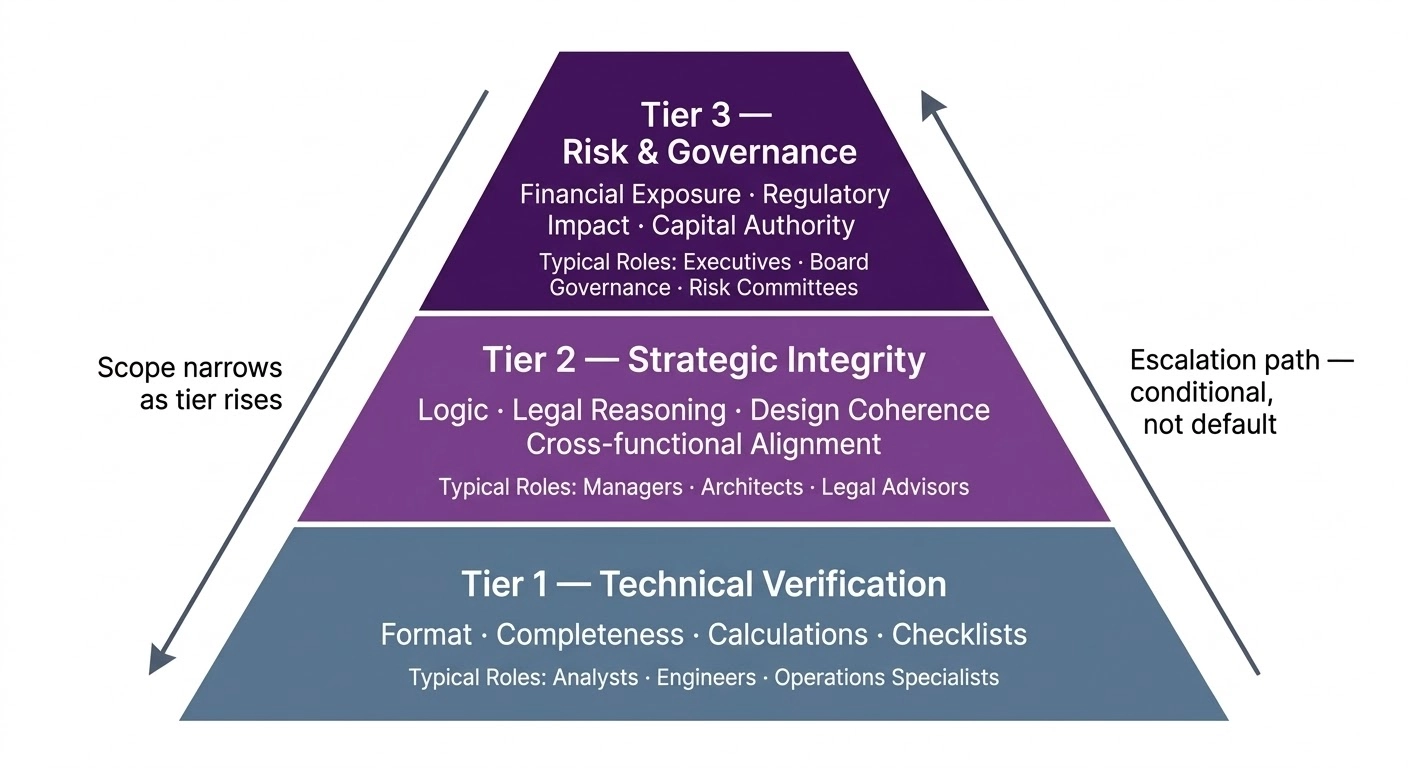
Tiered Review Architecture (TRA) structures review into three strictly defined, non-overlapping tiers. Each tier carries a legally and operationally bound scope, a defined authority level, explicit trigger conditions that determine when a document requires that tier, and defined escalation boundaries that govern when work must move up to the next tier rather than be resolved at the current one. The fundamental architectural principle is scope isolation: what Tier 1 reviews, Tier 2 does not re-review. What Tier 2 validates, Tier 3 does not re-validate.
Verification
Tier 1 — Technical Verification (Junior / Paralegal / QA Technician)
The scope of Tier 1 is strictly bounded to surface-level correctness: format compliance, data completeness, calculation validation, regulatory checklist confirmation, and version control verification. The objective is to eliminate all detectable surface defects before the document advances. A Tier 1 reviewer confirms that the document is complete, correctly formatted, and contains no arithmetic or data errors. They do not evaluate logical coherence, strategic alignment, or risk exposure — those are out of scope by structural rule, not by preference.
Typical profile: Paralegal · QA technician · Junior analyst · Junior associate · Engineering technician
Tier 1 Reviews
- Format compliance
- Data completeness
- Calculation accuracy
- Checklist verification
- Version control
- Reference accuracy
Integrity
Tier 2 — Strategic & Logical Integrity (Senior Professional / Senior Engineer / Legal Counsel)
The scope of Tier 2 is bounded to structural and logical correctness: design coherence, legal reasoning, risk logic, cross-functional alignment, and internal consistency of argument or analysis. The Tier 2 reviewer validates that the document's core structure is sound, that its reasoning is defensible, and that it aligns with the governing requirements of the project, jurisdiction, or specification. They do not check formatting — Tier 1 already confirmed surface compliance. They do not evaluate financial exposure or client sensitivity — those are Tier 3 scope. Their review begins where Tier 1 ended and ends where Tier 3 begins.
Typical profile: Senior associate · Senior engineer · Legal counsel · QA lead · Project engineer
Tier 2 Reviews
- Logical coherence
- Legal reasoning
- Design integrity
- Cross-dept. alignment
- Risk logic
- Technical soundness
Governance
Tier 3 — Risk & Exposure Governance (Director / Partner / Managing Engineer / VP)
The scope of Tier 3 is bounded exclusively to high-impact governance decisions: financial exposure assessment, regulatory implications, client or counterparty sensitivity, capital allocation authority, and reputational risk evaluation. The Tier 3 reviewer confirms that the document's risk profile is acceptable and that the organization's exposure is within authorized parameters. They do not verify formatting — that was Tier 1. They do not re-validate the logical structure — that was Tier 2. They exercise the judgment and authority they were hired and compensated to exercise, and nothing else. Tier 3 is where Partner-level cognitive capacity should be exclusively deployed.
Typical profile: Partner · Director · VP Engineering · Managing Counsel · COO · QA Director
Tier 3 Reviews
- Financial exposure
- Regulatory impact
- Client sensitivity
- Capital allocation
- Reputational risk
- Final authority
6. Trigger-Based Routing Logic: Not Every Document Needs Every Tier
A critical architectural principle of TRA is conditional escalation. Not every document, contract, engineering drawing, or BOM quote requires all three tiers. The decision about which tier or combination of tiers a given piece of work requires should be made by encoded routing logic — not by default habit, not by individual judgment at point of submission, and certainly not by the reflexive assumption that every piece of work must eventually reach the most senior available reviewer.
Conditional trigger logic governs routing based on objectively definable parameters: the financial value of the transaction, the regulatory classification of the document type, the risk tier assigned to the matter or project, the compliance requirements of the applicable jurisdiction, and the capital expenditure threshold. A low-value, low-risk, standard-form document needs Tier 1 verification and Tier 2 logical review — it does not need a Partner-level governance assessment. A high-value, high-exposure transaction with regulatory implications requires all three tiers. The routing logic makes this distinction automatically, consistently, and without requiring any individual to remember to apply the rules.
{
  "routing_logic": "TRA_Conditional_Execution",
  "version": "2.1.0",
  "document_types": [
    "Engineering_Change_Request",
    "Legal_Contract",
    "BOM_Quote",
    "Quality_Deviation",
    "CAPEX_Authorization"
  ],
  "triggers": [
    {
      "condition": "matter_value < 50000 AND risk_level == 'Low' AND compliance == 'Standard'",
      "action": "execute_tier_1_only",
      "auto_approve_after_tier_1": true,
      "sla_hours": 4
    },
    {
      "condition": "matter_value >= 50000 AND matter_value < 250000 AND risk_level == 'Moderate'",
      "action": "execute_tier_1_and_tier_2",
      "tier_2_assignment": "Senior_Professional_by_capacity",
      "sla_hours": 24,
      "tier_2_scope_restriction": "logic_and_legal_only"
    },
    {
      "condition": "regulatory_exposure == 'High' OR capex_value >= 250000 OR risk_level == 'Critical'",
      "action": "execute_all_tiers",
      "tier_3_assignment": "Director_Level_by_authority",
      "tier_3_scope_restriction": "risk_and_exposure_only",
      "sla_hours": 48
    }
  ],
  "escalation": {
    "sla_breach_action": "auto_escalate_to_next_tier_authority",
    "override_requires_justification_code": true,
    "immutable_ledger_write": true
  },
  "governance": {
    "scope_violation_alert": true,
    "if_tier_3_reviews_tier_1_scope": "flag_as_architectural_waste_event"
  }
}
The final governance rule in this architecture is particularly significant: if a Tier 3 reviewer performs a review that falls within Tier 1 scope, the system logs it as an architectural waste event. This is not punitive — it is diagnostic. It generates data on where scope boundaries are being breached, by whom, and at what frequency, allowing the organization to identify structural gaps in its routing logic and correct them before the pattern compounds into systematic cognitive margin erosion.
7. Industry Manifestations: How Review Depth Ambiguity Costs Different Verticals
The structural failure of undefined review scope manifests with precise consistency across knowledge-intensive industries — with specific financial consequences determined by the billing rates, regulatory requirements, and output velocity of each vertical.
⚖️ Legal Firms
The Clio 2023 Legal Trends Report documents that law firms average only 37 percent billable utilization — the lowest of any professional services category. The principal cause is administrative and review overhead consuming fee-earner time. Senior associates and partners routinely re-review documents that junior associates and paralegals have already reviewed at identical depth. At billing rates of $400–$1,200/hour for senior professionals, each hour of redundant review represents $400–$1,200 in foregone billable revenue and simultaneously delays client delivery.
⚙️ Engineering & Design Consultancies
Engineering change order (ECO) review cycles represent the highest-frequency redundant review pattern in engineering organizations. A drawing or specification passes through junior engineer → senior engineer → principal engineer → project manager, each performing a full technical and format review. When a drawing change order passes through four full reviews averaging 90 minutes each, 6 hours of professional time is consumed per change order. At 200 change orders per year in a mid-sized engineering firm, that is 1,200 hours of redundant technical review annually.
🏭 Manufacturing Change Control
Engineering Change Requests in manufacturing environments suffer a specific variant of review depth ambiguity: every reviewer re-verifies production impact, inventory impact, and procurement impact — work that each downstream function also independently verifies when the change reaches them. Without TRA, the same impact assessment is performed 4–6 times per ECR by different reviewers, each generating no additional quality signal beyond what the first verified assessment already established.
📋 Quality Validation & Regulated Ops
In regulated environments — aerospace, pharmaceutical, medical device — multi-tier review is legally required. The structural failure is not that multiple tiers review a document, but that each tier is not clearly scoped to its regulatory purpose. When a QA Director re-verifies calculation accuracy that a QC Technician's Tier 1 review should have confirmed, they are consuming authority-level capacity on sub-authority-level tasks and creating regulatory ambiguity about which review actually constitutes the formal compliance verification.
💼 BOM Quoting & Sales Engineering
BOM quote packages in complex manufacturing and distribution environments typically pass through three management tiers — sales engineer, sales manager, and director — before client submission. Without defined scope per tier, each tier fully re-verifies margin calculations, component specifications, and delivery commitments. A quote that takes 6 hours to produce takes 4 additional hours to review with each management layer repeating the same verification of figures the previous tier already confirmed. Client response time suffers directly.
🔬 Contract Research & Technical Writing
In contract research organizations and technical writing departments generating regulatory submissions, ISO documentation, and engineering reports, the review cycle is where the majority of cycle time resides — not in the drafting. Multiple senior researchers review drafts for technical accuracy, logical structure, and regulatory compliance simultaneously, with no defined scope separation between what each reviewer is responsible for confirming. The result is conflicting feedback from different tiers addressing the same scope, requiring reconciliation cycles that extend delivery timelines further.
8. The AI Multiplier: Why Review Architecture Must Precede AI Deployment
The introduction of AI drafting and generation tools — large language models for contract generation, automated engineering documentation, AI-assisted BOM quoting, generative code review — is fundamentally changing the volume dynamics of professional services production. AI dramatically accelerates draft velocity. A contract that took a junior associate 6 hours to draft can be produced in 30 minutes with AI assistance. An engineering change documentation package that required 4 hours of technical writing can be auto-populated in under an hour. The production constraint for knowledge work is migrating rapidly from drafting time to review time.
In organizations with structured Tiered Review Architecture, this migration is transformative: AI output is fast, volume is high, and the review architecture efficiently processes that volume through scoped, non-redundant tiers. Each document moves through Tier 1 technical verification, Tier 2 logical validation, and — where triggered by risk parameters — Tier 3 governance review. Total cycle time remains bounded. Senior professional capacity is consumed only at the governance level. AI becomes a productivity amplifier, and the review architecture becomes the throughput mechanism that converts that amplification into client delivery speed.
In organizations without structured TRA, the AI productivity gain is immediately neutralized and often reversed. Every AI-generated document still passes through the full multi-layer, full-depth, undifferentiated review process. The document volume increases by 5 to 10 times. The review burden increases proportionally. Senior professionals who were already stretched across redundant review cycles are now stretched across 5 to 10 times as many redundant review cycles. The AI has not reduced cognitive load. It has multiplied it.
- AI generates 10× more drafts per day
- Every draft still passes through full multi-layer review at identical depth
- Review queue grows 10× — not 10× faster
- Senior professionals bottlenecked by 10× volume of redundant review
- Delivery cycle time increases despite AI drafting speed
- AI investment generates no net productivity gain — backlog shifts from drafting to reviewing
- Professional burnout accelerates as review volume surges
- AI generates 10× more drafts per day
- Tier 1 technical verification handles surface AI output at scale — no senior involvement
- Tier 2 validates logic only on documents that passed Tier 1 — senior hours protected
- Tier 3 reviews only high-risk documents with financial or regulatory exposure — Partner time is structural governance, not proofreading
- Total cycle time decreases: AI speed + scoped review = maximum throughput
- Revenue per professional increases as billable hours are protected from review overhead
This relationship is not speculative. The Worklytics 2025 benchmark found that professional services firms with 52 percent AI adoption rates are reporting measurable gains specifically in document analysis and research automation. But those gains materialize only in organizations where the review process has been redesigned to match AI output velocity — not in organizations where AI has been layered onto an unstructured review topology that cannot absorb the volume increase.
The architectural sequencing is non-negotiable: you cannot deploy generative AI at scale in a knowledge-intensive organization without first engineering the review architecture that will process its output. Organizations that invert this sequence — deploying AI before encoding review structure — will consistently find that their AI investment generates new review problems rather than eliminating existing ones.
9. Financial Impact of Structured Review Architecture
The financial case for TRA is direct and calculable from available industry benchmarks. The key variable is the seniority-weighted cost differential between the tier at which work is currently reviewed and the tier at which it should be reviewed under a structured architecture. When a Partner reviews formatting that a paralegal should have caught, the organization is paying the difference between Partner and paralegal rates — typically $400–$1,100 per hour — for a task that generates exactly the same quality outcome regardless of who performs it.
| Metric | Unstructured Review (Legacy) | Tiered Review Architecture | Improvement Range |
|---|---|---|---|
| Review Cycle Time | Extended, unpredictable — full depth at every tier | Bounded by SLA per tier — scoped and non-redundant | 20–35% reduction |
| Overall Delivery Cycle Time | Sequential full-depth reviews compound delay | Parallel and conditional routing — only required tiers activated | 15–30% reduction |
| Billable Utilization | Senior professionals consumed by sub-tier review tasks | Senior hours protected for Tier 3 governance only | 5–8 percentage point increase |
| Revenue Per Professional | Suppressed by non-billable, redundant review overhead | Maximized through focused scope and protected billing time | 8–15% increase |
| Senior-Level Re-Review | 100% overlap with junior staff on identical scope | Senior review isolated to risk and exposure only — zero formatting overlap | Redundancy structurally eliminated |
| AI Output Throughput | Review backlog grows proportionally with AI draft velocity | Tier 1 handles AI surface output at scale — senior tiers unaffected | Throughput scales with AI production |
| Governance Record Quality | Undifferentiated — who reviewed what at what scope is unrecorded | Each tier's authority, scope, and decision are timestamped and immutably logged | Audit-ready by default |
In unstructured review environments, senior professionals perform all review tasks at all depths. The chart below shows the cost of performing a Tier 1 (technical verification) task at each tier's billing rate — illustrating the avoidable cost premium generated by each misallocated review hour.
10. Six Structural Interventions for Knowledge Operations Leaders
The following six interventions constitute the implementation sequence for Tiered Review Architecture. They are ordered by structural dependency — each builds the conditions required for the next. Implementing them selectively will generate partial improvement. Implementing them in sequence produces a self-reinforcing architecture that eliminates review redundancy permanently.
01 — Define Scope Boundaries for Each Tier
Produce a written scope document for each review tier that explicitly lists what the tier reviews and what it does not review. The "does not review" list is as important as the scope list — it is the structural boundary that prevents scope creep. Distribute this to every professional in the review chain and encode it into the routing system. Until scope boundaries are written and published, they do not exist.
02 — Encode Conditional Trigger Routing
Use Quanzar's AI Ops Layer to route documents to the appropriate tier based on objectively encoded parameters: matter value thresholds, risk tier classifications, regulatory requirements, and CAPEX levels. Remove the default assumption that all documents escalate upward. Low-risk, standard-form, low-value documents should auto-approve after Tier 1 without ever consuming Tier 2 or Tier 3 capacity.
03 — Eliminate Email Confirmation for Review Authority
A review confirmation transmitted by email reply has no structural properties. It cannot be reliably attributed to a specific version, cannot be verified as having been performed within the defined scope, and cannot withstand regulatory scrutiny. Enforce review confirmation within a structured governance system — such as Quanzar's AI Ops Layer — where every confirmation is timestamped, version-linked, authority-tagged, and scope-attributed. Review that is not recorded is not review.
04 — Protect Senior Cognitive Capacity Structurally
Implement the scope restriction that Tier 3 reviewers cannot be assigned Tier 1 or Tier 2 scope tasks without generating an architectural waste event flag. This protection must be structural, not cultural — relying on individuals to self-restrict their review scope consistently is the definition of a policy that will not hold. The system must enforce the boundary, not the individual.
05 — Engineer TRA Before Deploying Generative AI
If your organization is planning to deploy AI drafting, AI-assisted documentation, or AI-generated reporting tools, implement Tiered Review Architecture first. Without TRA, AI output velocity will multiply review burden, not eliminate it. The review architecture is the throughput mechanism that converts AI speed into delivery speed. Deploying AI without it is deploying acceleration without steering. Start with Quanzar's free Margin Audit to identify where review waste is costing you most before you add AI velocity.
06 — Enforce Escalation Timestamps and SLA Logic
Deploy AI Ops Layer logic to assign SLA windows to every review tier. If a Tier 1 review is not completed within the defined window, the system must automatically escalate — not wait for a manager to notice the overdue item. If a Tier 2 reviewer fails to act within their SLA, the system routes to the backup authority. Review that has no enforcement mechanism has no reliability guarantee.
11. Strategic Conclusion
Organizations often attempt to improve output quality by increasing the volume of review. They add management layers, extend approval chains, and apply senior professional judgment to documents that have already passed through multiple review cycles. The assumption is that more oversight generates better outcomes. The evidence is that it generates longer cycle times, higher costs, lower utilization, professional dissatisfaction, and no measurable improvement in the quality of final deliverables.
Quality improves when review is structured — not when it is multiplied. When each tier performs a defined, non-redundant function bounded by explicit scope, when escalation is conditional rather than reflexive, when senior professional capacity is protected for the governance-level judgment it was developed and compensated to exercise, the review process becomes a precision engineering mechanism rather than a defensive organizational ritual.
The financial stakes are directly measurable in the industry benchmarks. At 68.9 percent billable utilization — the 2024 professional services average — organizations are operating 6 percentage points below the 75 percent profitability threshold. The gap between those two numbers represents hundreds of professional hours per year, per firm, consumed by tasks that structured review architecture would have eliminated. At $200 to $800 per professional hour, this is a material and entirely recoverable financial inefficiency.
The AI dimension makes the urgency structural rather than incremental. As AI drafting tools increase draft velocity by 5 to 10 times, organizations with unstructured review will face review queues that are 5 to 10 times larger — consuming 5 to 10 times more senior professional capacity, generating 5 to 10 times the cognitive waste that already threatens the profitability and talent retention of knowledge-intensive organizations. TRA is not an enhancement to AI deployment — it is a prerequisite for AI deployment at any scale.
Quanzar's product suite — Margin Intelligence, Quote Intelligence, and the AI Ops Layer — is built precisely for this architecture. It surfaces where margin and review waste is occurring, structures the routing and SLA enforcement that TRA requires, and provides the immutable audit trail that governance-level review demands. Encode the tiers, protect the expertise, and enforce the scope. Review discipline is operational intelligence.
Find Out Exactly Where Your Review Process Is Costing You.
Run Quanzar's free Margin Leak Audit to identify where review waste, quote delays, and unstructured approval loops are suppressing your realized margin — before adding AI velocity that compounds the problem.
Free · No sales call · Results in under 10 minutes
References & Data Sources
- SPI Research / Deltek. (2025). 2025 Professional Services Maturity™ Benchmark. Comprehensive annual survey of thousands of professional services organizations. Key findings: billable utilization 68.9% in 2024 (5-year low); EBITDA fell from 15.4% (2023) to 9.8% (2024); revenue per consultant $199K; on-time delivery 73.4%.
- Asana. Anatomy of Work Global Index. Survey of 10,223 knowledge workers. Key finding: average knowledge worker spends 209 hours/year on redundant tasks; 10% of "less meaningful work" explicitly categorized as duplication.
- Zoom / Atlassian. (2024–2025). Meeting statistics and productivity research. Key findings: unproductive meetings cost U.S. professionals $259 billion annually; 80% of workers believe meetings could be completed in half the time; 54% leave meetings unclear on next steps.
- Microsoft. (2025). Work Trend Index Annual Report 2025: Breaking Down the Infinite Workday. Based on trillions of anonymized Microsoft 365 productivity signals, 31,000 knowledge workers surveyed across 31 markets (February–March 2025). Key findings: employees interrupted 275 times/day; knowledge workers reach cognitive peak 2–4 hours/day.
- Clio. (2023). Legal Trends Report. Average law firm billable utilization: 37% — the lowest of any professional services category measured.
- Worklytics. (2025). 2025 Productivity Benchmarks for Knowledge Workers. Professional services: avg 4.2 hours daily meeting time (highest sector measured); focus time 3.0 hours; AI adoption 52%. HBR collaboration overload cited: 50%+ growth in collaboration time over two decades.
- DHR Global. (2025). Workforce Trends Report. Persistent burnout affects 34% of desk-based knowledge workers; 82%+ report feeling burned out at various times.
- Productive.io / Mosaic. (2025). Billable utilization benchmarks: optimal "Goldilocks Zone" 70–80% for professional services; average 65% for agencies; 36% of managers spend 3–4 hours/day on administrative tasks.
- Quanzar Technologies. (2026). Margin Intelligence · Quote Intelligence · AI Ops Layer · Revenue Leak Tracker. Available: quanzar.com.
Note on financial impact ranges: The improvement ranges cited in the financial impact table represent directional benchmarks drawn from professional services operational efficiency research and documented TRA implementation archetypes. They are not contractual performance guarantees. Billing rate figures used in chart annotations are illustrative of typical professional services ranges and not attributed to any specific firm or engagement.