
Turning RFQ Chaos Into Real-Time Margin Visibility
Executive context
A global independent semiconductor distributor, running sales and sourcing hubs across the USA, Asia, and Europe, was processing thousands of RFQs a week. Revenue was strong. Gross margin was not. Leadership could see the top line growing and had no reliable way to see where it was leaking underneath.
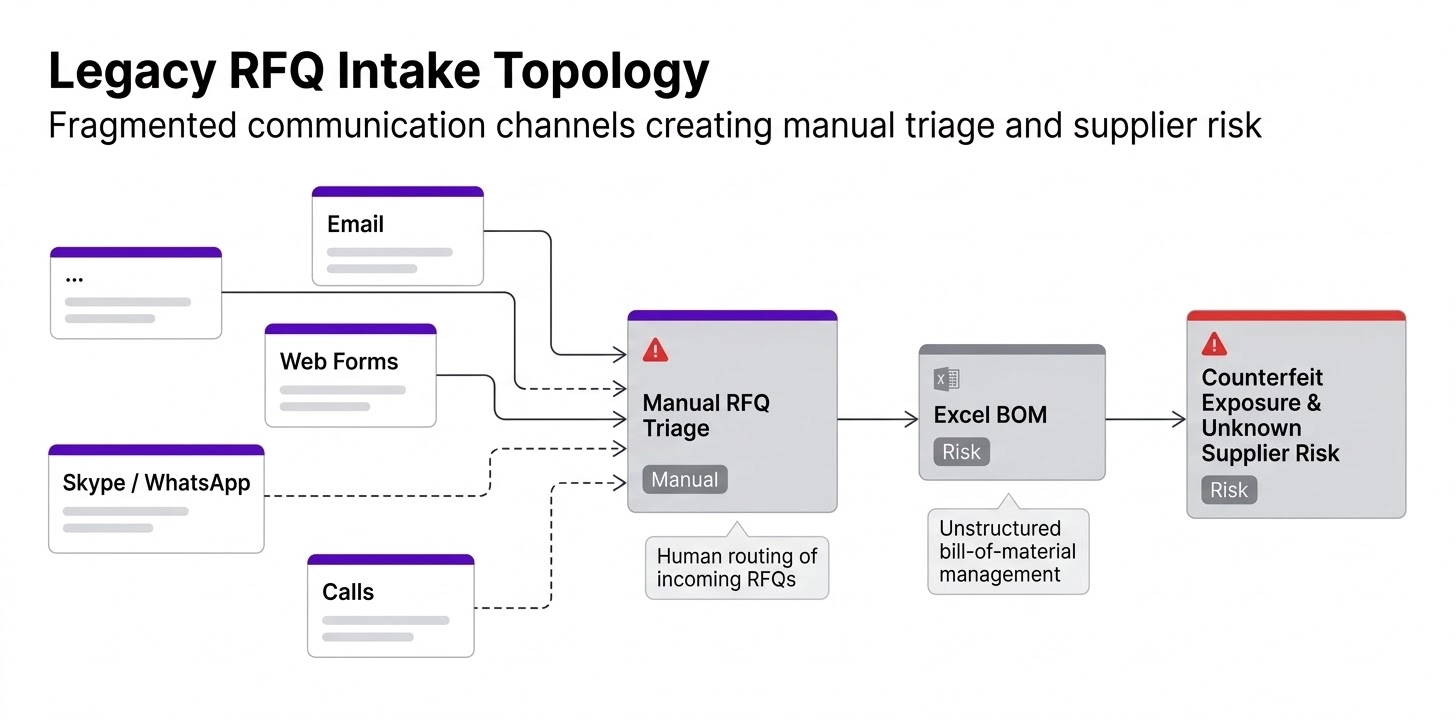
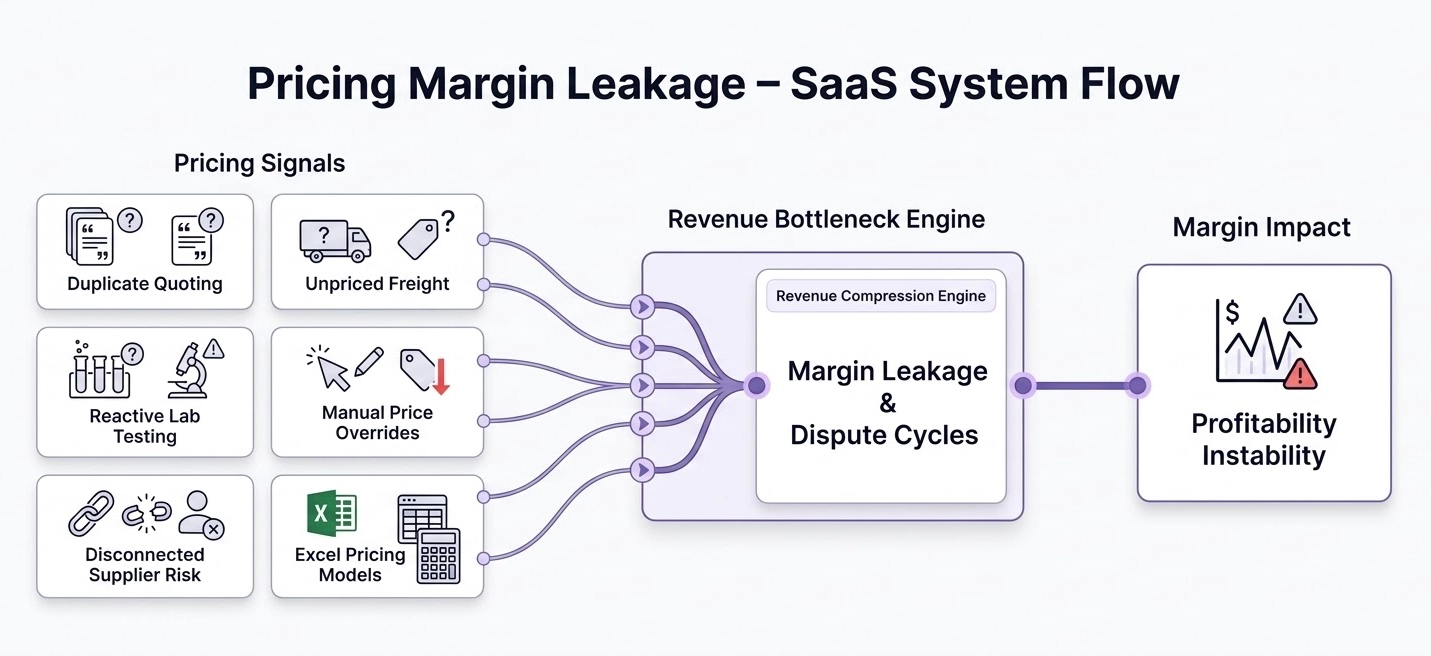
Sales engineers were triaging RFQs by hand and managing 200 to 800-line BOMs in emailed Excel files. Duplicate quotes went out across regions for the same opportunity. AS6081 counterfeit exposure was typically only discovered after shipment, when it showed up as a dispute or a failed test, not before. Nobody could say with confidence which jobs, customers, or reps were actually profitable until the books closed weeks later.
The distributor ran Quanzar's free Margin Leak Audit against fifteen recent RFQs as a first step, not a commitment. The audit took twelve minutes and flagged enough leakage to justify a 30-minute diagnostic call, then a 60-day pilot.
What the audit found
Nine of fifteen RFQs entered into the audit were flagged. The pattern was consistent: quotes priced on instinct rather than historical job cost data, and a handful of accounts that had drifted well below target margin without anyone noticing in real time.
| What the audit surfaced | Operational reality | Margin impact |
|---|---|---|
| RFQ routing with no scoring | Requests arrived by email, web form, and chat with no margin or urgency ranking. | High-margin opportunities sat in the same queue as low-value noise. |
| BOM lines priced manually | 200 to 800-line BOMs worked in Excel with no historical cost lookup. | Underpriced lines and missed cross-sell on comparable jobs. |
| No live AS6081 risk view | Supplier and counterfeit risk had no scoring tied to the quote. | Risk discovered after shipment; longer dispute cycles. |
| ERP, CRM, and quoting disconnected | Job cost data existed in the ERP but never reached the person quoting. | Quotes built on memory instead of data. |
What we built in the 60-day pilot
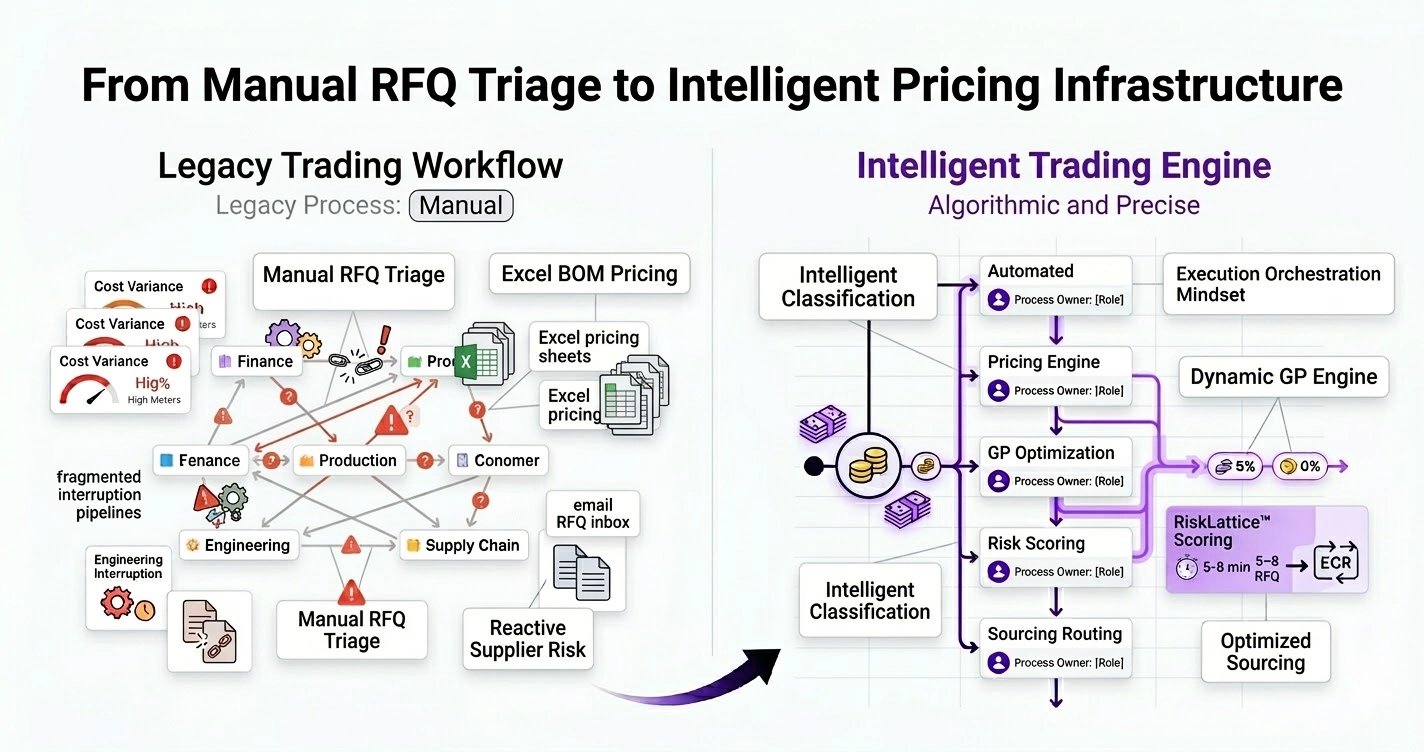
We did not ask the distributor to replace their ERP. Quanzar connects read-only to the systems already in place, including P21, NetSuite, SAP, and Epicor, and layers a live margin and quoting view on top. The pilot deployed two connected products: the Margin Intelligence Dashboard and the Quote Intelligence Engine.
Three capabilities deployed in the pilot
1. RFQ scoring instead of first-come triage
Inbound RFQs are no longer worked in the order an engineer happens to open them. Each request is scored against margin potential, volume, customer tier, and AS6081 risk exposure as it lands, so senior staff see the high-margin opportunities first and low-value noise gets routed to automated channels.
2. BOM lines priced against historical job cost
The Quote Intelligence Engine pulls comparable BOM lines from the distributor's own job history, the same way it does for contract manufacturers, and suggests a margin per line backed by a confidence score. Freight, testing cost, and risk buffer are factored in automatically instead of guessed at.
3. AS6081 risk routed to a human before shipment, not after
Suppliers are scored on defect history, AS6081 exposure, and lead-time reliability. When a high-risk supplier shows up on a quote, the system requires a larger margin buffer and routes a flag to the quality team automatically, so decapsulation testing and EDS/XRF validation happen before the order ships, not after a customer reports a failure.
How the pilot was rolled out
| Phase | Focus | Outcome |
|---|---|---|
| Free Margin Leak Audit | 15 recent RFQs entered, analyzed in 12 minutes | $410K in annual leakage identified, 9 of 15 jobs flagged |
| 30-minute diagnostic call | Reviewed audit results, scoped the pilot | Clear picture of what was fixable in 60 days |
| 60-day pilot | Margin Dashboard + Quote Intelligence connected to ERP | $246K recovered, RFQ response time cut 48% |
| Scale | Expand to AI Ops Layer and Revenue Leak Tracker | Automated follow-up and customer drift detection across all regions |
Measured impact
| Commercial metric | Measured impact |
|---|---|
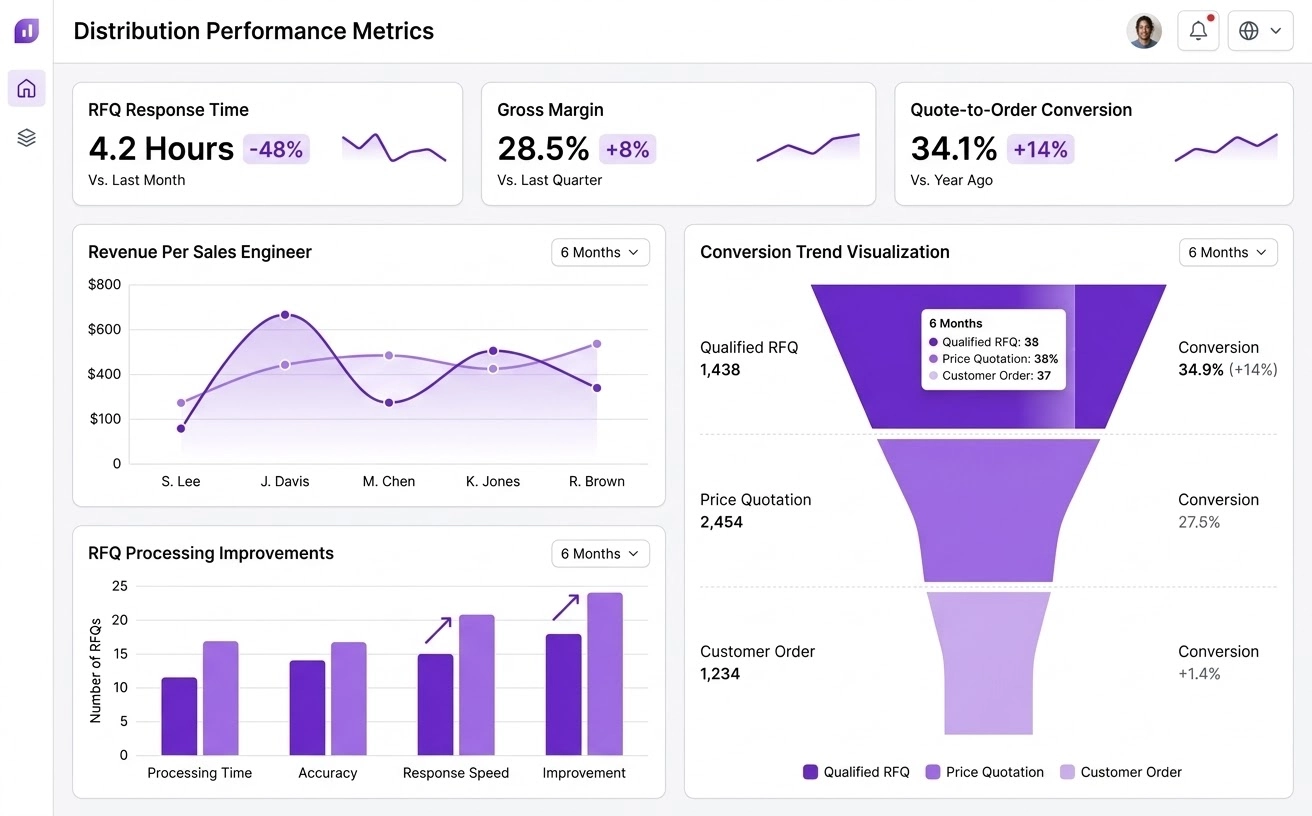
| RFQ response time | Reduced by 48% |
| BOM processing time | Reduced by 55% |
| Quote-to-order conversion | Increased by 14% |
| Quote accuracy on new RFQs | Improved by 6.8 margin points |
| Margin and risk metric | Measured impact |
|---|---|
| Margin recovered in pilot | $246,000 |
| Gross margin improvement | 5–8% uplift across flagged accounts |
| Supplier disputes | Reduced by 22% |
| Credit memo issuance | Reduced by 19% |
| Inventory aging | Reduced by 15% |
Strategic insights
1. Margin leaks before the job ever ships
Most of the gap was set the moment the quote went out. Fixing it at month-end is fixing it too late.
2. Speed and price are the same problem
Slow RFQ response and underpriced quotes both come from the same root cause: no historical data at the point of quoting.
3. Risk has to be scored before the quote, not after the claim
Waiting for a counterfeit dispute to flag a bad supplier is the most expensive way to find out.
4. The data already exists in your ERP
None of this required new data collection. It required connecting data that was already sitting in P21, NetSuite, SAP, or Epicor.
5. Prove it in 60 days before scaling it
A small, measured pilot on real RFQs builds more confidence than a roadmap. Scale only what shows ROI.
6. Visibility compounds
Once margin is visible in real time, every team — sales, quality, finance — starts making better decisions with the same numbers.
Where this applies
This pilot model is built for high-volume, multi-line distribution environments where speed, compliance, and margin control all matter at once. It applies well to:
- Independent semiconductor distributors managing high RFQ volume
- Electronic component brokers handling large, multi-line BOMs
- Franchise distributors looking to tighten their independent sourcing arm
- Organizations needing real-time AS6081 and counterfeit-risk visibility
See your own margin leakage
Enter data from your last 5 to 15 RFQs or jobs. Get a one-page report in about 10 minutes — no sales call required.
Run Your Free Margin Audit → Book a Diagnostic Call