
How Abdul Datarwala Built Quanzar After Scaling From $7M to $85M+

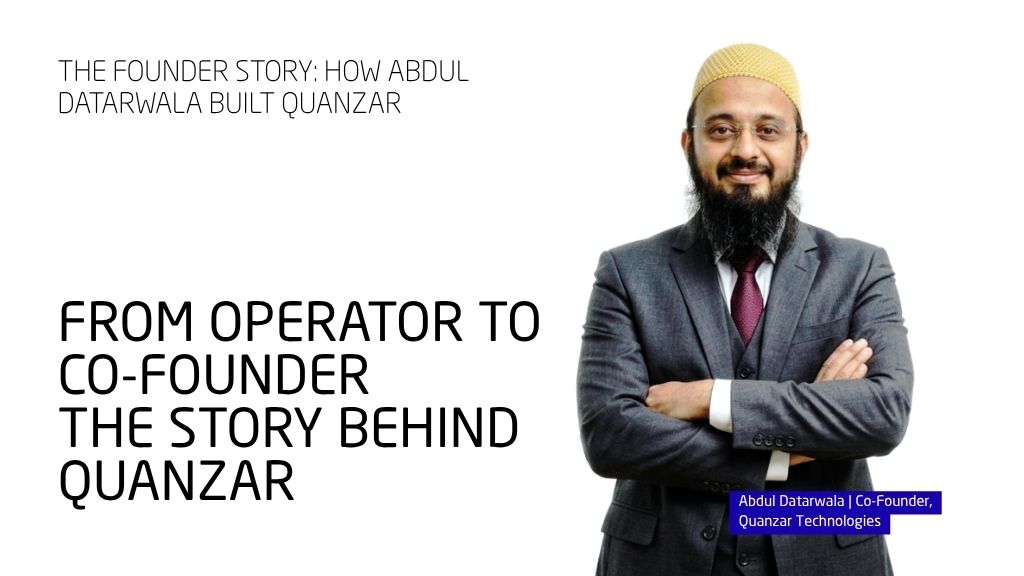
Revenue growth can make an industrial business look healthier while making it harder to see what is actually happening underneath. Abdul Datarwala experienced that problem firsthand while working in industrial distribution. According to Abdul’s account, he helped scale an industrial distribution business from $7M to more than $85M in revenue during his eight years in the industry. As the business grew, so did the difficulty of seeing where margin was being created, protected, or quietly lost.
One type of situation stayed with him: fixed-price commitments on hard-to-find, obsolete parts, sourced through supply chains where supplier prices could keep changing. Handling those commitments meant securing pricing from suppliers, qualifying backup sources, and keeping the customer fully informed throughout the process. The challenge was not simply finding the part. It was protecting the economics of the commitment after the customer had already been given a price.
That operating experience became part of the thinking behind Quanzar Technologies. Today, Quanzar is positioned as a margin intelligence platform for contract manufacturers and industrial distributors: a layer designed to help teams understand the difference between what they expected to earn and what they are actually earning, while there is still time to act.
This is the story behind that idea, what Abdul learned from operating at scale, and why those lessons shaped the way Quanzar approaches margin, quoting, and revenue leakage.
If you want to skip the backstory and look at your own numbers, you can run the free Margin Leak Audit.
Who founded Quanzar?
Abdul Datarwala is Co-Founder and CEO of Quanzar Technologies. His background is in industrial distribution, where he spent eight years operating in an environment where pricing decisions, supplier costs, customer commitments, and delivery outcomes could all affect margin.
According to Abdul’s account, he helped scale an industrial distribution business from $7M to more than $85M in revenue. That experience exposed him to a recurring operational problem: the information needed to understand margin often arrived after the decision that created the margin had already been made.

Abdul Datarwala and Quanzar: founder facts at a glance
| Question | Answer |
|---|---|
| Founder | Abdul Datarwala, Co-Founder and CEO of Quanzar Technologies |
| Background | Industrial distribution operator |
| Industry experience | 8 years in industrial distribution |
| Business scale | Grew from $7M to more than $85M in revenue, according to Abdul’s account |
| Problem that influenced Quanzar | Difficulty seeing and acting on margin changes across quotes, supplier costs, jobs, and customers |
| What Quanzar does | Provides visibility into margin, quoting, and revenue leakage for manufacturers and industrial distributors |
| ERP approach | Works with existing business systems rather than requiring an ERP replacement |
| Starting point | Free Margin Leak Audit |
The operator years: growing from $7M to $85M+
The headline number is straightforward: according to Abdul Datarwala’s account, the industrial distribution business he helped operate grew from $7M to more than $85M in revenue.
But revenue growth changes the operating environment. More customers mean more pricing decisions. More products mean more supplier variables. More salespeople mean more people making commitments to customers. More transactions mean that an individual margin problem can disappear inside an otherwise healthy monthly result.
At a smaller scale, an operator can often see most of the important decisions personally. A quote goes out, a supplier responds, a customer places an order, and the people involved know what happened. As the business grows, that visibility becomes harder to maintain.
The person responsible for the overall result may know that gross margin moved, but not necessarily which jobs caused the movement. A sales rep may know that a customer pushed back on price, but not what happened to the account’s realized margin several months later. A finance team may have accurate month-end numbers without having an operating view of which open jobs are starting to drift.
That distinction became important in Abdul’s experience: knowing the business’s financial result was not always the same as knowing where the result was being created or lost.
The operational problem that stayed with Abdul
One type of situation stayed with Abdul: fixed-price commitments involving hard-to-find or obsolete parts.
These situations are difficult because the customer expects a price and the supplier environment may continue changing after that commitment is made. A part may be difficult to source. A supplier may change its price. An alternative source may need to be qualified. The customer still needs an answer, and the business still has to protect the economics of the transaction.
Handling those situations meant securing pricing commitments from suppliers, qualifying backup sources, and keeping the customer fully informed throughout the process.
The operational lesson is broader than obsolete parts. A quote is made using the information available at one point in time. The conditions surrounding that quote can change before the job is completed.
That creates a fundamental margin question:
How quickly can the business see that the economics of the job are changing?
If the answer only arrives after the job closes, the information is useful for reporting but much less useful for intervention.
That distinction became one of the ideas behind Quanzar’s approach to margin intelligence.
Why fixed-price commitments make margin visibility difficult
Consider a simple situation. A distributor quotes a customer a fixed price based on a supplier cost available at the time of quoting. The customer accepts the quote. Before fulfillment, the supplier increases the price, the original source becomes unavailable, and the business has to use a more expensive alternative.
The customer may never see the internal cost problem. The business still has to deliver what it promised.
The original quote was not necessarily careless. The problem is that the economics changed after the commitment.
This is why margin management is not only about preventing bad quotes. It is also about detecting changes between the quote and the final result.
Why quoted margin and realized margin can diverge
To understand the problem, it helps to distinguish between quoted margin and realized margin.
Quoted margin
Quoted margin is the margin implied by a quote when it is created. It is based on the price and cost information available at that point.
Realized margin
Realized margin is the margin achieved after the job is delivered and the relevant revenue and costs have been recorded.
The two can differ for many reasons: supplier price changes, freight, rework, scope changes, discounts, concessions, or errors in the original cost assumptions.
Margin is not markup
Markup and margin are related but different measurements.
If a product costs $70 and sells for $100, gross profit is $30. Gross margin is therefore 30% because the $30 profit is divided by the $100 selling price.
Markup, however, is calculated against cost. The $30 profit divided by the $70 cost produces a markup of approximately 42.9%.
That distinction matters when pricing. Applying a 30% markup to a $70 cost produces a selling price of $91. The resulting gross profit is $21, which is approximately a 23.1% gross margin, not 30%.
A business that consistently confuses these two percentages can create a margin problem before a job ever begins.
Example: one job, quoted versus realized margin
The following example is illustrative only. The numbers are invented to demonstrate the mechanics and are not Quanzar customer data.
| Line | Quoted | Realized |
|---|---|---|
| Revenue | $100,000 | $100,000 |
| Product and direct cost | $66,000 | $66,000 |
| Supplier price increase | $0 | $4,000 |
| Expedited freight | $0 | $2,500 |
| Rework | $0 | $2,500 |
| Total cost | $66,000 | $75,000 |
| Gross profit | $34,000 | $25,000 |
| Gross margin | 34.0% | 25.0% |
The job was quoted at a 34% margin and ultimately realized a 25% margin. The nine-point difference represents $9,000 of gross profit on $100,000 of revenue.
Nothing in the example requires a catastrophic failure. A supplier increase, expedited freight, and rework can each look manageable on their own. Together, they change the economics of the job.
That is the operating problem margin intelligence is intended to make easier to see.
Three ways margin can disappear
1. The margin is wrong at the quote
A job can start with the wrong economics because the quote uses stale costs, incorrect assumptions, an inappropriate markup, or a discount that pushes the selling price below the intended margin.
The important question is not simply whether a quote was wrong. It is whether the business can identify patterns in the quotes that repeatedly underperform.
2. The economics change after the quote
Supplier costs, freight, labor, rework, scope, and other variables can change after the customer has accepted a price.
This is particularly important for fixed-price commitments. The business has already made a commercial promise, but the underlying cost structure may no longer match the assumptions behind that promise.
3. Customer revenue can drift without an obvious failure
A customer does not always leave in one dramatic event. Ordering frequency can decline. A few purchases can move to another supplier. A quote can take too long. A price can become less competitive. The account may still appear active while the underlying revenue opportunity is shrinking.
That is a different type of leakage from a bad job, but it creates the same operating problem: the business needs to identify the change early enough to investigate it.
Why growth can hide margin problems
A growing business can absorb individual problems because good jobs can offset weak ones.
Consider five illustrative jobs:
| Job | Revenue | Realized Margin | Gross Profit |
|---|---|---|---|
| A | $100,000 | 32% | $32,000 |
| B | $80,000 | 30% | $24,000 |
| C | $60,000 | 12% | $7,200 |
| D | $40,000 | 35% | $14,000 |
| E | $20,000 | 8% | $1,600 |
| Total | $300,000 | 26.3% | $78,800 |
The blended margin is approximately 26.3%, but jobs C and E together represent $80,000 of revenue at only 11% combined margin.
If those two jobs had instead achieved a 30% margin, they would have generated $24,000 of gross profit instead of $8,800 — a difference of $15,200.
The lesson is not that 26.3% is good or bad. The lesson is that the average does not tell an operator which jobs are creating the deviation.
This is why job-level visibility matters when the goal is not only to report what happened, but to understand what should change next.
Why existing systems did not always answer the operating question
An ERP, accounting system, spreadsheet, or business intelligence platform can be extremely valuable. The issue is not whether these systems contain useful data. The issue is how that data is turned into an operating decision.
An ERP may accurately record costs and revenue. A finance report may accurately show the month’s gross margin. A spreadsheet may combine data from several sources.
But an operator may still need to answer a different question:
Which specific jobs, customers, or quotes are creating the problem, and what can we do about them now?
That question often requires connecting information from different stages of the commercial process: the original quote, the expected cost, the actual cost, the customer, the sales representative, and the eventual financial result.
As a business grows, doing that manually becomes increasingly difficult. The data may exist, but the path from data to action becomes longer.
Quanzar’s approach is therefore not based on replacing the ERP. It is designed to work with existing systems, including platforms such as P21, NetSuite, SAP, and Epicor.
The goal is to add an operating layer around the data rather than asking an industrial business to replace its core system.
How Abdul’s operating experience shaped Quanzar
The founder’s background matters because it influenced what the product is designed to help an operator see.
Start with actual jobs
The first principle is practical: start with real business data rather than asking a company to begin with a large software implementation.
Looking at recent jobs can reveal whether quoted and realized margins are actually behaving differently. It can also show whether the issue is concentrated in certain customers, reps, job types, or cost categories.
Show the dollar impact
A percentage-point difference is useful, but operators also need to know what that difference means in dollars.
A two-point margin miss on a $20,000 job is not the same financial event as a two-point miss on a $2M job.
That is why useful margin analysis should connect percentage changes to actual dollars at risk or lost.
Keep the existing ERP in place
The operating systems that run a manufacturing or distribution business are deeply embedded in daily work. Replacing an ERP simply to gain another view of margin is a significant undertaking.
Quanzar’s model is instead designed to connect with existing systems and use the information already being generated by the business.
Focus on decisions, not just dashboards
A dashboard can tell an operator that margin moved. A useful operating system should help answer what changed, where it happened, and which jobs or customers deserve attention.
That difference is central to the idea of margin intelligence.
What margin intelligence means
Margin intelligence is the ability to connect expected economics with actual performance and surface meaningful deviations early enough for the business to respond.
In practical terms, that can mean comparing quoted and realized margin by job, customer, or sales representative; identifying the causes of the gap; and bringing the highest-impact exceptions to an operator’s attention.
The distinction can be summarized simply:
Margin analysis asks: “What happened?”
Margin intelligence asks: “What is changing, where is it happening, and what should we look at now?”
The second question is where the operational value comes from.
How to manually check margin leakage
A business does not need specialized software to determine whether it has a margin visibility problem. A simple manual review of recent jobs can establish whether the gap is worth investigating.
- Choose a representative sample.
Select around 15 recently completed jobs across different customers, representatives, and job sizes. - Capture the original quote.
Record the quoted price and the quoted margin. If the quote uses markup rather than margin, convert it before comparing the numbers. - Capture the actual result.
Pull the final invoiced revenue and actual job cost from your financial or ERP system. - Use a consistent cost definition.
Make sure the cost definition used for the quoted margin and realized margin is comparable. Document what is included. - Calculate the margin gap.
Compare quoted margin with realized margin in percentage points and calculate the associated dollar impact. - Rank the largest dollar gaps.
Look at the jobs with the largest financial impact rather than focusing only on the largest percentage difference. - Identify the cause.
For the largest gaps, classify the likely cause: supplier cost change, price concession, freight, rework, scope change, or quoting error.
The goal is not to prove that every margin difference is a problem. Some differences are expected and explainable. The goal is to determine whether the business is seeing a repeatable pattern that deserves attention.
If gathering this information manually is difficult, that difficulty is itself useful information. It tells you that the business may have the underlying data without having an efficient way to turn it into an operating view.
What other operators can learn
1. Treat quoted margin as a hypothesis
A quote represents what the business expects to earn based on the information available at that moment. It should be tested against what actually happens.
2. Separate price problems from cost problems
A margin miss caused by a customer discount is different from one caused by a supplier price increase. The first may require a commercial response. The second may require sourcing, purchasing, or pricing changes.
3. Review large dollar deviations first
Percentage points tell you how far performance moved. Dollars tell you how much the movement matters.
4. Give sales teams feedback on realized outcomes
A salesperson can improve quoting decisions faster when they can see how previous quotes performed after delivery.
5. Watch customers for changes in behavior
Revenue decline can be a lagging indicator. Changes in ordering frequency, quote activity, or purchasing patterns can provide earlier signals that an account deserves attention.
6. Do not blame people before checking the system
A rep can only quote from the cost and pricing information available to them. If that information is stale or incomplete, the underlying issue may be the process rather than the individual.
7. Shorten the feedback loop
The faster a business can connect a commercial decision with its financial consequence, the faster it can learn from the decision.
What Quanzar does today
The operating problem that influenced Quanzar has developed into a broader platform for manufacturers and industrial distributors.
Margin Intelligence focuses on understanding margin performance and identifying deviations that deserve attention.
Quote Intelligence focuses on the quoting stage, where commercial decisions establish the expected economics of a job.
Revenue Leak Tracker focuses on changes in customer revenue and purchasing behavior.
For organizations looking to automate more operational work, Quanzar also offers an
AI Ops Layer.
The common idea across these capabilities is straightforward: use the data already generated by the business to identify where attention is most needed.
From founder problem to operating system
The strongest connection between Abdul’s experience and Quanzar is not that he encountered one bad job or one difficult supplier. It is that the same underlying challenge can appear in many forms.
| Operator problem | What needs to be visible |
|---|---|
| Supplier prices change after a fixed-price commitment | Expected versus actual job economics |
| Quotes use incomplete or outdated cost information | Quote-level margin and historical performance |
| Jobs close below target margin | Quoted versus realized margin by job |
| Customers gradually reduce purchasing | Changes in customer ordering and revenue patterns |
| Data exists across multiple systems | A connected operating view without replacing the ERP |
This is the core idea behind the company: the goal is not simply to produce another financial report. It is to make the operational consequences of commercial decisions easier to see and act on.
Who is Quanzar for?
Quanzar is most relevant to contract manufacturers, manufacturers, and industrial distributors that quote work or products at an expected margin and want better visibility into what happens after the quote is accepted.
It may be particularly relevant if:
- month-end is when margin problems become visible;
- quoted and realized margins are difficult to compare;
- supplier cost changes frequently affect fixed-price commitments;
- sales representatives quote independently across a large customer base;
- customer revenue is changing without a clear explanation;
- important data exists in multiple systems and requires manual reporting.
If your business already has trusted, timely visibility into margin by job, customer, and sales representative, you may have already solved much of the problem Quanzar was designed to address.
See where your own margin is going
The easiest way to test the idea is with your own data.
The free Margin Leak Audit is designed to compare recent quoted and realized job performance and identify where the largest gaps appear.
Run the free Margin Leak Audit
If you prefer to discuss the findings with the team, you can also
book a diagnostic conversation.
Frequently asked questions
Who is the founder of Quanzar?
Abdul Datarwala is Co-Founder and CEO of Quanzar Technologies. His background is in industrial distribution, where he spent eight years and, according to his account, helped scale an industrial distribution business from $7M to more than $85M in revenue.
Why did Abdul Datarwala build Quanzar?
His operating experience exposed him to the difficulty of protecting margin when customer commitments are fixed but supplier costs and operating conditions can change. One recurring example involved hard-to-find and obsolete parts, where protecting the economics of a commitment required supplier pricing, backup sourcing, and close customer communication.
What is margin intelligence?
Margin intelligence is the ability to compare expected and actual economics, identify meaningful deviations, and surface them early enough for an operator to investigate or act. It goes beyond simply reporting historical financial results.
What is the difference between gross margin and markup?
Gross margin is gross profit divided by revenue. Markup is gross profit divided by cost. For a product that costs $70 and sells for $100, the gross margin is 30% while the markup is approximately 42.9%.
What is the difference between quoted margin and realized margin?
Quoted margin is the margin implied by a quote when it is created. Realized margin is the margin achieved after the relevant revenue and costs have been recorded. The difference can result from supplier price changes, freight, rework, concessions, scope changes, or errors in the original assumptions.
Does Quanzar replace an ERP?
No. Quanzar is designed to work with existing business systems, including ERP platforms such as P21, NetSuite, SAP, and Epicor, rather than requiring a company to replace its core ERP.
How can I find out where my business is losing margin?
You can start by reviewing a representative sample of recent jobs and comparing quoted versus realized margin. You can also use the free Margin Leak Audit to analyze recent job data.
Is this financial or accounting advice?
No. This article describes an operator’s experience and explains general margin concepts using illustrative examples. It is not accounting, tax, legal, or financial advice. Your margin definitions and results will depend on your business, accounting policies, contracts, and data.