
The Capacity Problem That Wasn't a Capacity Problem
Executive context
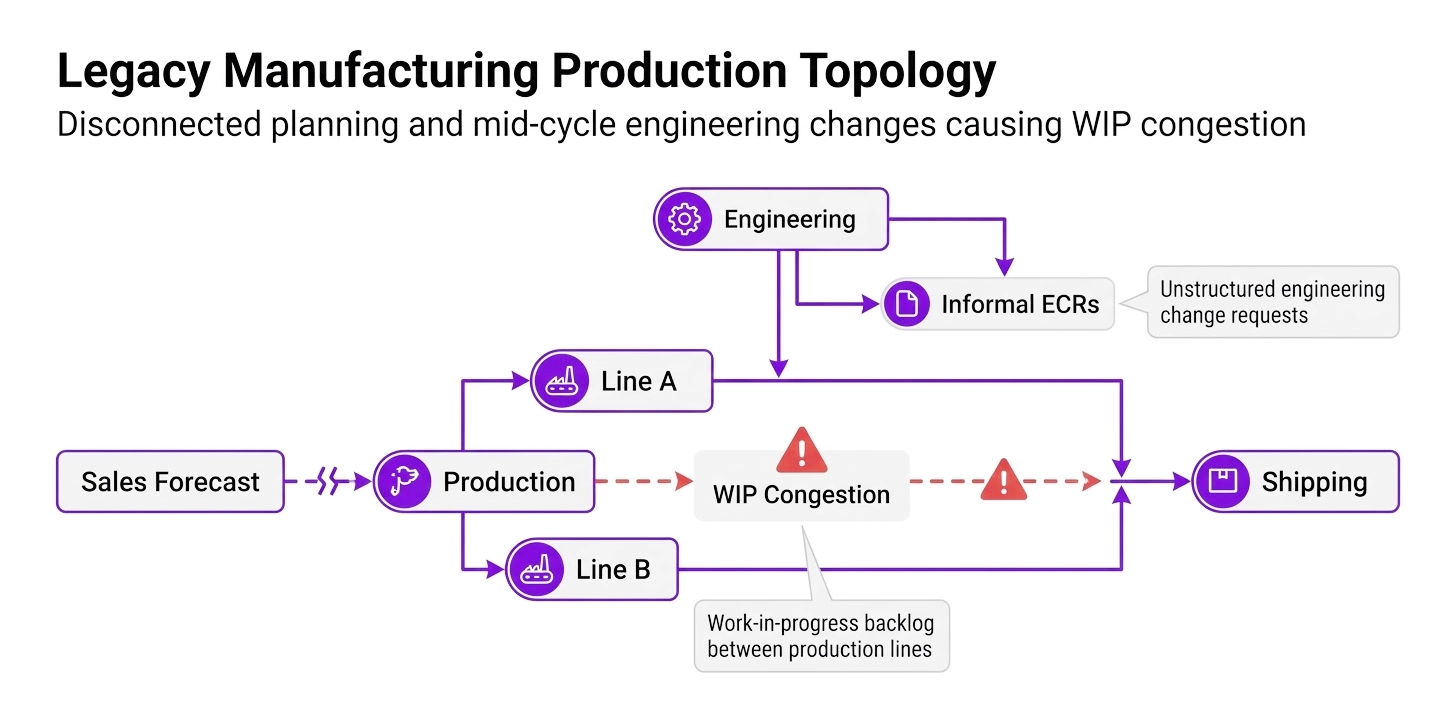
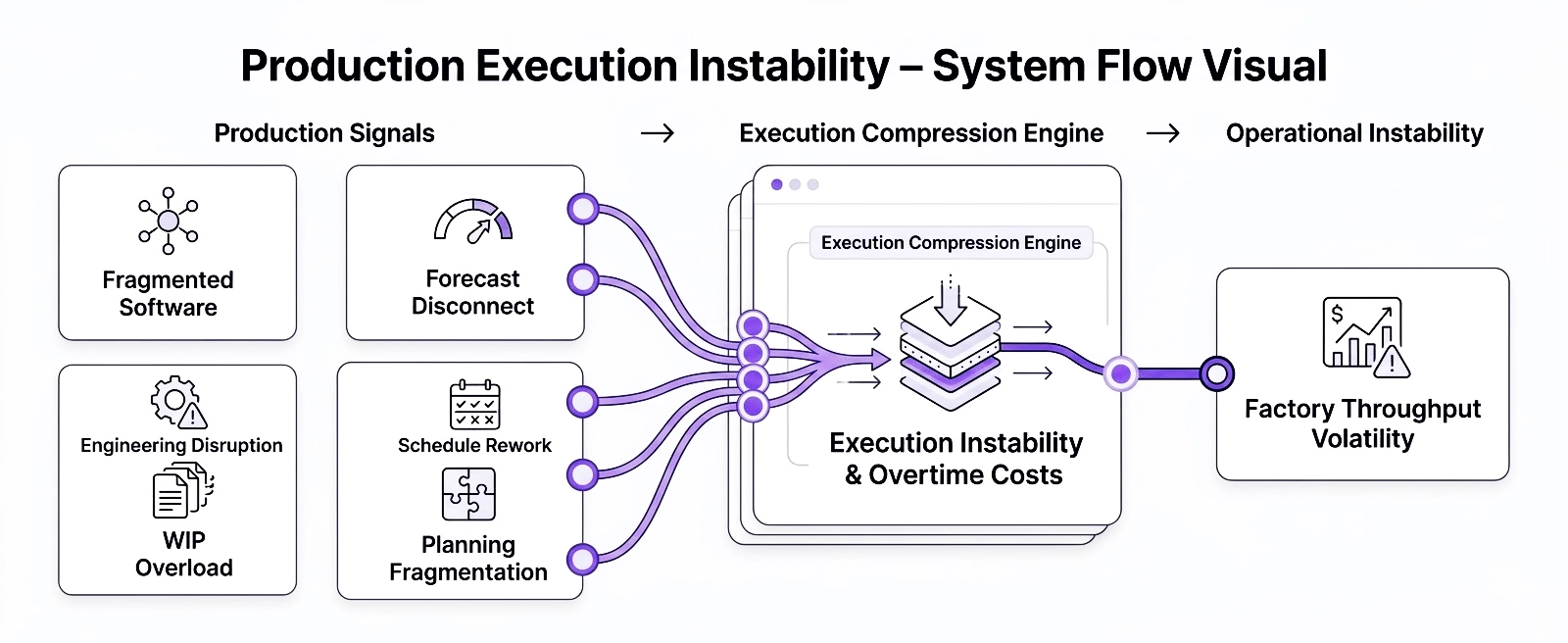
A mid-sized manufacturer running a mix of custom and repeat multi-line production was riding a real demand surge. Revenue was climbing. So was the chaos. Work-in-progress piled up between stations, engineering change orders disrupted active builds mid-cycle, and procurement kept reacting to shortages instead of planning around them. Overtime and expedited freight quietly ate into every job's margin.
Leadership had a number in mind for a new production line. Before signing off on the capital spend, they ran Quanzar's free Margin Leak Audit on their last fifteen jobs to see whether the numbers actually supported a capacity shortage. They did not.
What the audit found
Ten of fifteen jobs entered into the audit were flagged. The margin was not disappearing because the plant lacked capacity. It was disappearing because nobody could see a job's margin slipping until the WIP pileup, the expedite fee, or the overtime hours had already happened.
| What the audit surfaced | Operational reality | Margin impact |
|---|---|---|
| Forecasts disconnected from live WIP | Sales forecasts ignored current line congestion and lead times. | Planning reacted to shortages instead of preventing them. |
| No visibility into station-level drag | One line overproduced while the next became a bottleneck, invisible until finished goods slipped. | Expedited freight and overtime absorbed the margin. |
| Engineering changes entering mid-build | ECRs approved over email with no impact assessment. | Rework, scrap, and schedule volatility. |
| Job margin invisible until month-end | Cost data existed in the ERP but never reached a live view. | CapEx considered as the default fix. |
What we built in the 60-day pilot
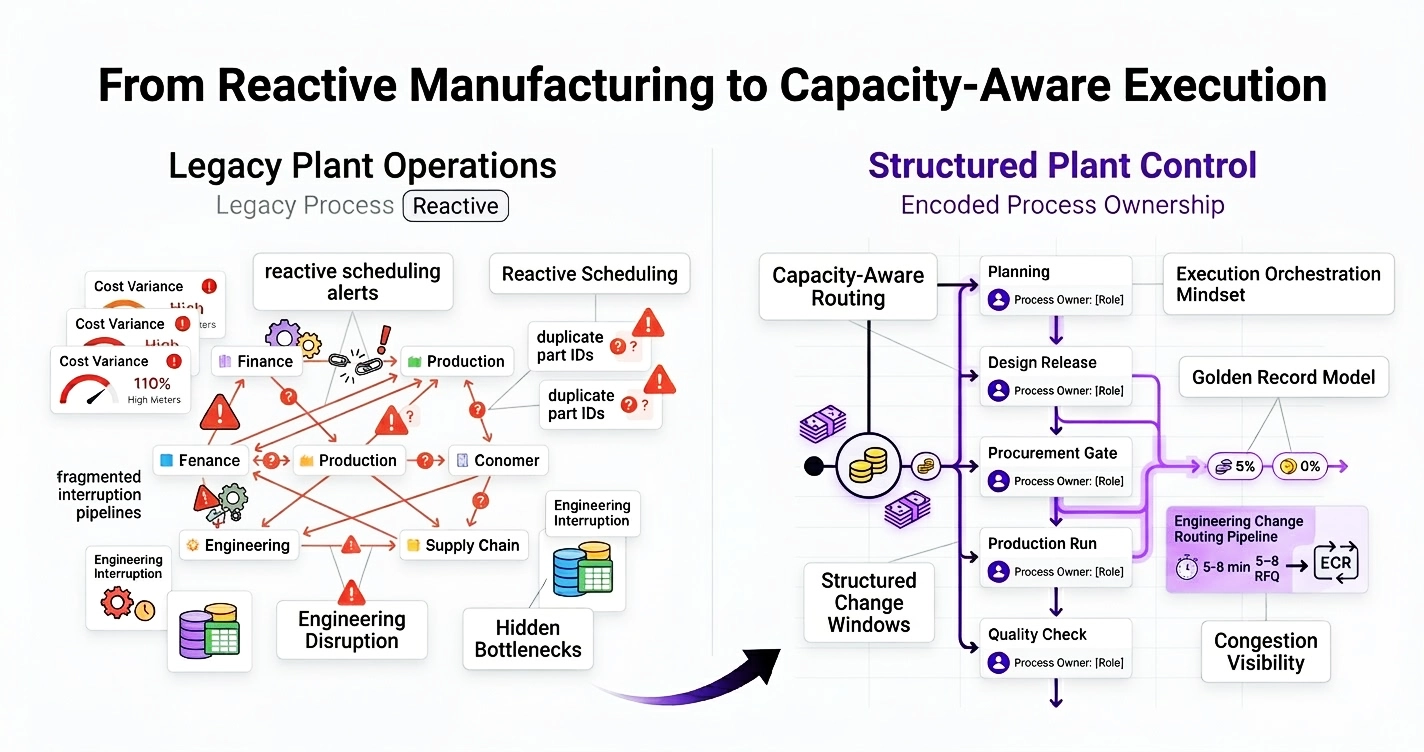
Instead of recommending the new line, we connected the manufacturer's ERP and MES read-only and deployed two products: the Margin Intelligence Dashboard to surface job-level margin drag in real time, and the AI Ops Layer to act on WIP and engineering-change signals automatically instead of waiting for a supervisor to notice on the floor.
Three capabilities deployed in the pilot
1. Job-level margin drag traced to its source
The Margin Intelligence Dashboard connected ERP job cost to MES station data, so a job drifting below target margin could be traced back to where it was actually losing ground — a station running over capacity, an unplanned overtime shift, an expedited shipment — instead of showing up as an unexplained gap weeks later.
2. WIP threshold alerts before the floor backs up
When work-in-progress at a station crosses a defined threshold, the AI Ops Layer fires an alert to the right supervisor automatically, with the job, the station, and the dollar impact attached. The floor moves from reacting to a visible pileup to catching the drift while it is still a small problem.
3. Engineering changes assessed before they hit an active build
ECRs now route through a defined risk classification and impact assessment before they are scheduled, instead of landing mid-build through an email approval. Active jobs are protected from sudden disruption, and the margin impact of each change is visible before, not after, it ships.
How the pilot was rolled out
| Phase | Focus | Outcome |
|---|---|---|
| Free Margin Leak Audit | 15 recent jobs entered, analyzed against quoted vs realized margin | $365K in annual leakage identified, traced to WIP and ECR disruption |
| 30-minute diagnostic call | Reviewed whether the capacity problem was real or a visibility problem | Capital equipment purchase put on hold pending pilot results |
| 60-day pilot | Margin Dashboard connected to MES, AI Ops Layer bound to WIP and ECR triggers | $221K recovered, output up 15% with no new equipment |
| Scale | Extend WIP alerting to remaining lines and shifts | Capital spend deferred, throughput stabilized across all lines |
Measured impact
| Throughput metric | Measured impact |
|---|---|
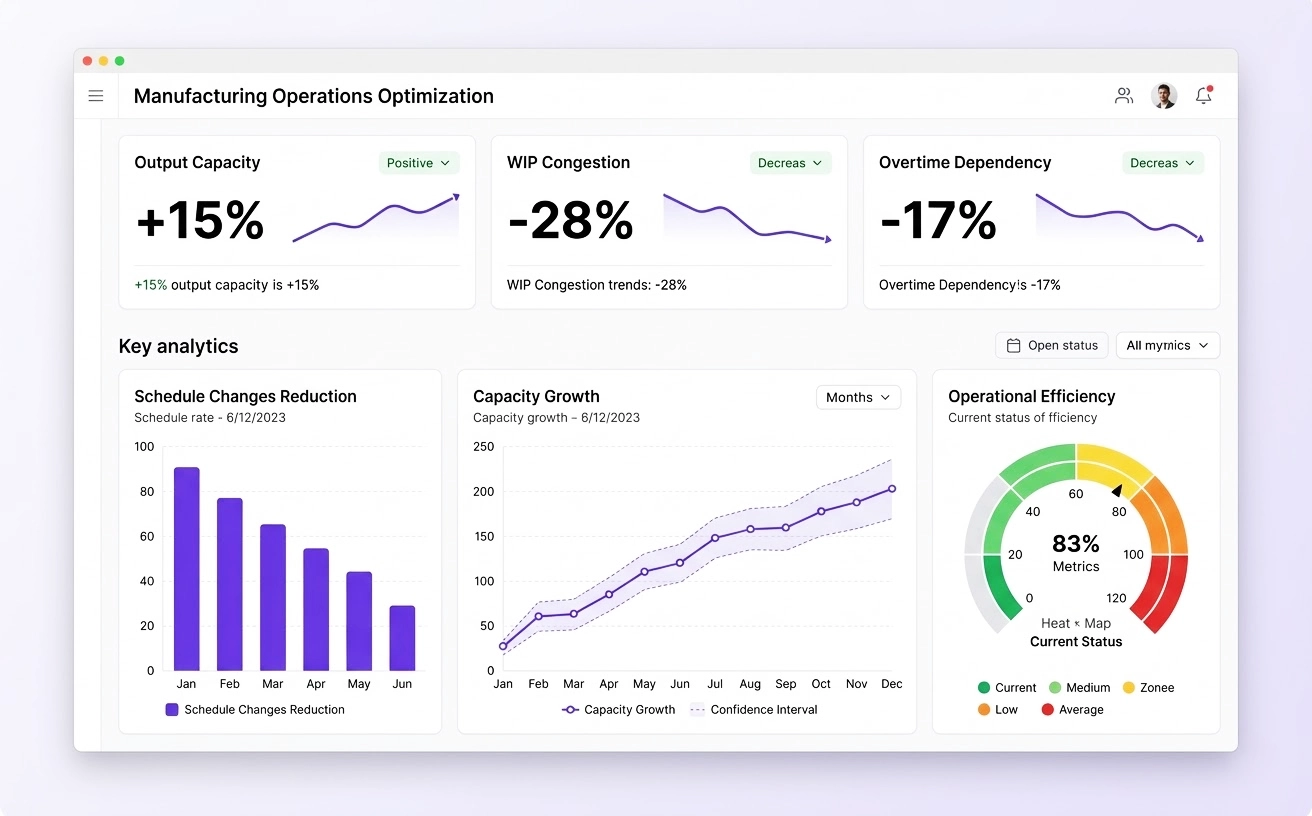
| WIP congestion | Reduced by 28% |
| Production schedule changes | Reduced by 35% |
| Engineering change disruption | Reduced by 30% |
| Overtime dependency | Reduced by 17% |
| Financial metric | Measured impact |
|---|---|
| Margin recovered in pilot | $221,000 |
| Output capacity | Increased by 15%, no new equipment purchased |
| Expedited freight cost | Reduced by 19% |
| Scrap and rework cost | Reduced by 14% |
Strategic insights
1. Growth exposes whatever visibility you don't have
A demand surge does not create instability. It reveals instability that was already there, just below the threshold anyone noticed.
2. WIP congestion is a margin problem wearing a floor problem's clothes
Expedited freight, overtime, and scrap are not the cost of growth. They are what margin leakage looks like on a production floor.
3. CapEx is the most expensive way to fix a visibility gap
Before approving new equipment, check whether the constraint is physical or whether it is simply invisible until it is too late to act on.
4. A faster station upstream just moves the bottleneck
Adding capacity at one station without visibility into the rest of the line accelerates the pileup at the next one.
5. Engineering changes need an impact check before they ship
An ECR approved by email carries the same risk as a quote priced on gut feel: nobody catches the cost until it has already landed.
6. The audit should come before the capital request
A free 10-minute audit on real job data is a cheaper way to test a capacity assumption than a six- or seven-figure equipment purchase.
Where this applies
This pilot model fits manufacturers who are considering capital expansion to solve what may actually be an execution visibility problem. It applies well to:
- Mid-market discrete manufacturers facing high WIP congestion during demand growth
- Facilities running a mix of custom and repeat production lines
- Operations teams struggling with mid-cycle engineering disruptions
- Leadership teams weighing a capital equipment purchase against fixing execution first
Test your capacity assumption in 10 minutes
Enter data from your last 5 to 15 jobs before you sign off on new equipment. Get a one-page margin leak report — no sales call required.
Run Your Free Margin Audit → Book a Diagnostic Call