Restructuring Legal Execution to Eliminate Review Friction and Unlock Revenue Expansion
Executive Context
A leading multi-department law firm was experiencing significant execution drag despite possessing top-tier legal talent. Across Litigation, Corporate, Regulatory, and Compliance departments, operational inefficiencies were actively limiting the firm's intake capacity and capping revenue expansion. The firm's partners recognized that the constraint was not legal expertise; it was the underlying operational architecture.
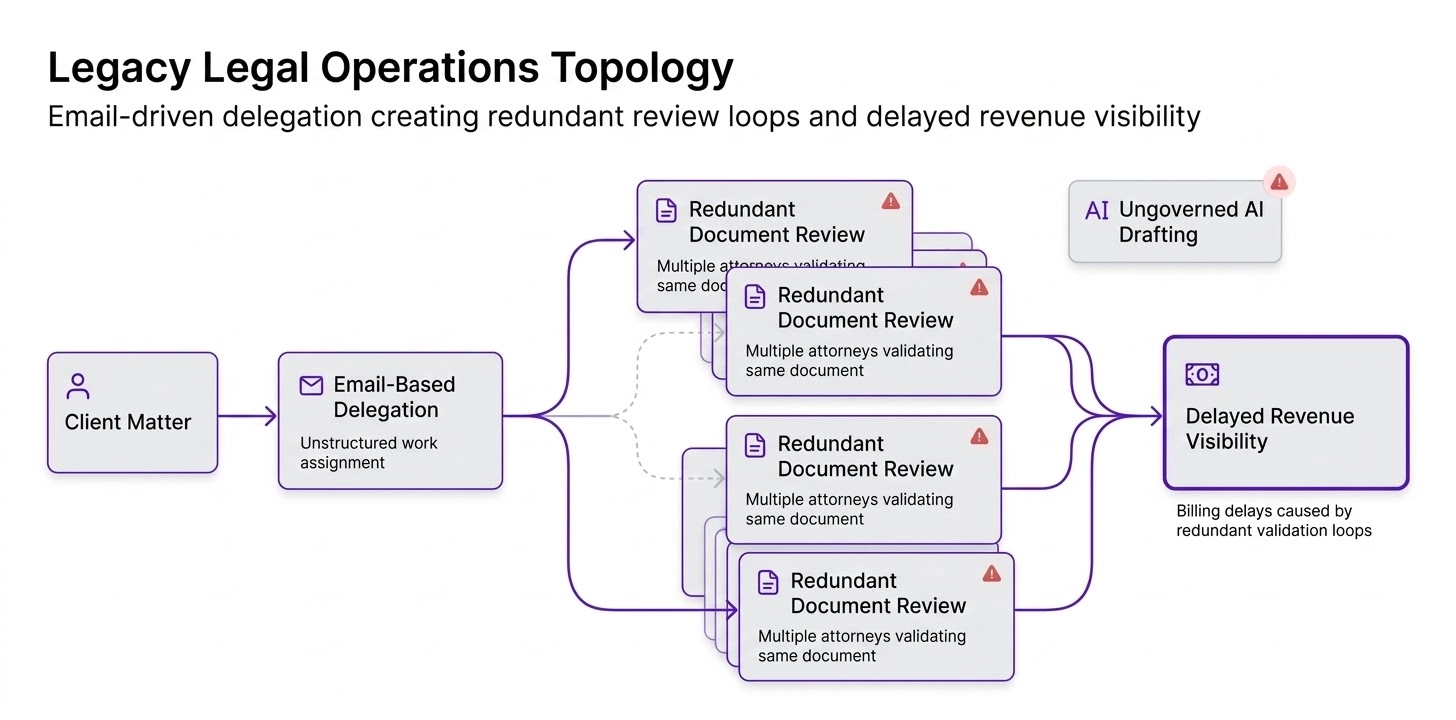
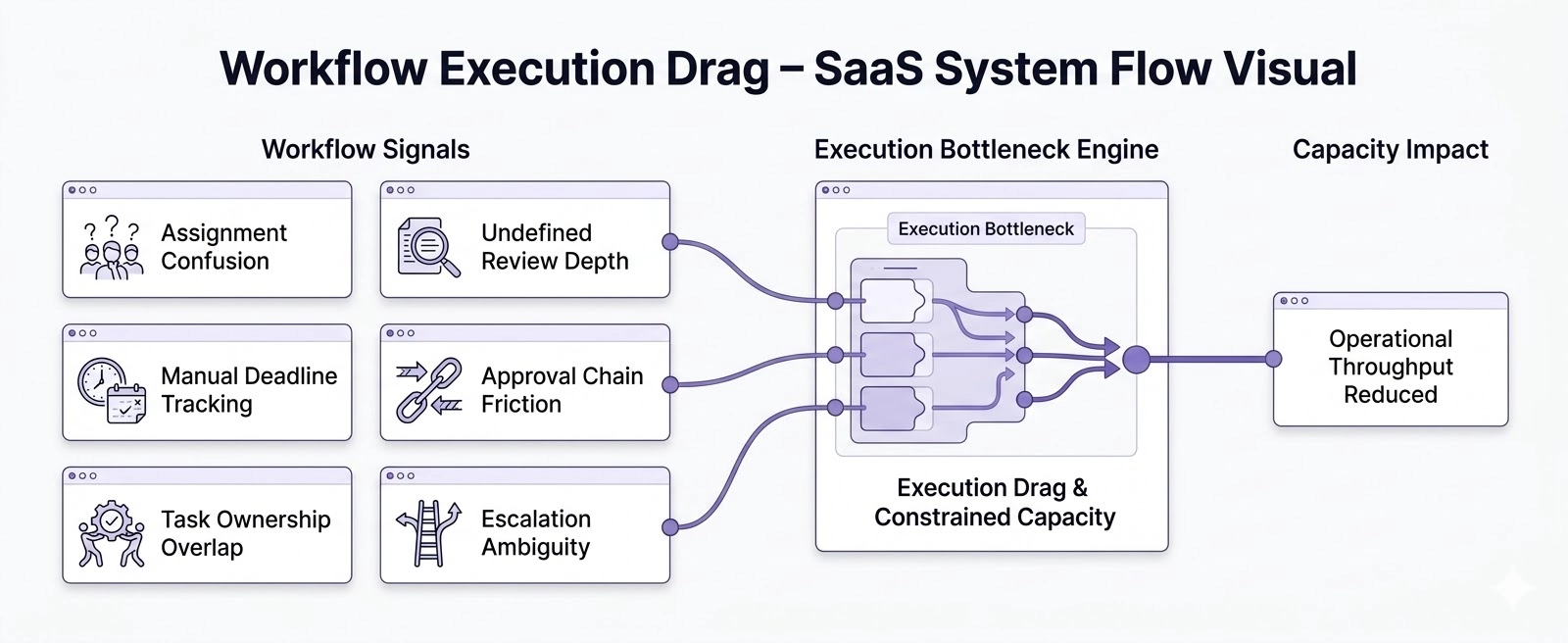
Attorneys were trapped in an environment of redundant labor. Multiple lawyers frequently reviewed the same documents at undefined depths. Assignment confusion reigned across departments, with work delegated via fragmented email threads. Furthermore, individual attorneys were utilizing AI drafting tools independently, without a centralized governance framework, escalating risk. Deadlines were tracked partially through manual memory, and revenue visibility was notoriously delayed until late-stage billing cycles.
The organization engaged Quanzar Technologies™ to diagnose and restructure their operational topology. They realized that supervising harder was no longer a viable strategy; they needed to engineer exactly how work moved.
Initial Operational Topology
Our initial diagnostic mapped the firm's legacy execution workflows, identifying severe structural breakdowns that directly eroded margin and billable potential.
| Operational Stage | Legacy Execution | Observed Weakness |
|---|---|---|
| Intake & Assignment | Email-Based Task Delegation | Assignment confusion and uneven workload distribution |
| Execution & Drafting | Independent AI Usage | Fragmented information flow without version control or governance |
| Validation & Approval | Undefined Review Depth | Attorneys reviewing the same documents multiple times at full depth |
| Monitoring & Reporting | Manual Deadline Tracking | Revenue visibility delayed until late-stage billing |
The Transformation Strategy
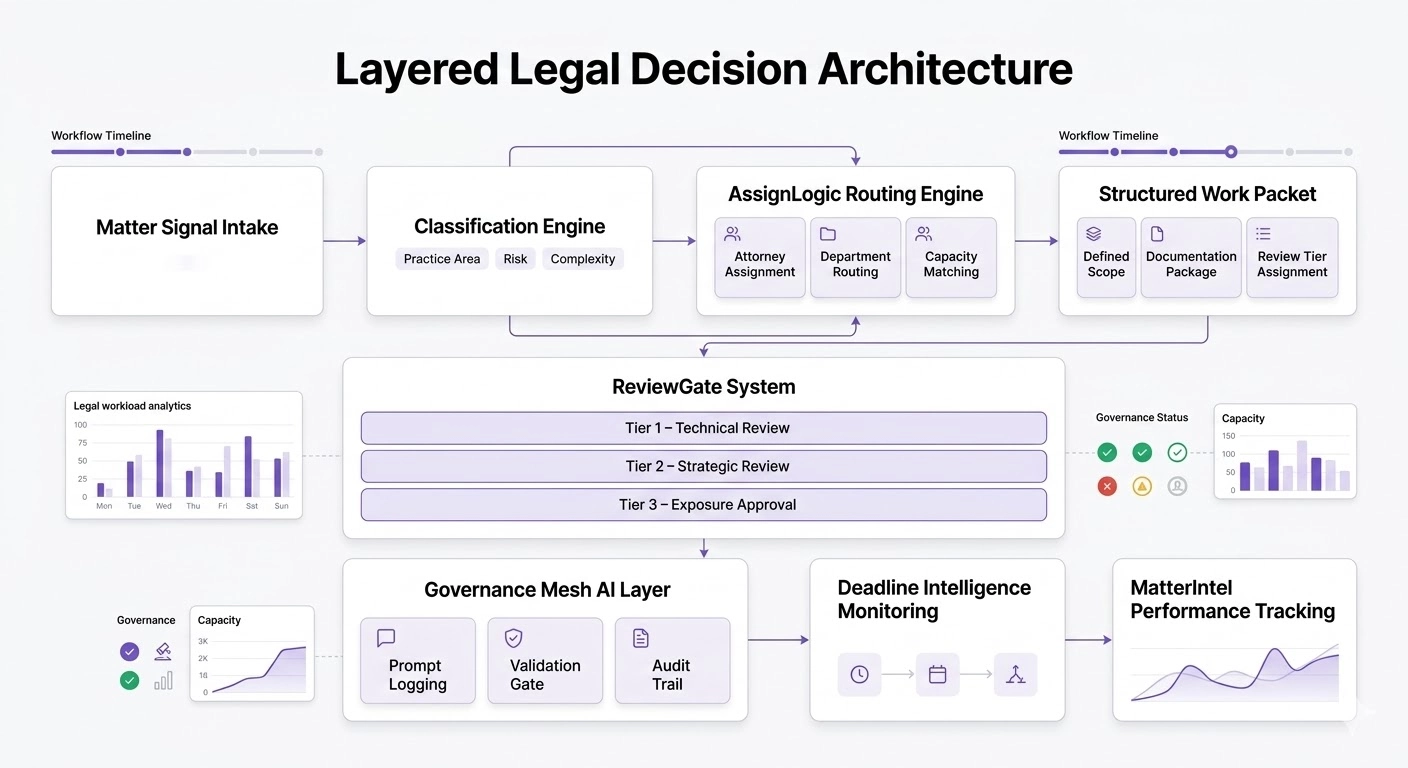
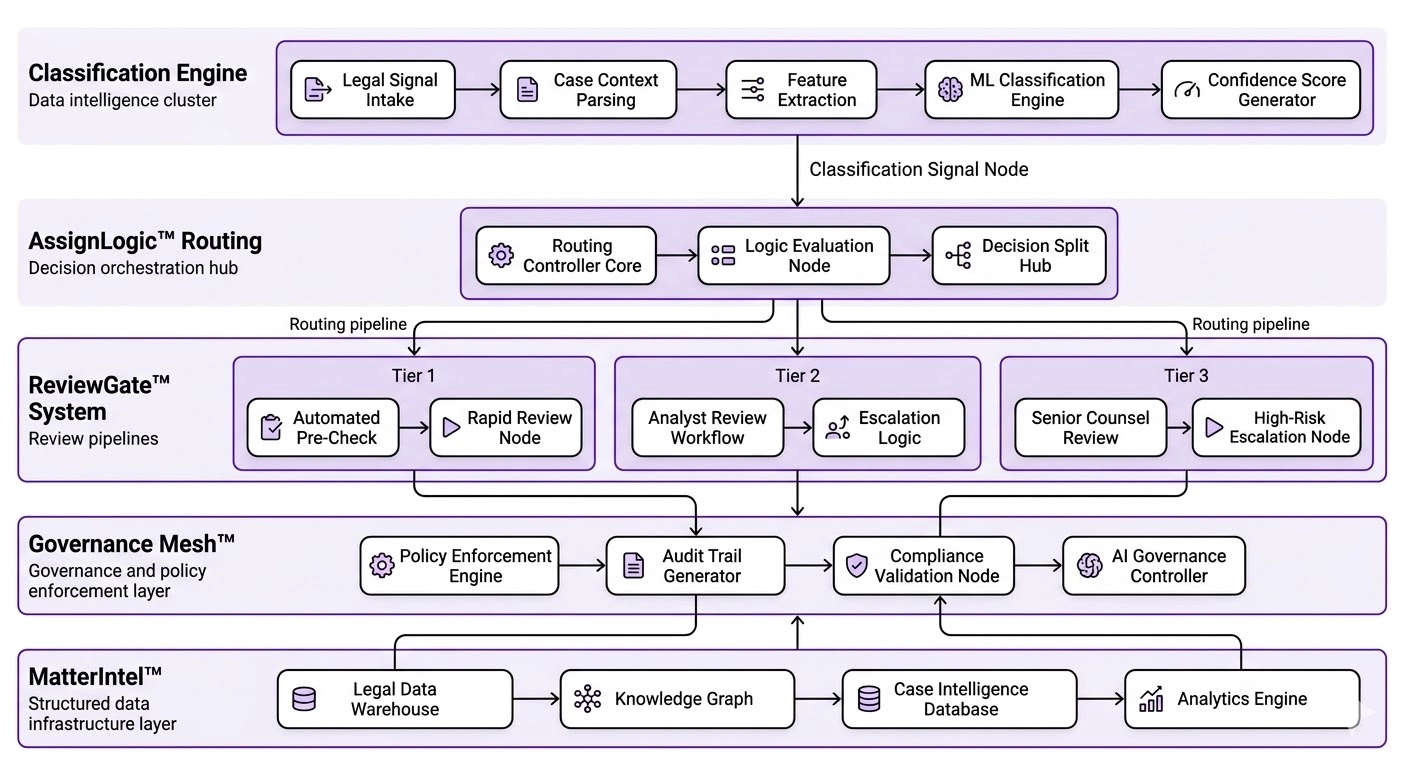
To eliminate execution drag, we deployed the Quanzar Legal Execution Architecture™, a structured operational model powered by our Intelligent Execution Engine and proprietary workflow technologies.
This architecture shifted the firm away from reliance on individual attorney memory and manual coordination, replacing it with encoded logic, structured review tiers, and governed AI integration.
Core Structural Components
The transformation was driven by encoding five highly specific structural components into the firm's daily operations.
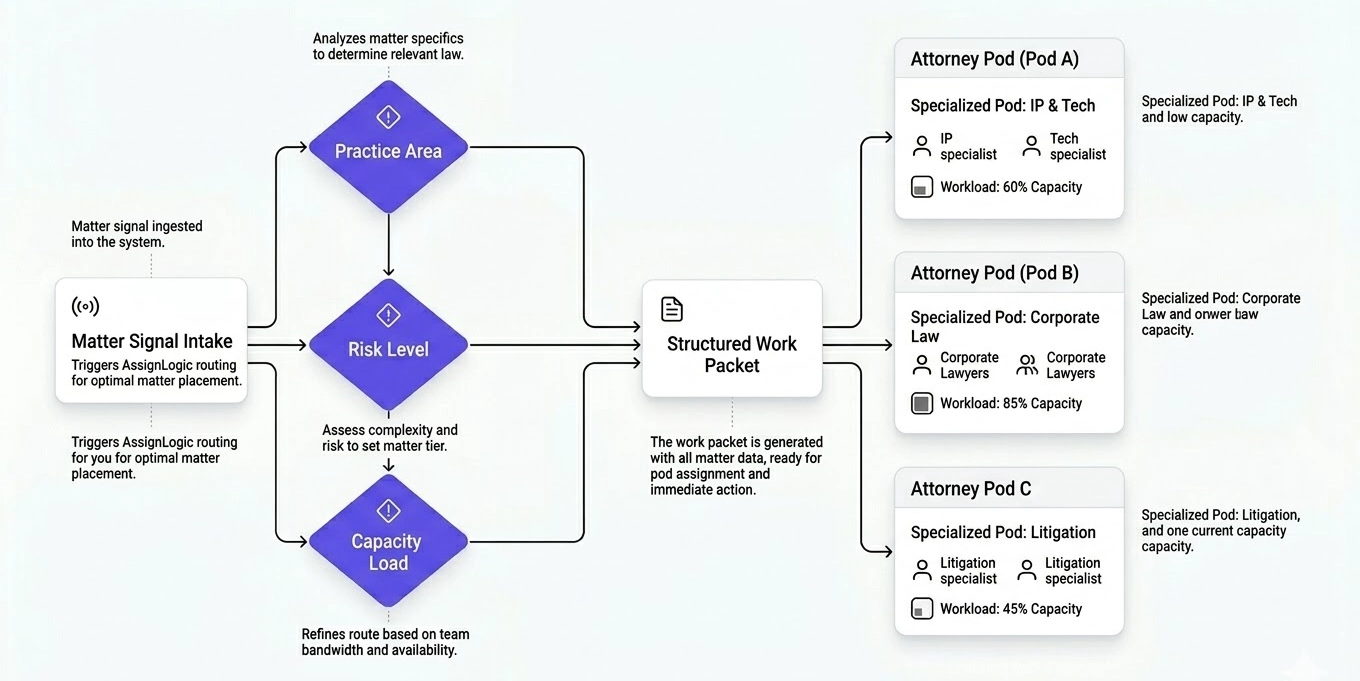
1. Assignment Logic Encoding (AssignLogic™)
Instead of partner-led email delegation, assignments were routed programmatically based on practice specialization, current capacity load, deadline proximity, and matter complexity. This immediately reduced reassignment delays and smoothed uneven workload distributions across the firm.
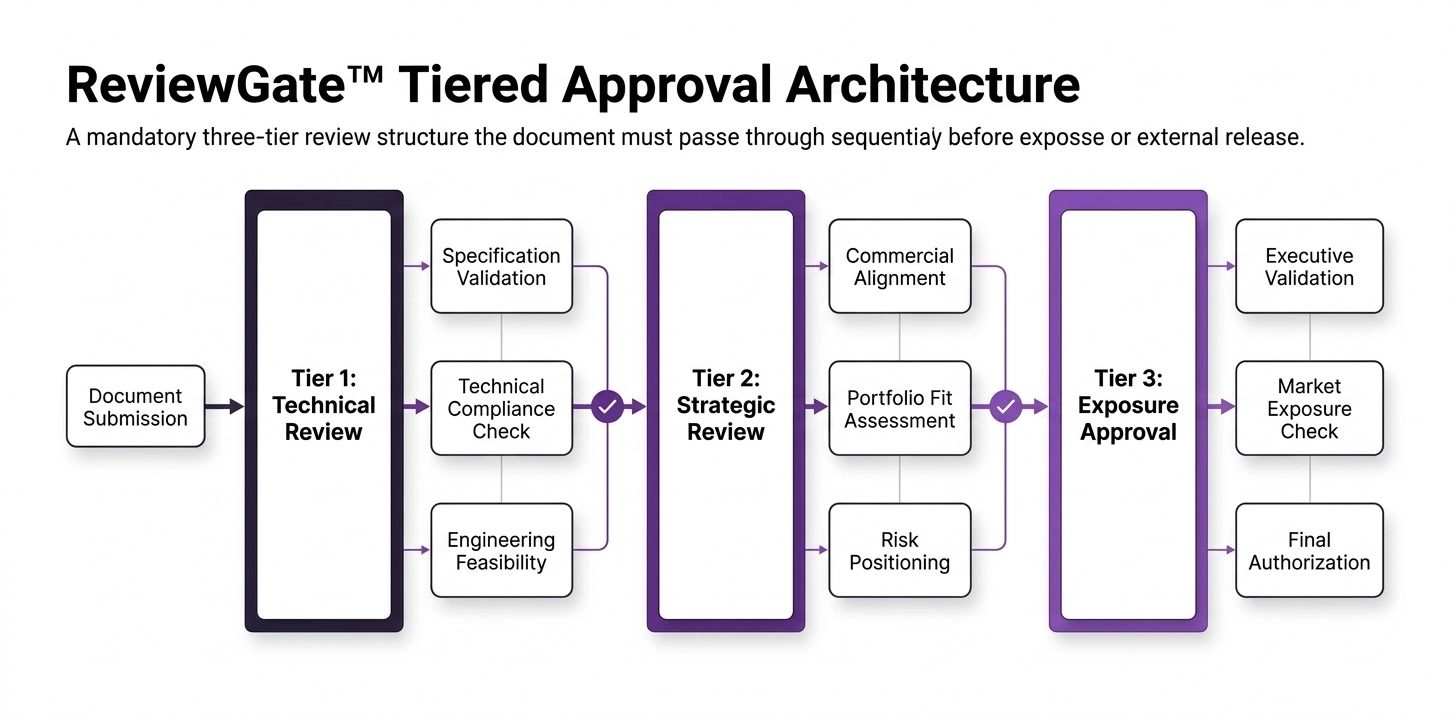
2. Tiered Review Discipline (ReviewGate™)
We eliminated the costly practice of multiple attorneys reviewing documents at full depth. We introduced Decision Acceleration Systems through a structured review framework consisting of Tier 1 (Technical validation), Tier 2 (Legal reasoning & structure), and Tier 3 (Risk exposure & strategic approval). Review scope became strictly defined, eliminating redundant deep reviews.
3. AI Governance Integration (Governance Mesh™)
To safely capitalize on generative technology, AI usage was embedded directly into the workflow via a Digital Governance OS. This introduced mandatory prompt logging, restricted document categories, human validation gates, and strict version control enforcement. AI shifted from an uncontrolled variable into a structured accelerator.
4. Deadline Signal Architecture (Deadline Intelligence™)
Manual tracking was replaced with active signals. We engineered escalation timers, review completion triggers, filing window monitoring, and automated risk alerts, completely removing memory-based operational dependencies.
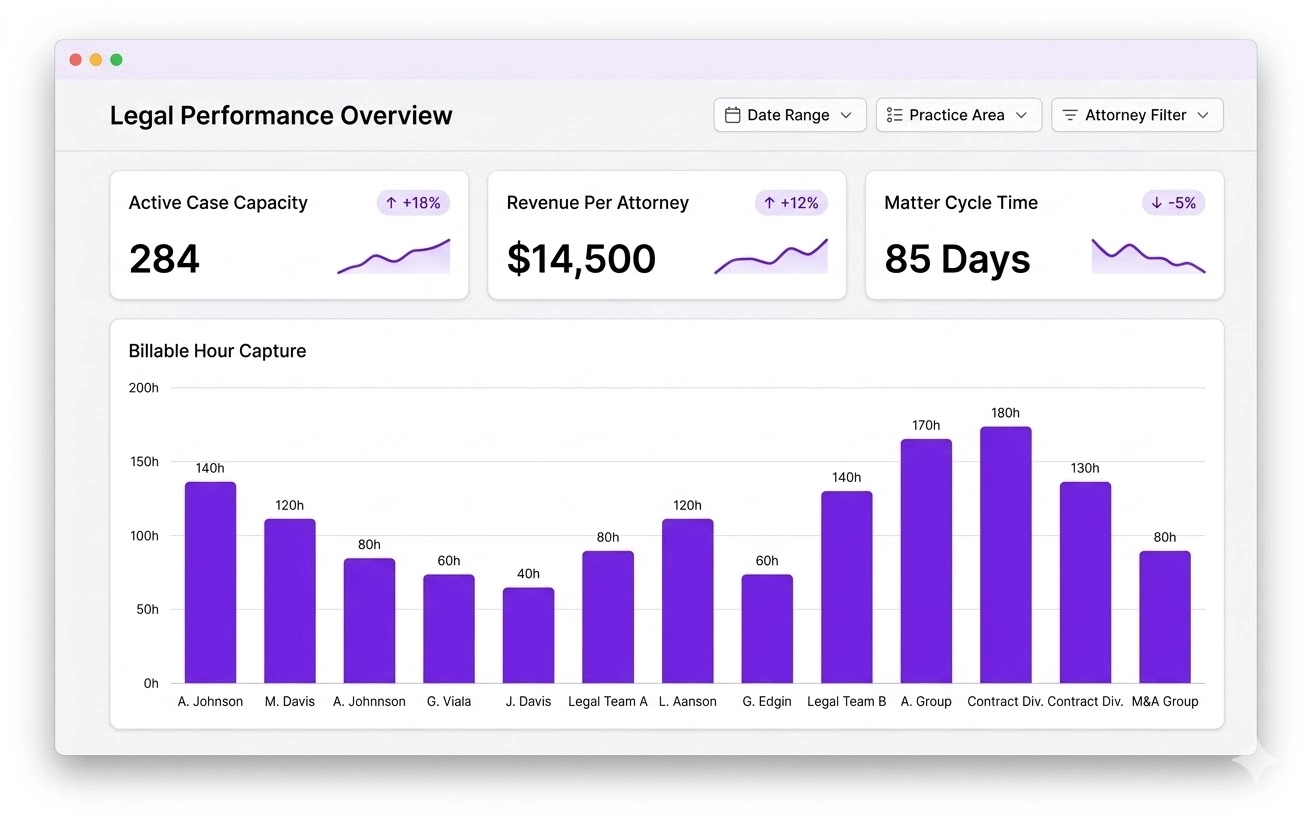
5. Matter Performance Visibility (MatterIntel™)
Operational visibility was elevated to track review cycle durations, revision loop frequencies, assignment-to-feedback latency, and billable hour leakage. This real-time insight drastically improved the firm's revenue predictability.
Operational Implementation
Structuring a complex multi-department firm required precise execution to maintain active caseloads during the transition.
| Implementation Phase | Focus Area | Outcome Delivered |
|---|---|---|
| Phase 1: Diagnostics | Mapping legacy review cycles and capacity bottlenecks | Identified redundant review waste per practice area |
| Phase 2: Logic Encoding | Deploying AssignLogic™ and defining ReviewGate™ tiers | Elimination of email-based task delegation |
| Phase 3: AI & Security | Implementing Governance Mesh™ across all departments | Secure by Design AI usage with mandatory validation |
| Phase 4: Visibility | Activating MatterIntel™ and Deadline Intelligence™ | Real-time tracking of cycle times and billable capture |
Performance Measurement
Following a 6–9 month stabilization period, the firm measured substantial improvements across both operational efficiency and financial performance.
| Operational Efficiency Metric | Measured Impact |
|---|---|
| Redundant Review Cycles | Reduced by 22% through ReviewGate™ scoping |
| Assignment Re-routing Delays | Reduced by 35% via capacity-based AssignLogic™ |
| Internal Clarification Time | Reduced by 25% due to structured work packets |
| Deadline Near-Miss Incidents | Reduced by 40% through active signal architecture |
| Matter Cycle Time | Improved by 15–20% firm-wide |
Measured Outcomes
By restructuring the architecture of execution, the firm increased capacity without expanding headcount. Revenue growth was entirely operationally engineered—driven by faster case intake, reduced internal friction, recovered billable time, and increased case throughput, rather than increased marketing spend.
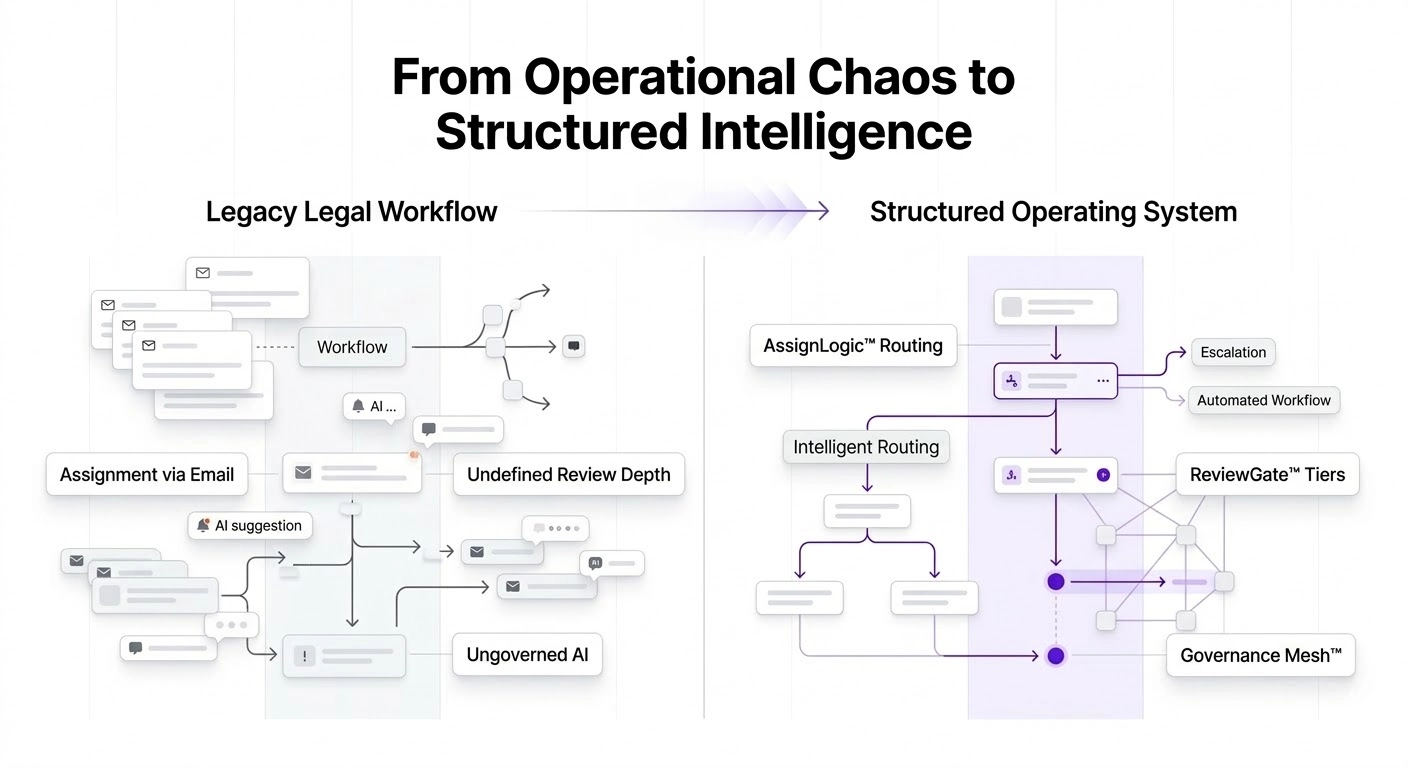
| Operational Vector | Legacy State | Structured State |
|---|---|---|
| Task Assignment | Assignment via email and partner memory | AssignLogic™ capacity-based routing |
| Document Validation | Undefined review depth (repeated deep reads) | ReviewGate™ tiered scoping |
| Technology Usage | AI used independently and ungoverned | Governance Mesh™ integrated control layer |
| Time Management | Deadlines manually tracked | Deadline Intelligence™ active signals |
| Financial Insight | Revenue visibility delayed to late billing | MatterIntel™ real-time performance tracking |
Strategic Insights
Operational intelligence is no longer optional; it is foundational to modern law firms. This restructuring yielded several critical truths for SmartOps™ in the legal sector.
1. Review Waste Erodes Margin
Redundant, unstructured document reviews are not a quality control mechanism; they are a topological flaw that actively drains billable realization.
2. Confusion Caps Capacity
Assignment confusion and email delegation create internal friction that directly limits how many new matters the firm can safely intake.
3. AI Requires Governance
Deploying AI without an encoded workflow governance layer increases risk and fragments institutional knowledge rather than accelerating it.
4. Escalation Dictates Revenue
Manual escalation and memory-based deadline tracking slow down matter resolution, delaying revenue realization and cash flow.
5. Revenue Can Be Engineered
Revenue lift does not always require higher top-of-funnel marketing spend; it can be unlocked by structurally recovering lost billable time.
6. Structure Amplifies Talent
Structured decision gates and clear assignment logic convert raw legal talent into predictable, measurable operational performance.
Where This Applies
The Quanzar Legal Execution Architecture™ is designed to resolve execution drag in environments where precision and complex workflows intersect. It is highly applicable for:
- Multi-department corporate law firms facing capacity limits
- Litigation practices struggling with redundant document review waste
- In-house corporate legal teams managing high-volume compliance tasks
- Regulatory practices needing strict audit trails for AI-assisted drafting
Unlock Your Firm's Hidden Capacity
Is unstructured review and assignment confusion capping your revenue potential?
Book a Diagnostic Calculate Operational Waste Explore SmartOps™