
From Silos to AI-Orchestrated Execution: Deploying Neural OS™
Executive Context
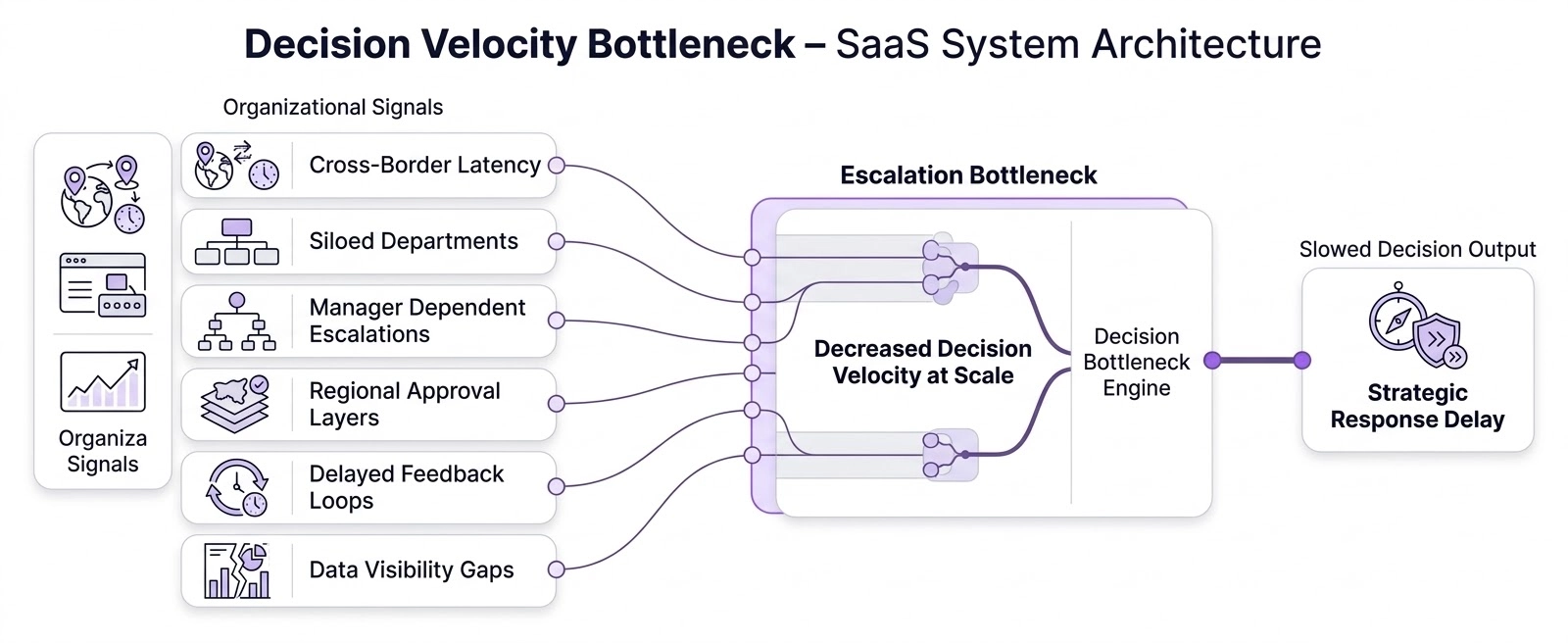
As enterprise organizations expand globally, operational scale often masks underlying architectural inefficiencies. A multinational organization operating across 24 countries approached Quanzar Technologies™ facing a critical inflection point: as their scale increased, their decision velocity decreased. The enterprise was trapped in a highly fragmented operational topology.
Departments were operating entirely independently. Core workflows—from lead intake to invoicing and logistics—were entirely dependent on email-based handoffs and manual supervision. Cross-border latency was severe, with escalations heavily reliant on the availability of regional managers. The organization lacked a unified execution logic, resulting in siloed data, delayed operational response times, and fragmented customer experiences.
To resolve this execution drag, the solution was not to restructure the organizational chart or hire additional regional supervisors. The solution was to structurally redesign how operational logic was routed across the globe.
Initial Operational Topology
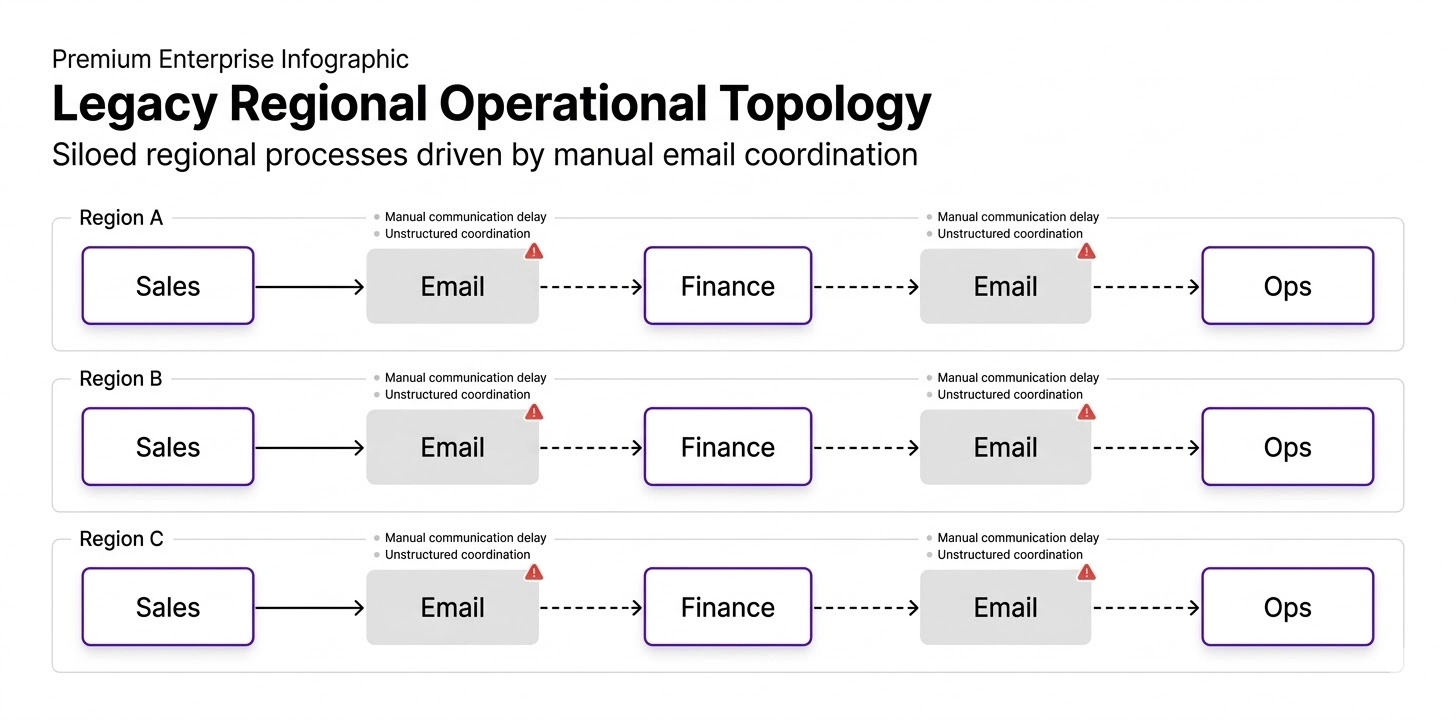
Our initial diagnostic mapped the legacy execution framework, immediately identifying the structural constraints preventing seamless global operations.
| Regional Pipeline | Legacy Execution State | Observed Constraint |
|---|---|---|
| Region A (Americas) | Sales → Email → Finance → Email → Ops | Departmental silos blocking unified execution |
| Region B (EMEA) | Sales → Email → Finance → Email → Ops | Manager-dependent escalations delaying approvals |
| Region C (APAC) | Sales → Email → Finance → Email → Ops | Cross-border latency disrupting follow-through |
The Transformation Strategy
We engineered and deployed the Quanzar Neural OS™, a proprietary architecture designed to eliminate departmental borders. Instead of attempting to restructure teams, we restructured the fundamental execution logic itself the same layered, read-only, no-rip-and-replace approach behind how Quanzar connects to a client's existing systems today (see How It Works).
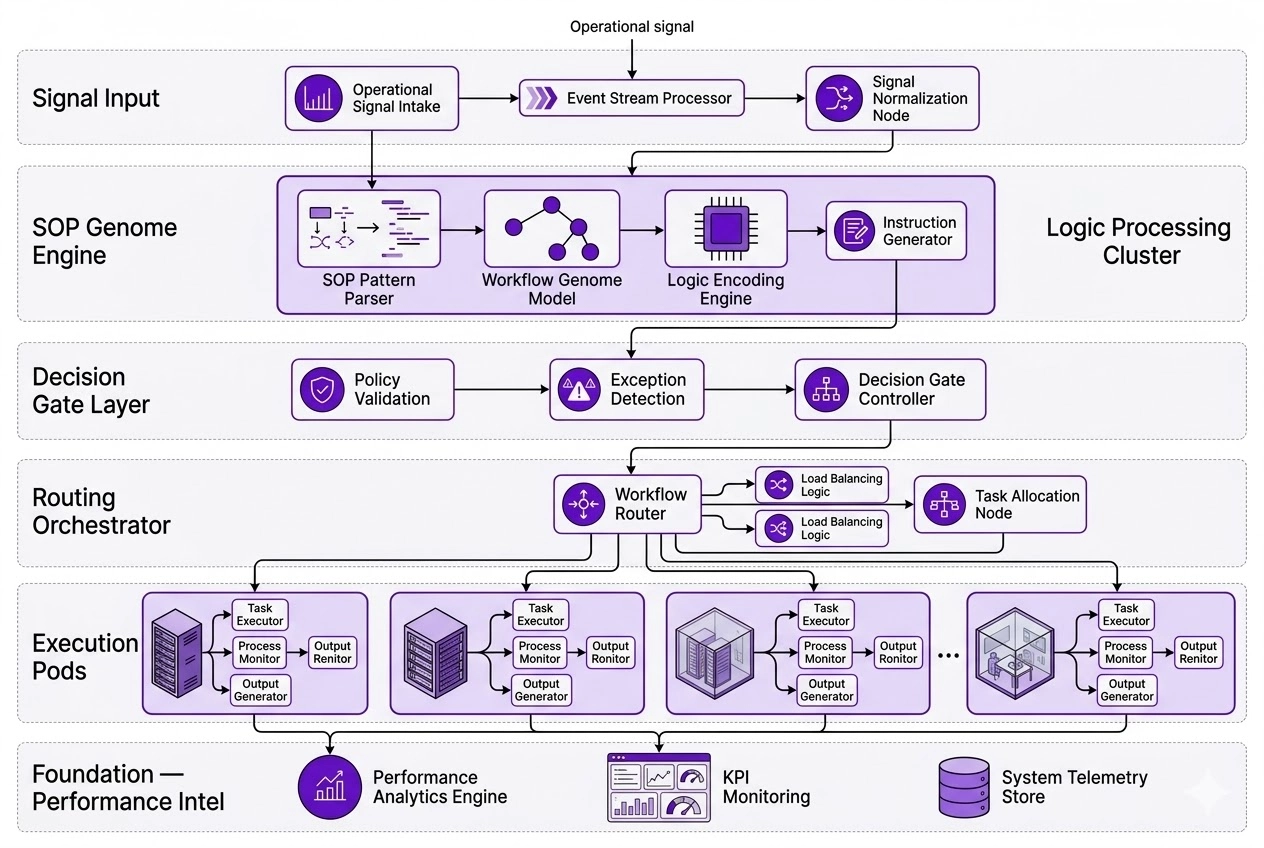
By routing signals through structured decision layers, the architecture bypassed manual human handoffs, enabling real-time, global execution.
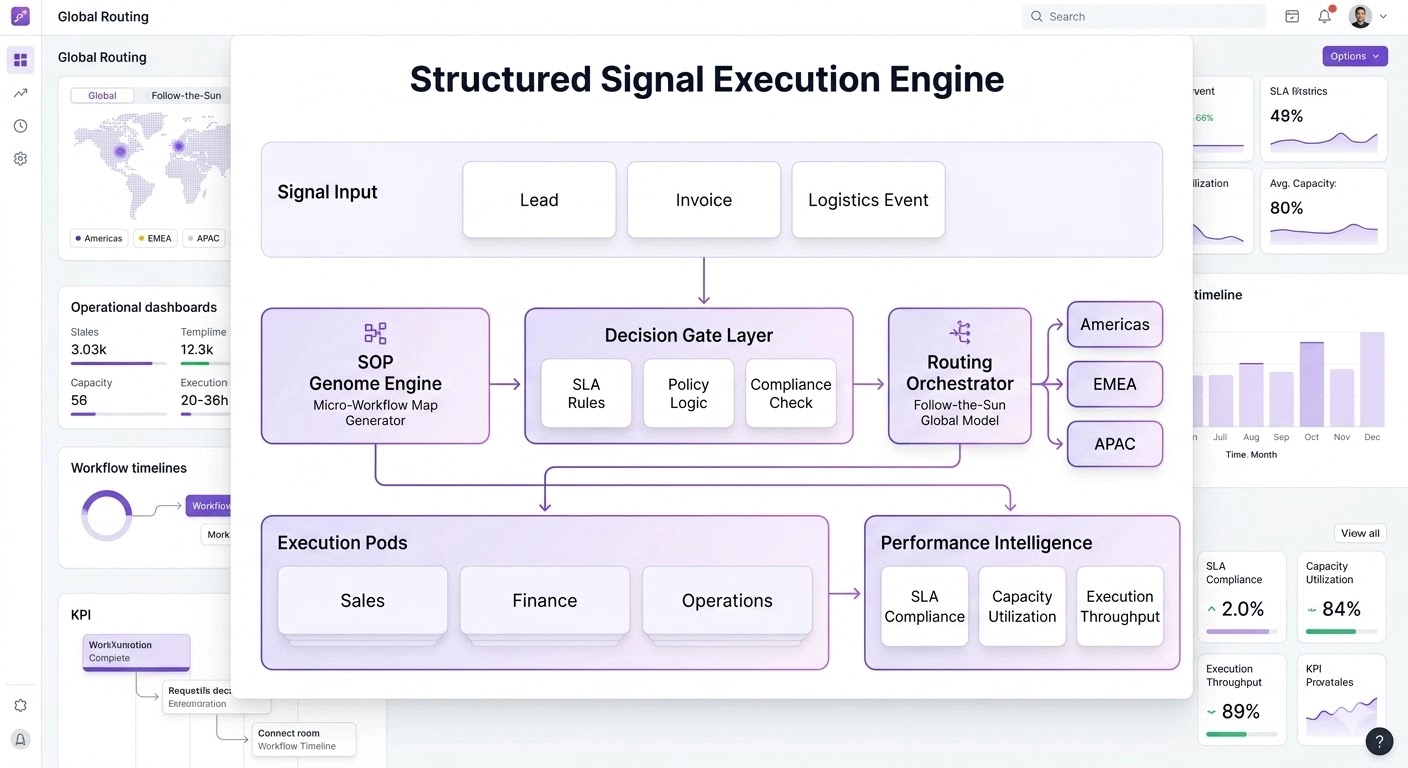
Core Structural Components
The global Neural OS™ was brought online through five specific architectural components.
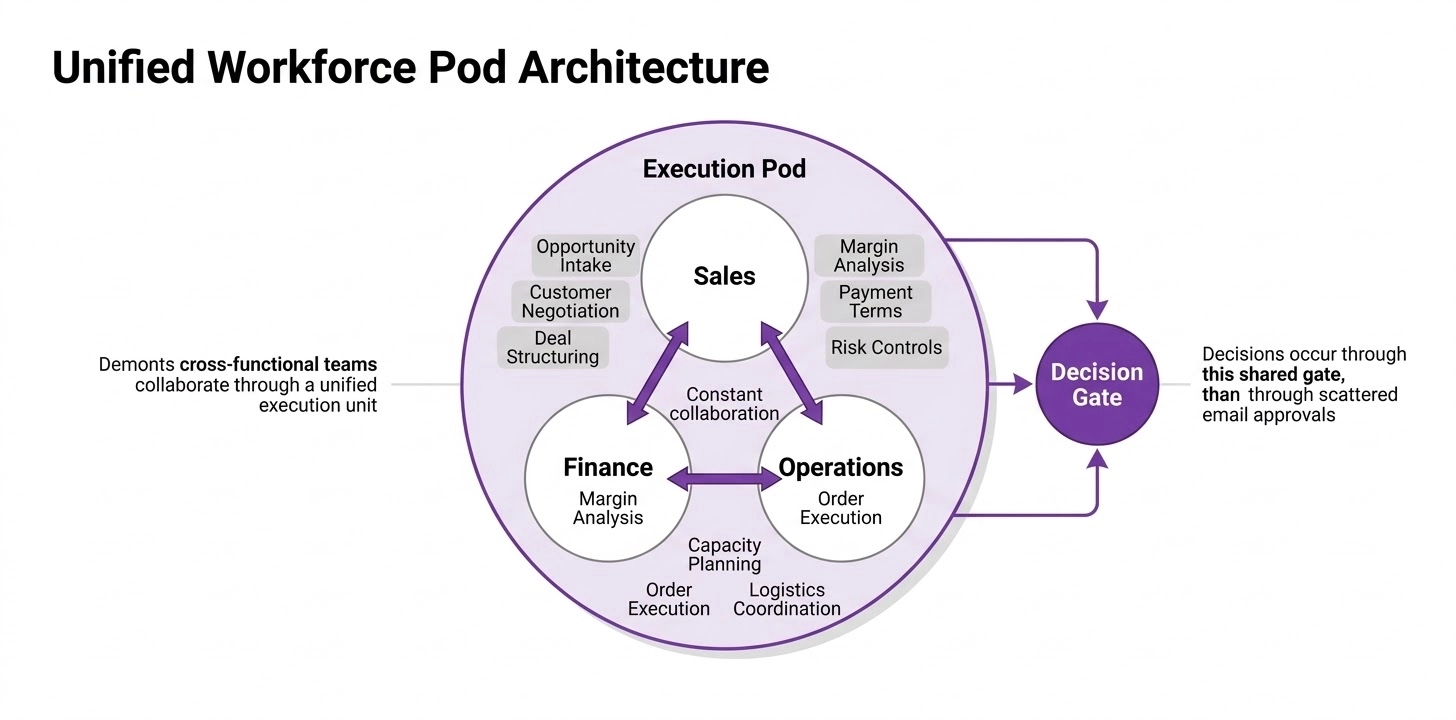
1. Workforce Pod Architecture
Departments were structurally reorganized into execution pods. Instead of siloed handoffs, Sales, Finance, and Operations teams shared joint ownership of the pipeline. This physical and digital proximity immediately reduced inter-department handoffs and created unified accountability.
2. Encoded Micro-Workflows (SOP Genome™)
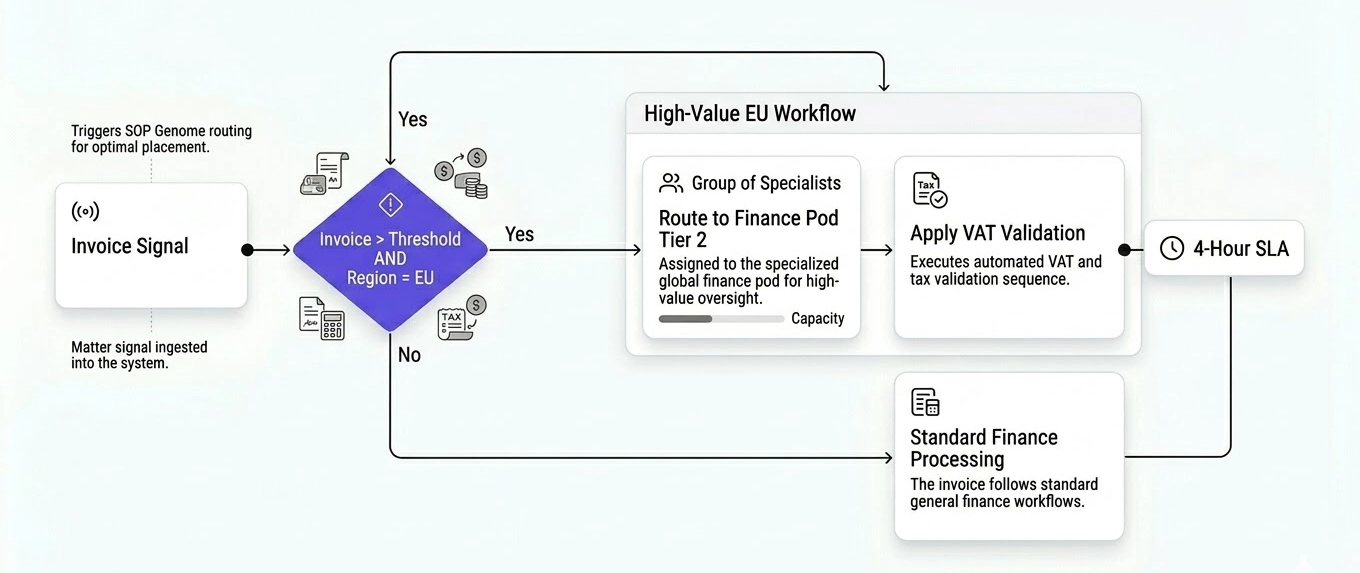
Static, unread SOP documents were completely eliminated. They were converted into structured micro-workflows using the same workflow-automation logic behind Quanzar's AI Ops Layer. This encoded logic entirely replaced manual routing decisions.
3. Unified Decision Gate Layer
Rather than relying on regional managers to approve or reject work packets, rules were hard-coded into centralized gates. Approvals for pricing, logistics, and legal validation were processed against encoded enterprise policy before ever reaching human supervision.
4. Follow-the-Sun Orchestration Engine
The same dynamic task-routing logic behind Quanzar's AI Ops Layer removed region-dependence from execution continuity. Routing parameters dynamically sent tasks to the right pods based on resource availability, skill alignment, real-time zone coverage, and SLA priority.
5. Performance Intelligence Layer
Manual supervision was replaced by an autonomous metrics layer. The system independently tracked decision cycle times, routing accuracy, escalation frequencies, and capacity utilization. Performance became a quantifiable, structurally managed asset.
Operational Implementation
A global restructuring requires phased execution to ensure 24/7 operations are not disrupted.
| Implementation Phase | Focus Area | Outcome Delivered |
|---|---|---|
| Phase 1: Genome Mapping | Translating static SOPs into encoded micro-workflows | Digitized operational rules for 24 regions |
| Phase 2: Pod Formation | Breaking silos to create joint Sales/Finance/Ops pods | Elimination of inter-departmental email handoffs |
| Phase 3: Orchestration | Deploying the Follow-the-Sun routing engine | Activation of 24/7 borderless execution |
| Phase 4: Intelligence | Activating real-time capacity and cycle-time metrics | Transitioned supervision from manual to automated |
Performance Measurement
At Quanzar, we measure success strictly through verifiable structural improvements. Following deployment, the organization experienced transformative gains in measurable revenue and operational output the same category of metric Quanzar's Revenue Leak Tracker is built to surface at the customer level today.
| Operational Metric | Measured Impact |
|---|---|
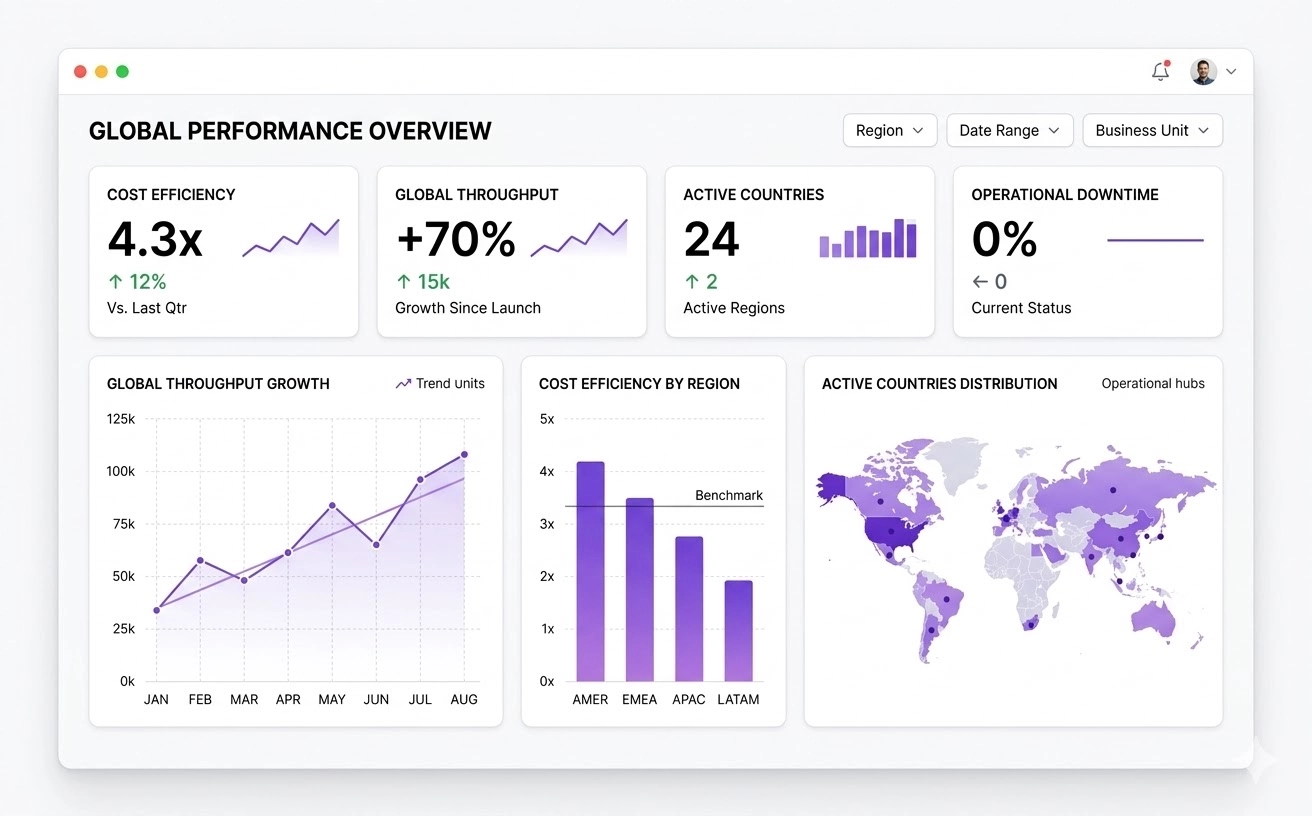
| Cost Efficiency | 4.3x improvement across all global divisions |
| Execution Throughput | +70% increase in processed operational volume |
| Market Coverage | 24 countries unified under a single orchestration model |
| Operational Downtime | Eliminated completely via Follow-the-Sun routing |
Measured Outcomes
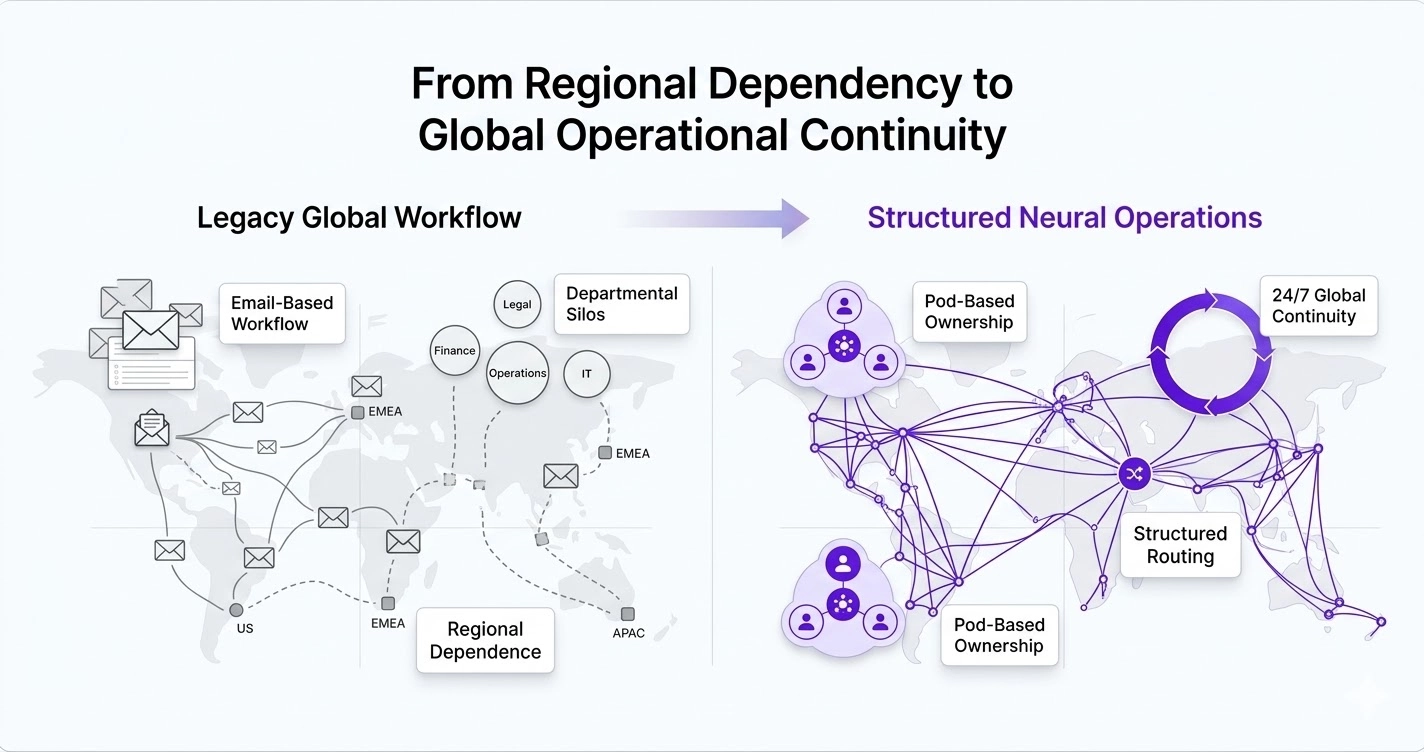
Scale alone did not solve the enterprise's inefficiency. Structured execution did. By deploying Neural OS™, the organization shifted from a fragmented, region-dependent business into a continuously operating global machine.
| Operational Vector | Legacy State | Neural OS™ State |
|---|---|---|
| Workflow Mechanism | Email-based manual routing | Structured system routing |
| Escalation Path | Manager-driven supervision | SLA-triggered automated escalation |
| Accountability | Fragmented departmental ownership | Unified pod-based ownership |
| Global Coverage | Strictly region-dependent availability | 24/7 Follow-the-Sun continuity |
| Management Style | Manual human supervision | Logic-encoded intelligence |
Strategic Insights
This deployment yielded critical insights for enterprises seeking to apply this same execution-layer discipline across complex global footprints.
1. Speed is Architectural
You cannot demand faster execution from a topology that requires manual email handoffs between discrete departments.
2. Structure Over Scale
Adding more personnel to a broken process simply scales the inefficiency. Throughput increases only when handoffs are structurally reduced.
3. Gates Beat Supervision
Encoding policies into mandatory decision gates is infinitely more reliable and scalable than relying on managers to enforce rules manually.
4. SOPs Must Be Executable
Static standard operating procedures are ignored. They must be mapped into micro-workflows that the system enforces dynamically.
5. Borders Are Friction
Cross-border orchestration requires automated routing logic. If execution halts when a specific time zone logs off, your operations are vulnerable.
6. Intelligence is Measurable
Operational visibility is impossible if work lives in inboxes. A centralized architecture turns performance into a transparent, measurable asset.
Where This Applies
The Quanzar Neural OS™ is purpose-built for enterprise environments suffering from scale-induced operational drag. It is highly applicable for:
- Multinational corporations experiencing cross-border latency
- Global logistics and supply chain networks
- BPO and shared service centers requiring 24/7 continuity
- Enterprise sales and finance operations reliant on complex manual approvals
Architect Your Enterprise Execution
Is your global scale creating operational drag instead of competitive advantage?
Run Free Margin Audit Book a Diagnostic Call Explore AI Ops Layer