
Golden Record Identity Architecture:
Why Component Identity Is the Hidden Root Cause of Supply Chain Failure
In regulated industrial supply chains, the same physical component routinely exists under six or more conflicting identities across disconnected systems. This is not a data cleanliness problem. It is an execution topology failure and it drives duplicate inventory, counterfeit exposure, compliance breakdown, RFQ latency, and margin erosion simultaneously. This whitepaper defines the five-layer Golden Record Identity Architecture required to eliminate it permanently.
In regulated industrial markets spanning aerospace and defense supply chains, semiconductor distribution, medical device manufacturing, and complex electronics production the same physical component routinely exists under multiple, conflicting identities simultaneously. A single microchip might be cataloged by its OEM manufacturer part number, a distributor reference code, an internal ERP stock-keeping unit, a legacy EDI system alias, an AS6081 compliance certification identifier, a regional market naming variation, and a customer-specified cross-reference number. That is seven identities for one physical object, maintained across seven disconnected systems, with no single governed layer resolving the conflicts between them. The operational consequences are direct, compound, and financially significant: duplicate inventory accumulates because the ERP cannot reconcile identities across systems; alternates are misidentified, halting production; compliance documentation cannot be traced to the physical lot; sales teams lose RFQ cycles because cross-reference response takes days rather than seconds; and counterfeit exposure rises because identity ambiguity creates the exact conditions fraudulent components exploit. Gartner documents the average annual cost of poor data quality at $12.9 million per organization. MIT Sloan research suggests organizations lose 15–25 percent of revenue to poor data quality across the enterprise. This whitepaper defines Golden Record Identity Architecture (GRIA) the five-layer structural framework that converts component identity from a source of operational chaos into a governed execution asset.
1. The Fragmented Identity Problem Defined
Data fragmentation in industrial supply chains is consistently misdiagnosed as a data quality problem a deficiency of the systems storing the data or the people entering it. In reality, it is an identity governance failure: the absence of any structural layer that maintains a single, authoritative, confidence-scored, compliance-attributed identity for each physical component across every system in the organization's operational stack. The symptom is data inconsistency. The root cause is an absent identity architecture.
The practical reality of this failure is visible in the operational data of virtually every mid-to-large semiconductor distributor, aerospace supplier, and electronics manufacturer operating today. A single capacitor a commodity component present in virtually every electronic assembly can simultaneously appear as five or more distinct alphanumeric strings across the systems that collectively govern the organization's commercial and operational functions.
Each of these representations refers to the same physical component. Each is used by a different system, maintained by a different team, and updated on a different schedule. When a production order is raised against the ERP stock code, the warehouse team must manually verify that it corresponds to the correct compliance-validated part. When a customer submits an RFQ using their cross-reference number, the sales team must manually cross-match it to the internal SKU, verify the current distributor pricing, confirm the RoHS status, and check alternate availability a process that takes hours in a well-run organization and days in a fragmented one.
Golden Record Identity Architecture is not a database strategy. It is an execution topology discipline. The question is not whether you can store the data you already have it stored in six places. The question is whether you can govern it.
2. The Financial Anatomy of Identity Chaos
The financial cost of component identity fragmentation is distributed across five operational vectors simultaneously. This distribution is one of the reasons it is so consistently underestimated: no single cost center accumulates a large enough figure to trigger executive attention, while the aggregate across vectors is often material relative to the organization's total gross margin.
Duplicate Inventory Accumulation
When the ERP cannot reconcile a distributor part number with an internal SKU, the procurement system treats them as different components and orders both. In electronics distribution, duplicate inventory across unreconciled identities is documented at 10–20% of total stock value. McKinsey's 2024 analysis of AI-driven inventory management found 20–30% inventory reduction is achievable when underlying master data is clean conversely, dirty master data locks that reduction as permanent waste.
RFQ Processing Latency
Manual cross-referencing between customer BOM part numbers and internal identifiers is the primary source of RFQ response latency in electronics distribution. Where the industry benchmark for competitive RFQ response is under 4 hours, fragmented identity environments routinely produce 24–72 hour response times. Lost RFQ cycles translate directly into lost revenue and in semiconductor distribution, where spot market windows close in hours, latency is a structural competitive disadvantage that compounds with every missed cycle.
Compliance Documentation Mismatch
When compliance records (RoHS certificates, AS6081 traceability documentation, REACH declarations) are stored in a QMS system that does not share a unified identity with the ERP or warehouse management system, lot-level traceability becomes a manual reconstruction exercise at audit time. For organizations operating under AS9100D (aerospace), ISO 13485 (medical devices), or ITAR/EAR export control frameworks, this manual reconstruction is both legally inadequate and operationally expensive. Gartner documents 86% fewer emergency air-freights at organizations with supplier portals integrated with clean master data a proxy for the systemic cost of compliance data fragmentation.
Counterfeit Exposure
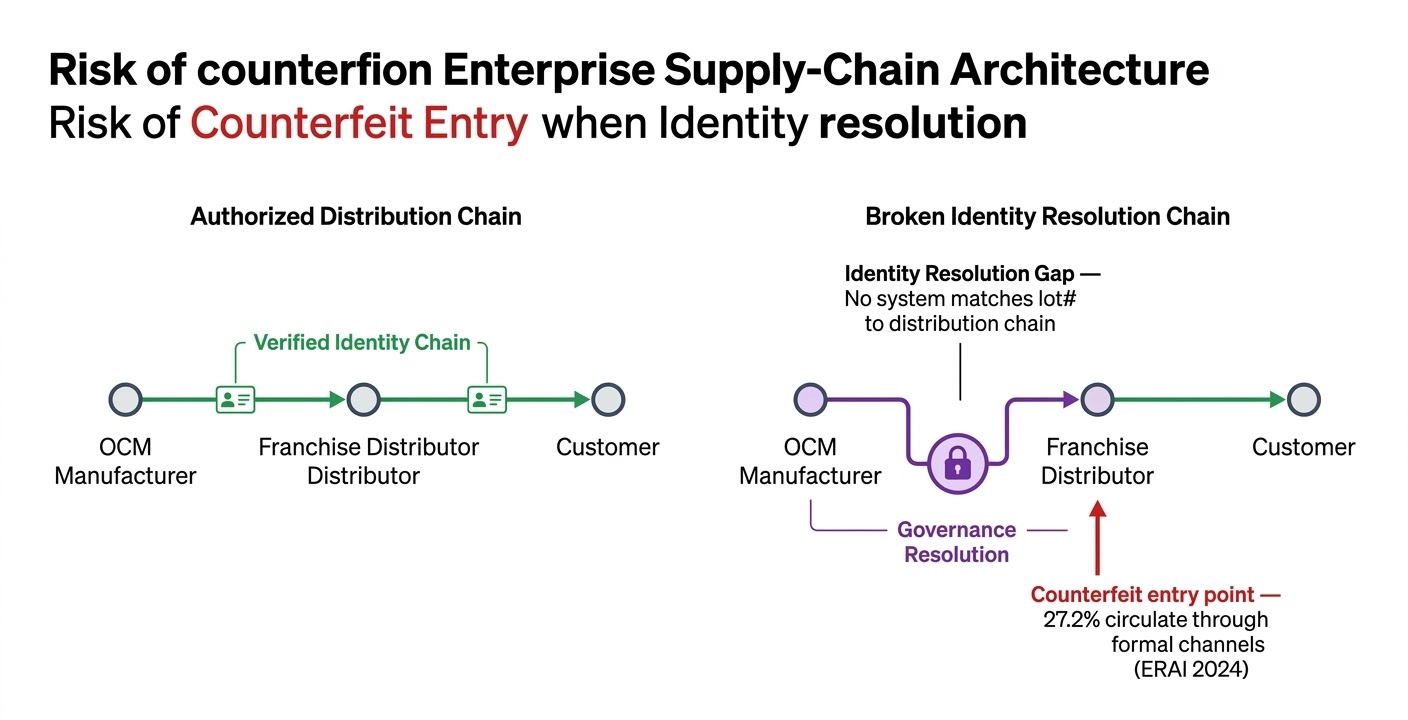
Identity ambiguity is the primary structural condition that enables counterfeit electronic components to enter regulated supply chains. When an organization cannot definitively and automatically link an incoming lot to a specific authorized-distribution chain, lot qualification history, and compliance certification because those records exist in disconnected systems under different identifiers the counterfeit detection window collapses. ERAI's 2024 Counterfeit Components Report documented 1,055 suspected cases a 25% year-over-year increase and decade high with 27.2% of counterfeit goods circulating through formally authorized distribution channels. The SIA estimates counterfeit components cost U.S. firms $7.5 billion annually.
AI Initiative Failure
Deloitte's 2025 Manufacturing Trends Survey found 70% of manufacturers identify data quality, contextualization, and validation as the biggest obstacles to AI implementation. McKinsey found predictive maintenance programs with upfront data governance deliver 1.8× more ROI than those that skip it. Gartner projects that through 2026, organizations will abandon 60% of AI projects due to insufficient data quality. Every AI investment the organization makes demand forecasting, alternate sourcing intelligence, predictive maintenance is building on a foundation that fragmented component identity makes structurally unsound.
Each of the five cost vectors operates independently and simultaneously. Organizations typically address them one at a time as individual operational problems, never identifying the shared structural root cause: the absence of a governed identity layer. The aggregate financial exposure across all five vectors exceeds most organizations' annual IT investment in supply chain tooling.
3. Why Traditional Master Data Management Fails Regulated Supply Chains
Most organizations have attempted to address component identity fragmentation through some variant of traditional Master Data Management (MDM). They have built master data tables in the ERP, created alias fields that map distributor part numbers to internal codes, maintained shared Excel cross-reference files, and periodically commissioned data cleansing projects that normalize the most critical records. These approaches consistently fail to solve the problem at scale and in regulated supply chain environments, they fail in ways that are not merely operationally inconvenient but structurally dangerous.
The failures of traditional MDM are structural, not executional. They do not fail because the people managing them are incompetent. They fail because they share four architectural deficiencies that make them incapable of governing dynamic, multi-system, compliance-critical component identity.
Traditional MDM: What It Does
Maintains a master record table with primary identifiers and alias fields. Provides a reference for manual lookup. Requires periodic cleansing projects to remove duplicates. Stores compliance documents in an adjacent system. Relies on human operators to consult the master table before making operational decisions. Produces reports on data quality at periodic intervals.
Traditional MDM: What It Cannot Do
It cannot dynamically score the confidence of an AI-proposed alternate match and route low-confidence proposals to a human validation gate automatically. It cannot enforce that a production release in the MES cannot proceed if the QMS compliance record for the lot is unresolved. It cannot trigger a counterfeit risk flag when a new supplier lot cannot be traced to an authorized distribution chain. It cannot maintain a tamper-proof, version-locked change history for every identity modification.
The critical distinction is between a static reference architecture and a dynamic governance architecture. Traditional MDM is the former: a table that can be consulted. Golden Record Identity Architecture is the latter: a governed execution layer that enforces identity decisions, routes ambiguity to the appropriate authority tier, maintains compliance linkages in real time, and generates an immutable audit trail for every identity event. This distinction is the reason that organizations with well-maintained ERP master data still suffer from duplicate inventory, compliance mismatches, and counterfeit exposure their MDM tells them what the identity should be, but it has no structural mechanism to enforce that identity across every system that touches the component.
IBM's 2025 Institute for Business Value report documents this precisely: 43% of Chief Operations Officers identify data quality as their most significant data priority. More than a quarter of organizations lose more than $5 million annually from poor data quality. Yet a 2024 study covering over 300 Global 2000 businesses found that fewer than 40% possess either the metrics or methodology to assess the impact of poor data quality on their operations. The problem is known. The structural remedy a governed identity architecture with enforcement properties remains undeplyed in the majority of organizations.
4. The Five Layers of Golden Record Identity Architecture
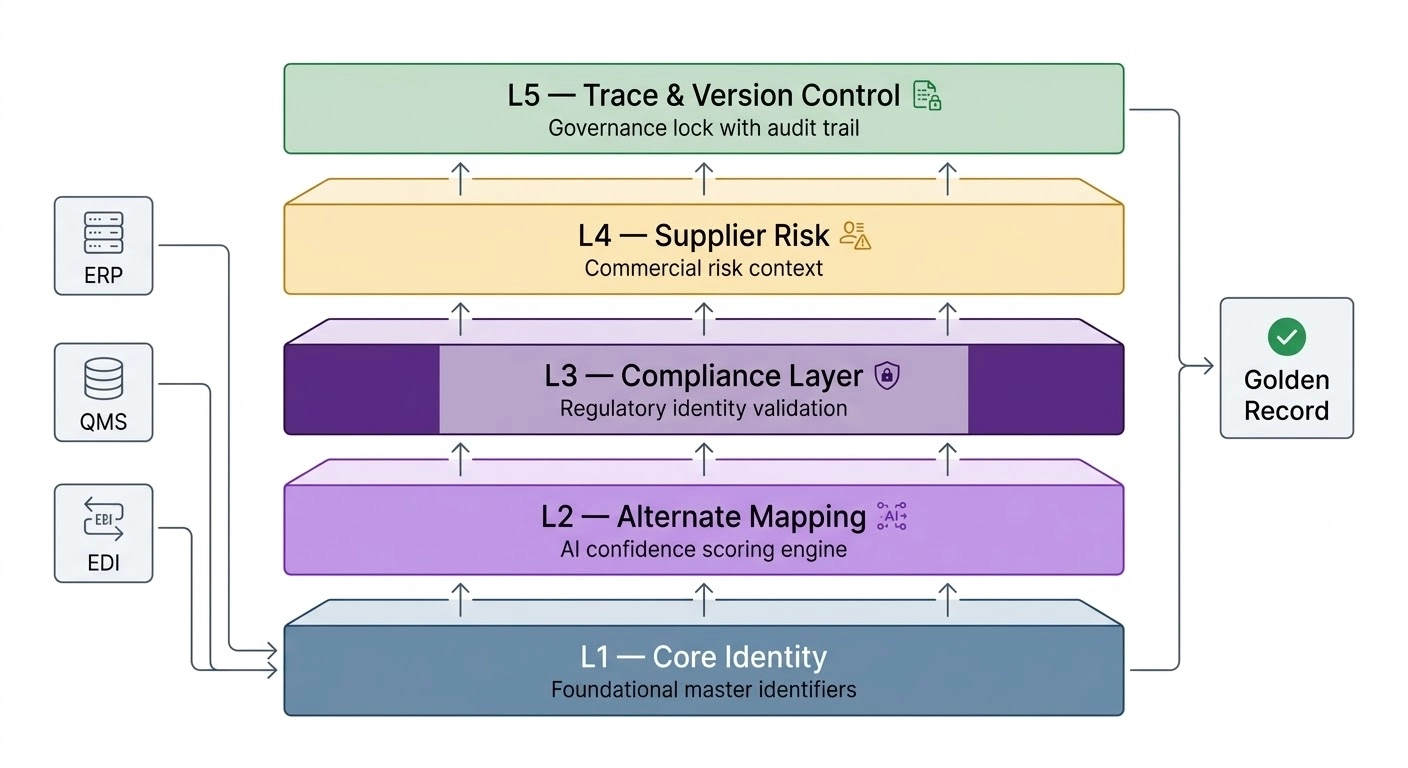
A Golden Record is a unified, confidence-scored, compliance-validated, supplier-risk-linked identity layer representing a single physical or logical component. It is not a database record. It is an active governance structure that maintains the authoritative identity of a component across all systems, enforces compliance linkages at the moment of operational use, and routes identity ambiguity to defined decision authorities automatically. It is built across five structural layers each with a distinct function, and each a prerequisite for the layers above it.
Identity
Layer 1 Core Identity: The Foundation Record
The Core Identity layer establishes the authoritative, immutable foundation of the Golden Record. It contains the Manufacturer Part Number (MPN) from the Original Component Manufacturer (OCM), the base technical description, component category and sub-category, and the strict set of electrical and mechanical attributes that define the component's form, fit, and function: package type, voltage rating, current rating, temperature range, dielectric classification, and dimensional tolerances. This layer is the only record that has authoritative status all other identity representations across all other systems are aliases that must be resolved to this layer. The Core Identity record cannot be modified without a version-locked change event that propagates to all dependent layers and all connected systems simultaneously.
Contains
- OEM Manufacturer PN
- Base technical description
- Package / case code
- Electrical attributes
- Mechanical tolerances
- Component category
Mapping
Layer 2 Alternate Mapping: The Equivalence Engine
The Alternate Mapping layer is where AI-assisted identity management provides its highest-value function. This layer maintains a structured, confidence-scored registry of all known equivalents, cross-references, and form-fit-function substitutes for the Core Identity component. Each mapping entry carries a match source (AI-generated, engineering-validated, manufacturer cross-reference, customer-specified), a validation method, an AI confidence score expressed as a precise percentage, and a human confirmation status. Critically, the layer enforces strict thresholds: no alternate mapping below the defined confidence floor can be automatically used in production routing without triggering a human validation gate. This prevents the AI-generated equivalence tables from operating as silent executors every low-confidence mapping requires a defined authority to confirm it before it can affect an operational decision.
Contains
- Confidence-scored alternates
- Form/fit/function register
- Customer cross-references
- Distributor aliases
- Match source attribution
- Validation status
Layer
Layer 3 Compliance: The Regulatory Shield
The Compliance layer encodes all regulatory, environmental, and certification attributes directly into the Golden Record not in a separate QMS system that requires manual cross-referencing at audit time. This includes RoHS status and exemption codes, REACH SVHC declarations, AS6081 traceability certification for aerospace and defense applications, ISO 9001 / AS9100 quality system linkages, ITAR / EAR export classification codes, and lot-level traceability chain documentation. The critical architectural requirement is enforcement: the Compliance layer must be structurally linked to downstream workflow execution. A production release that requires an AS6081-certified lot cannot proceed in the MES if the Compliance layer for the proposed lot carries an unresolved certification flag the system must block the release automatically, not generate a warning that can be acknowledged and bypassed.
Contains
- RoHS / REACH status
- AS6081 certification
- ISO / AS9100 linkage
- ITAR / EAR codes
- Lot traceability chain
- Audit-ready flags
Risk
Layer 4 Supplier Risk: The Commercial Context
The Supplier Risk layer links the Golden Record to the operational performance history of every supplier that has ever provided the component. This includes defect rate history by lot, return and credit note frequency, delivery reliability score, lead-time variance history, counterfeit incident reports from ERAI or equivalent databases, and dispute frequency with the organization. A component cannot be evaluated in isolation from its source the same MPN delivered by an authorized franchise distributor with zero counterfeit history carries a fundamentally different risk profile than the identical MPN offered by an independent distributor whose prior lots have generated ERAI reports. The Supplier Risk layer makes this distinction structurally enforced rather than left to individual buyer judgment. High supplier risk scores can trigger automatic procurement restrictions, alternate sourcing requirements, or enhanced incoming inspection requirements without human initiation.
Contains
- Defect rate by lot
- Return / credit history
- Delivery reliability
- ERAI counterfeit flags
- Lead-time variance
- Dispute frequency
Version
Layer 5 Trace & Version Control: The Governance Lock
The Trace and Version Control layer is the governance infrastructure that makes the Golden Record auditable, tamper-proof, and legally defensible. Every change to any field in any layer a new alternate mapping added, a compliance status updated, a supplier risk score revised, a confidence threshold modified generates an immutable change event: timestamped, attributed to a specific user identity with a defined authority level, linked to the triggering event or document, and permanently stored in a central ledger. This layer is governed through Quanzar's Secure by Design principles read-only system connections, role-based access control, and a full audit trail and cannot be modified by anyone without generating an auditable record of the modification. In regulated industries where a product recall or compliance investigation requires lot-level traceability extending years into the supply chain history, this layer is the difference between a 48-hour audit response and a 6-week manual reconstruction exercise.
Contains
- Immutable change log
- User & authority attribution
- Version history
- Validation source docs
- Timestamp registry
- Audit-ready ledger
5. AI and Identity Confidence Scoring: Structure Before Intelligence
AI matching models have a genuine and substantial capability in the context of component identity management: they can detect alternate part equivalence across large catalogs at high speed, identify naming synonyms across different manufacturer conventions, flag likely duplicate records, and propose cross-reference mappings that would take weeks of manual engineering review to produce. These are capabilities that have real operational value in organizations managing catalogs of hundreds of thousands of active component identities across multiple supplier ecosystems.
The structural failure that undermines this value is the conflation of AI capability with AI authority. An AI model that proposes an alternate part equivalence with 88 percent confidence has produced a valuable analytical output but it has not produced a governed operational decision. In a regulated supply chain environment, an alternate part substitution carries engineering, compliance, and commercial implications that require human authority to validate at defined confidence thresholds. The AI's role in the Golden Record architecture is to accelerate the proposal of identity mappings and to flag ambiguity not to resolve it unilaterally. It is the same confidence-and-routing discipline Quanzar applies to AI-suggested quote margins in its own Quote Intelligence Engine: the model proposes, a human authority confirms.
Identity Confidence Scoring Registry Active Mapping Events
Confidence threshold: ≥95% → Auto-approved and propagated. 85–94.9% → Engineering validation gate required. <85% → Blocked pending structured human review with compliance check. All events logged immutably.
{
  "golden_record_id": "GR-99482-AX",
  "ai_mapping_event": {
    "proposed_alternate": "Generic_MLCC-47U-X5R",
    "confidence_score": 88.5,
    "match_basis": "package_and_capacitance_match",
    "dielectric_verified": false,
    "manufacturer_attribution": "partial"
  },
  "routing_thresholds": {
    "auto_approve_floor": 95.0,
    "engineering_review_band": [85.0, 94.9],
    "human_gate_required_below": 85.0
  },
  "execution_routing": {
    "action": "trigger_engineering_validation_gate",
    "assigned_authority": "Component_Engineer_L2",
    "sla_hours": 24,
    "compliance_checks_required": ["AS6081", "RoHS", "dielectric_class"],
    "production_use_blocked_until_resolved": true
  },
  "governance": {
    "ai_authority_limit": "proposal_only_below_threshold",
    "override_requires_dual_engineering_sign_off": true,
    "immutable_event_log": true
  }
}
The governance directive in this architecture is structurally enforced: AI authority is bounded to proposal generation below the confidence threshold. The AI cannot approve its own mapping. At 88.5 percent confidence, the system routes to an engineering validation gate, blocks production use of the proposed alternate until the gate is resolved, requires compliance verification for AS6081, RoHS, and dielectric classification, and logs the entire event immutably. The AI accelerates the identification of the mapping candidate. The architecture ensures that authority over the decision remains with the appropriate human tier.
6. The Counterfeit Exposure Vector: How Identity Ambiguity Enables Fraud
The relationship between component identity fragmentation and counterfeit risk is direct, structural, and severely underestimated by most procurement and supply chain leadership teams. Counterfeit electronic components do not typically enter supply chains by defeating sophisticated authentication systems. They enter by exploiting the identity governance gaps that fragmented supply chains create the gaps where no system can definitively and automatically verify that an incoming component lot corresponds to a specific authorized-distribution chain, a specific manufacturing date code, and a specific compliance certification.
ERAI's 2024 Annual Counterfeit Components Report the most authoritative independent source for counterfeit tracking in the electronics industry documented 1,055 suspected counterfeit and nonconforming component cases in 2024, representing a 25 percent year-over-year increase and the highest count in a decade. A critically important finding in the 2024 report challenges a widely held assumption about counterfeit risk: 27.2 percent of counterfeit goods reported in 2024 were circulating through formally authorized distribution channels. Components available through authorized channels are not significantly less likely to be counterfeit than those from open-market sources. The number of counterfeit goods detected through formal channels was more than twice that of components with extended delivery times.
This finding fundamentally undermines the "authorized distributor = safe" shortcut that many organizations use as a proxy for counterfeit prevention. Effective counterfeit prevention requires lot-level identity governance the ability to trace every incoming lot through its specific distribution chain to a specific authorized source event, with an unbroken identity linkage from the OEM manufacturer to the organization's receiving dock. This is architecturally possible only through a Golden Record system where Layer 3 (Compliance) and Layer 4 (Supplier Risk) are maintained with lot-level granularity and automatically consulted at every procurement and receiving event.
7. RFQ Velocity and the Commercial Cost of Identity Latency
In electronics distribution and semiconductor supply, the commercial dimension of identity governance failure is most directly visible in RFQ (Request for Quotation) response velocity. When a customer submits a BOM for quotation, the distributor or supplier's competitive advantage depends almost entirely on two variables: the accuracy and margin quality of the response, and the speed at which it is delivered. In spot market environments, where allocation windows close within hours and prices shift in real time, a response delivered in 24 hours may be commercially worthless not because it is inaccurate, but because the market moved while the sales team was manually cross-referencing part numbers.
In fragmented identity environments, the manual cross-referencing required for a multi-line BOM quotation is substantial. Each customer-specified part number must be looked up against the internal SKU system, verified against the distributor's catalog, cross-checked for available alternates against the cross-reference spreadsheet, confirmed against the compliance status in the QMS, and manually priced against the current inventory position. For a 50-line BOM, this process consumes hours of sales engineer time and produces results that may already be stale by the time they are delivered.
A Golden Record architecture eliminates this latency structurally. When a customer cross-reference enters the system, it resolves automatically to the Core Identity layer. Available stock, alternate mappings with confidence scores, current pricing, compliance status, and supplier risk scores are all available in real time from the unified record. A 50-line BOM that required 6 hours of manual cross-referencing becomes a sub-minute automated query. The commercial implications are direct: faster response rates, higher win rates on time-sensitive spot buys, and the ability to proactively surface high-margin alternates that a manual process would never identify within the required response window.
McKinsey's 2024 analysis of AI in distribution operations documented 5 to 20 percent procurement spend savings and 20 to 30 percent inventory level reductions where AI-driven systems were deployed on clean master data. The qualifier "clean master data" is not incidental it is the structural prerequisite that determines whether the AI delivers its documented ROI or compounds the fragmentation problem by operating on inconsistent identity data.
8. Cross-Industry Manifestations: GRIA Is Not Industry-Specific
Golden Record Identity Architecture is topology-specific, not industry-specific. The structural failure of fragmented component identity manifests with consistent patterns across every regulated supply chain, with industry-specific regulatory requirements determining the severity of the compliance exposure but the underlying architecture requirement remaining constant.
⚡ Semiconductor Distribution
The primary identity challenge is the density of cross-reference mappings required to service complex BOM requirements across multiple manufacturers, package types, and technology generations. Alternate identification the ability to propose an equivalent component when the specified part is unavailable is the core commercial capability in distribution, and it is structurally dependent on a confidence-scored alternate mapping layer. Without GRIA, alternate identification depends on manual engineering judgment and spreadsheet lookups. With it, high-confidence alternates surface automatically in under a second.
✈️ Aerospace & Defense Supply Chain
AS6081 certification requirements mandate lot-level traceability to the authorized distribution source for every electronic component in aerospace and defense applications. Without GRIA Layer 3 (Compliance) and Layer 5 (Trace), this traceability is manually reconstructed at audit time from a combination of certificates of conformance, purchase orders, and shipping documentation a process that is inherently unreliable and consistently challenged during DCSA/DCMA audits. GRIA makes AS6081 compliance a structural output of normal procurement operations, not an audit-time reconstruction project.
🏥 Medical Device Manufacturing
ISO 13485 and FDA 21 CFR Part 820 require full component-level traceability and change control documentation for medical device manufacturers. When engineering change orders modify a component specification substituting a new supplier, updating a voltage rating, or revising a package specification GRIA Layer 5 generates an immutable version-locked change event that propagates to all connected systems simultaneously. Without this, ECO propagation relies on email notifications and manual system updates, creating compliance gaps that trigger FDA observations and ISO surveillance audit findings.
🔧 Industrial Electronics Manufacturing (OEM)
OEM manufacturers face the identity challenge from both directions: component identity must be maintained for procurement purposes (supplier-sourced components) and for customer service purposes (customer-specified cross-references in warranty and repair BOM resolution). GRIA Layer 2 (Alternate Mapping) enables both directions simultaneously mapping inbound supplier part numbers to the Core Identity from the procurement side and mapping outbound customer cross-references to the same Core Identity from the service side, maintaining consistency without manual reconciliation.
🔌 Electronics Manufacturing Services (EMS)
EMS providers manage component identity complexity at the intersection of multiple OEM customer BOM specifications, multiple preferred supplier programs, and multiple regulatory compliance frameworks simultaneously. Without GRIA, a single component a standard MOSFET transistor, for example may appear under twenty or more customer-specific part numbers across different customer programs, each requiring separate manual management. GRIA resolves all twenty representations to a single Core Identity record and maintains customer-specific cross-references in Layer 2, eliminating the manual management overhead while preserving customer-specific compliance documentation.
⚙️ MRO & Asset-Heavy Industries
Gartner documents 86% fewer emergency air-freights at organizations with supplier portals integrated with clean master data. In MRO environments oil and gas, utilities, industrial plants the same maintenance component is frequently purchased under different names from different suppliers at different prices, with no system seeing the overlap because the organization lacks a unified identity architecture. McKinsey found predictive maintenance programs with upfront data governance deliver 1.8× more ROI. The data governance prerequisite is identical to GRIA.
9. Financial and Operational Impact of Implemented GRIA
| Operational Metric | Fragmented Identity (Legacy) | Golden Record Architecture | Impact |
|---|---|---|---|
| RFQ Processing Time | 24–72 hours manual cross-referencing | Sub-minute automated identity resolution | 40–60% win-rate improvement on time-sensitive RFQs |
| Duplicate Inventory | 10–20% of stock value in unreconciled duplicates | Reconciled at point of procurement duplicates structurally prevented | 10–20% reduction in working capital requirement |
| Compliance Validation Time | Days to weeks of manual document reconstruction at audit | Real-time compliance status embedded in Layer 3, immutably traced in Layer 5 | 70–85% reduction in audit preparation overhead |
| Alternate Sourcing Velocity | Hours of manual engineering review per shortage event | High-confidence alternates surface automatically in Layer 2 | Near-instantaneous alternate identification for >95% confidence matches |
| Counterfeit Risk Exposure | Identity gaps create undetectable entry points for fraudulent lots | Layer 4 supplier risk + Layer 5 trace every lot linked to authorized chain | Structural elimination of identity-gap-enabled counterfeit entry |
| AI Initiative ROI | AI operating on fragmented data produces inconsistent, untrustworthy outputs | Clean Core Identity enables AI to deliver documented 20–30% inventory reduction | McKinsey: 1.8× ROI uplift with data governance foundation in place |
| Engineering Change Propagation | Manual system updates version drift common, compliance gaps frequent | Layer 5 version-lock propagates change events to all connected systems | ECO compliance structurally guaranteed no manual propagation required |
10. Six Structural Interventions for Supply Chain and Data Architecture Leaders
01 Disconnect Identity from the ERP
The ERP is a transaction ledger, not a dynamic identity governance engine. Build the Golden Record architecture as a dedicated layer above the ERP one that feeds governed, reconciled identity data into the ERP rather than relying on the ERP to manage identity conflicts across systems, the same read-only, no-rip-and-replace pattern Quanzar uses to connect to P21, NetSuite, SAP, and Epicor (see How It Works). The ERP should consume the Golden Record; it should not be the Golden Record.
02 Enforce Confidence Thresholds Structurally
Define explicit confidence thresholds for alternate part matching for example, ≥95% for automatic approval, 85–94.9% for engineering validation gate, <85% for full human review with compliance check. Encode these thresholds into the routing logic exactly as Quanzar's Quote Intelligence Engine scores and routes AI-suggested margins today. Never allow AI matching to approve production use of an alternate without a defined authority validation at the appropriate threshold boundary.
03 Embed Compliance Directly into the Record
Do not store RoHS certificates, AS6081 traceability documentation, and REACH declarations in a separate QMS system that requires manual cross-referencing at audit time. Link compliance flags and lot traceability chain data directly to Layer 3 of the Golden Record, structurally enforcing that compliance status is always current, always linked to the correct identity, and always automatically consulted at production release decision points.
04 Link Supplier Risk to the Component Identity
A part number is not the same regardless of its source. Bind the ERAI counterfeit incident history, delivery reliability scores, and defect rate data for every supplier that has ever provided the component directly into Layer 4 of the Golden Record. Use the same automatic-flagging logic behind Quanzar's Revenue Leak Tracker to trigger sourcing restrictions when supplier risk scores exceed defined thresholds before procurement decisions are made, not after problems emerge.
05 Implement Immutable Trace Logging for Every Identity Event
Apply Secure by Design principles read-only connections, role-based access control, and a full audit trail, with no public model training to the identity governance layer. Every addition, modification, or deletion of any field in any layer must generate a tamper-proof, timestamped, authority-attributed event record in the central ledger. Identity governance without immutable trace is not governance it is a spreadsheet with extra steps.
06 Connect the Golden Record to Sales Quoting
Deploy a Quote Intelligence Engine to integrate the Golden Record directly into the sales quoting workflow, and route the alerts it generates through an AI Ops Layer. When a customer cross-reference is submitted in an RFQ, the system should automatically resolve it to the Core Identity, surface all high-confidence alternates with current pricing and availability, confirm compliance status in real time, and present a complete quote response without requiring any manual cross-referencing. This single integration directly converts identity governance investment into measurable revenue acceleration.
11. Strategic Conclusion
Component identity fragmentation is one of the most consistently underestimated sources of operational, financial, and compliance risk in regulated supply chains. It does not appear as a single catastrophic failure. It distributes its costs across duplicate inventory write-offs, lost RFQ cycles, extended audit preparation projects, costly counterfeit incidents, and AI initiatives that fail to deliver their documented returns because the master data they depend on is structurally inconsistent. Gartner documents the average annual cost at $12.9 million. MIT Sloan estimates revenue loss at 15 to 25 percent. IBM's 2025 IBV report finds 43 percent of Chief Operations Officers now identify data quality as their most critical data priority. The recognition is broad. The structural remedy remains absent in the majority of organizations.
The remedy is not data cleansing. It is not a more sophisticated ERP configuration. It is not a larger team of data stewards manually maintaining cross-reference spreadsheets. It is a governed identity architecture five layers that work together to maintain a single, authoritative, confidence-scored, compliance-linked, supplier-risk-attributed, and immutably traced identity for every component in the operational catalog, enforced across every system in the stack in real time.
The commercial imperative is equally direct. As semiconductor market complexity increases global sales reached $588 billion in 2024, with counterfeit incidents simultaneously rising the organizations that compete successfully on RFQ velocity, alternate sourcing speed, and compliance responsiveness are those that have converted their component identity from a source of manual friction into a governed operational asset. Without structured identity, compliance suffers, commercial velocity collapses, margin erodes, and counterfeit exposure expands. With it, each of those vectors reverses.
Operational intelligence begins with identity discipline. The Golden Record is not a database record. It is the foundation on which every supply chain decision is built.
End the Identity Chaos.
Transform your fragmented component data into a governed, compliance-linked execution architecture without replacing your ERP. Start with a free margin audit to quantify what fragmented identity is costing you, then book a diagnostic to map the fix.
References & Data Sources
- ERAI, Inc. (August 2025). 2024 Annual Report on Counterfeit and Nonconforming Electronic Components. 1,055 suspected cases reported in 2024 (+25% YoY); 27.2% of counterfeit goods circulated through formally authorized channels; analog ICs most reported for 10th consecutive year; 42.75% of cases involved obsolete components. Reported in Supply Chain Connect, August 25, 2025.
- Semiconductor Industry Association (SIA). Counterfeit component cost to U.S. firms: $7.5 billion annually. Cited in: ScienceDirect, "Semiconductor supply chain resilience: Systematic review" (2025, PRISMA methodology), referencing original SIA 2013 figure which remains the industry's primary benchmark citation.
- Gartner. Poor data quality costs organizations an average of $12.9 million annually. Widely cited benchmark; confirmed in Intalio 2025 MDM guide and Verdantis MDM Statistics (2025). Gartner also projects 60% of AI projects will be abandoned by 2026 due to insufficient data quality; 86% fewer emergency air-freights at organizations with supplier portals integrated with clean master data.
- Deloitte. (2025). Manufacturing Industry Trends Survey. 70% of manufacturers identify data quality, contextualization, and validation as the biggest obstacles to AI implementation. Cited in Verdantis MDM Statistics, March 2025.
- McKinsey & Company. (November 2024). Harnessing the Power of AI in Distribution Operations. AI-driven inventory management delivers 20–30% inventory reduction and 5–20% procurement spend savings where underlying master data is clean. Predictive maintenance programs with data governance deliver 1.8× more ROI.
- IBM Institute for Business Value. (November 2025). The 2025 CDO Study: The AI Multiplier Effect. 43% of COOs identify data quality as most significant data priority. 27%+ of organizations lose more than $5 million annually from poor data quality; 7% report losses of $25 million or more. Published January 23, 2026 (IBM Think Insights).
- HRS Research / Syniti. (2024). Data quality impact study. 300+ Global 2000 businesses surveyed. Less than 40% possess metrics or methodology to assess poor data quality impact. Available: data-sleek.com/blog/cost-of-poor-data-quality.
- MIT Sloan Management Review / Intalio. Organizations lose 15–25% of revenue due to poor data quality. Cited in Intalio MDM governance guide, August 2025.
- Verdantis. (March 2025). Master Data Management Statistics and Market Size. Comprehensive synthesis of MDM industry research including Gartner, McKinsey, Deloitte, and sector-specific findings for industrial and heavy-asset organizations. Available: verdantis.com/master-data-management/master-data-management-statistics.
- Sourceability. (2025). The Semiconductor Industry's Biggest Hurdle in 2025: Regulatory Compliance. AS6081 requirements for aerospace and defense; authorized distributor compliance documentation requirements. Available: sourceability.com.
- Quanzar Technologies. (2026). Margin Intelligence · Quote Intelligence Engine · AI Ops Layer · Revenue Leak Tracker. Available: quanzar.com.
Note on operational improvement ranges: RFQ processing, duplicate inventory, and compliance validation improvement ranges represent documented benchmarks from electronics distribution and regulated manufacturing contexts. They are directional indicators of achievable outcomes under GRIA implementation and are not contractual performance guarantees. Outcomes vary based on organization size, catalog complexity, regulatory framework, and baseline master data state.