
Eliminating Margin Leakage Through Execution Architecture
Executive Context
A financially stable mid-sized manufacturing company, operating multiple production lines across diverse departments, found itself becoming increasingly operationally fragile. Despite steady market demand and a full order book, executive leadership observed a persistent, troubling trend: gross margins were shrinking while revenue remained flat.
Operational symptoms were manifesting across the facility. Rework costs were escalating, expedited freight expenses were destroying project profitability, and inventory adjustments were quietly written off quarter after quarter. Mid-cycle engineering changes caused cascading disruptions on the production floor, leading to costly overruns and growing internal friction. The financial losses were highly visible in board reports, but the operational root causes were entirely obscured.
The organization approached Quanzar Technologies™ seeking clarity. We quickly identified that the company was not suffering from a lack of effort or market demand; it was suffering from a critical lack of structural accountability. Margin erosion was occurring precisely in the unmanaged gaps between departments.
Initial Operational Topology
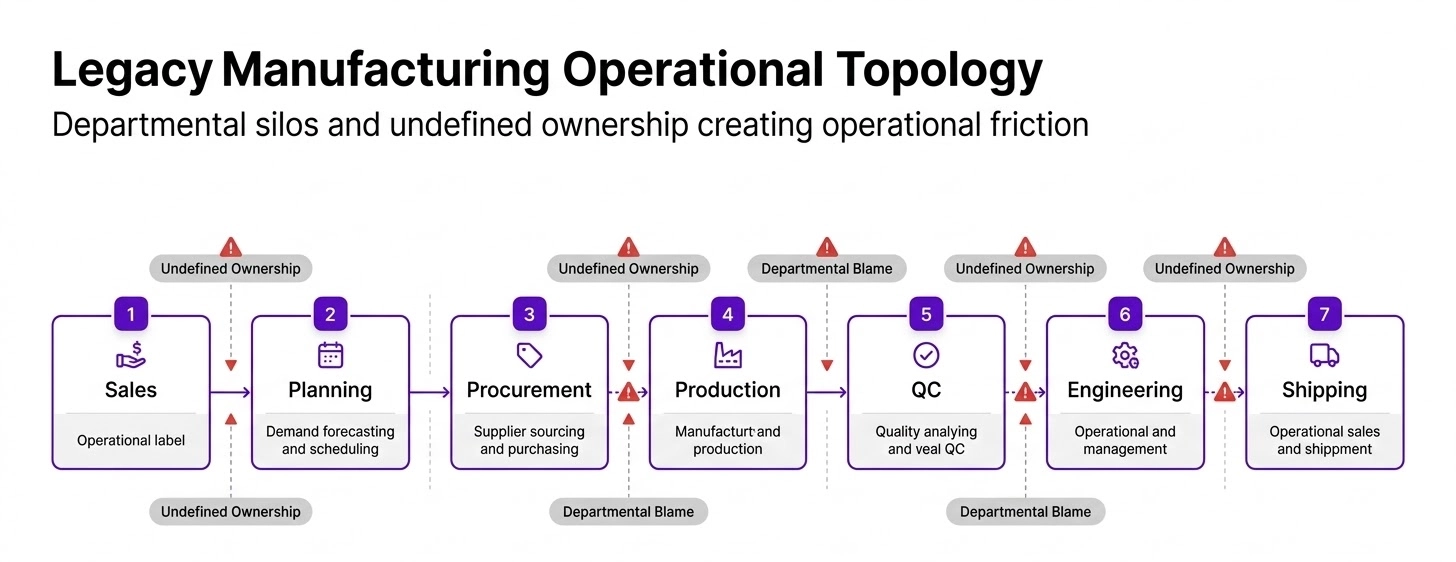
Our operational diagnostic revealed a deeply fragmented execution topology. Work orders moved linearly across Sales, Planning, Procurement, Production, QC, Engineering, and Shipping, but structural ownership was never formally established.
| Structural Breakdown | Operational Symptom | Financial Impact |
|---|---|---|
| Undefined Process Ownership | Departmental blame cycles when errors occurred | Losses absorbed rather than corrected |
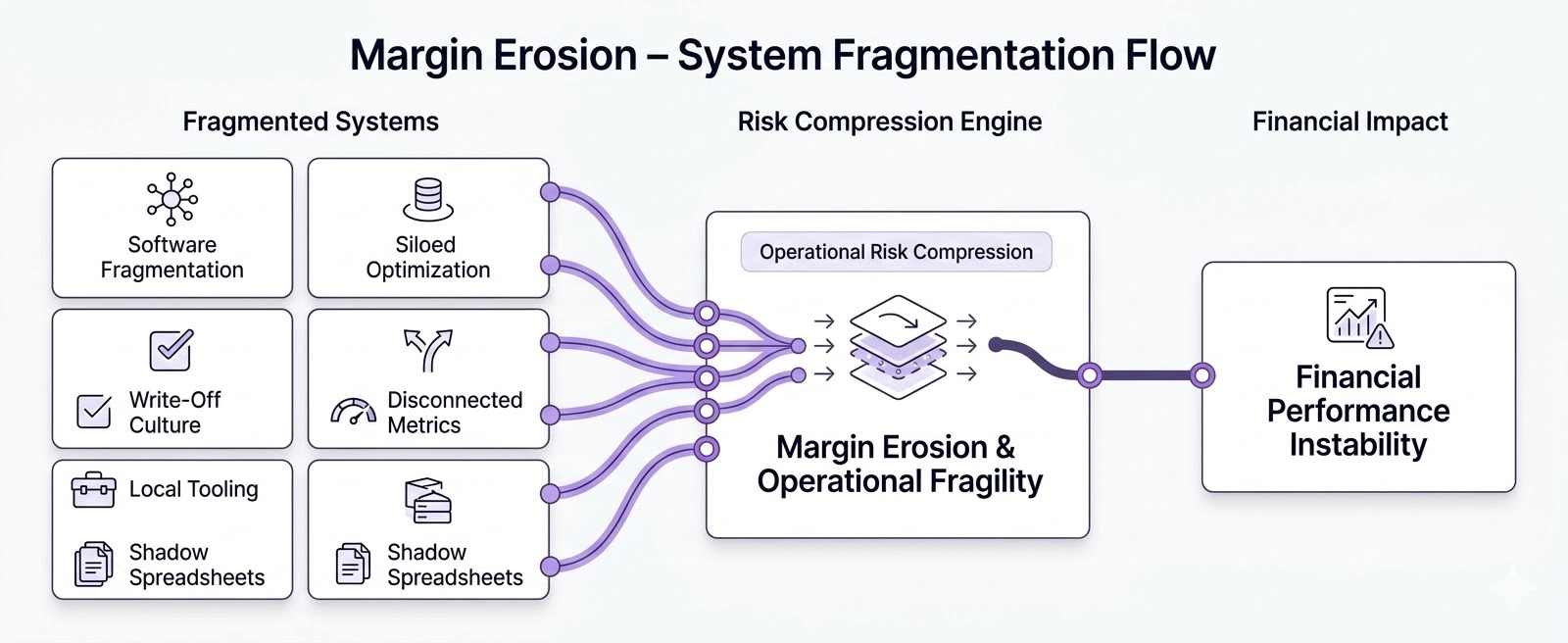
| Multi-Suite Fragmentation | Disconnected ERP, QC tools, and Excel sheets | Data existed, but execution logic did not |
| Siloed Optimization | Departments optimized locally (e.g., Procurement prioritized cost over lead time) | Global inefficiency and production bottlenecks |
| Write-Off Culture | Material waste and late penalties normalized as "variance" | Continuous, untraced margin erosion |
The Transformation Strategy
Instead of engaging in a costly, disruptive rip-and-replace of their legacy software, we implemented the Quanzar Manufacturing Execution Architecture™. This approach layers our AI Ops Layer over existing tools, orchestrating the flow of data and establishing strict architectural discipline.
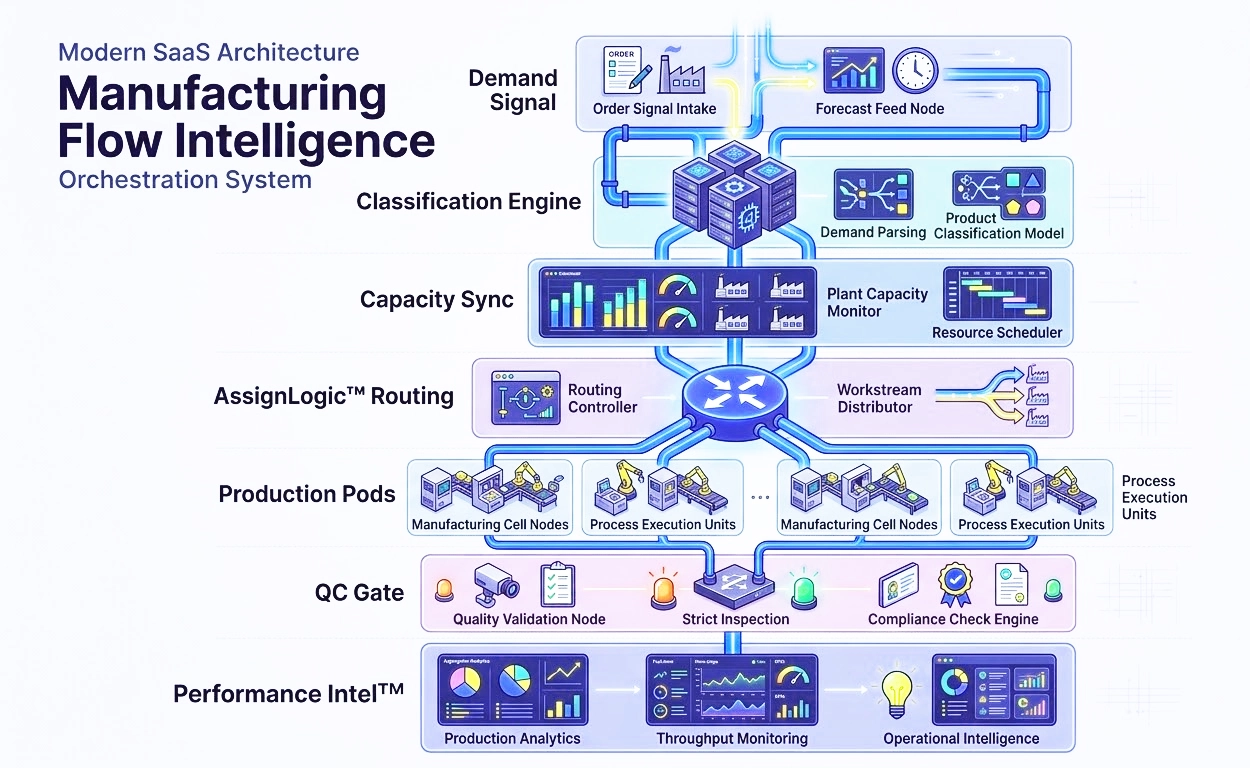
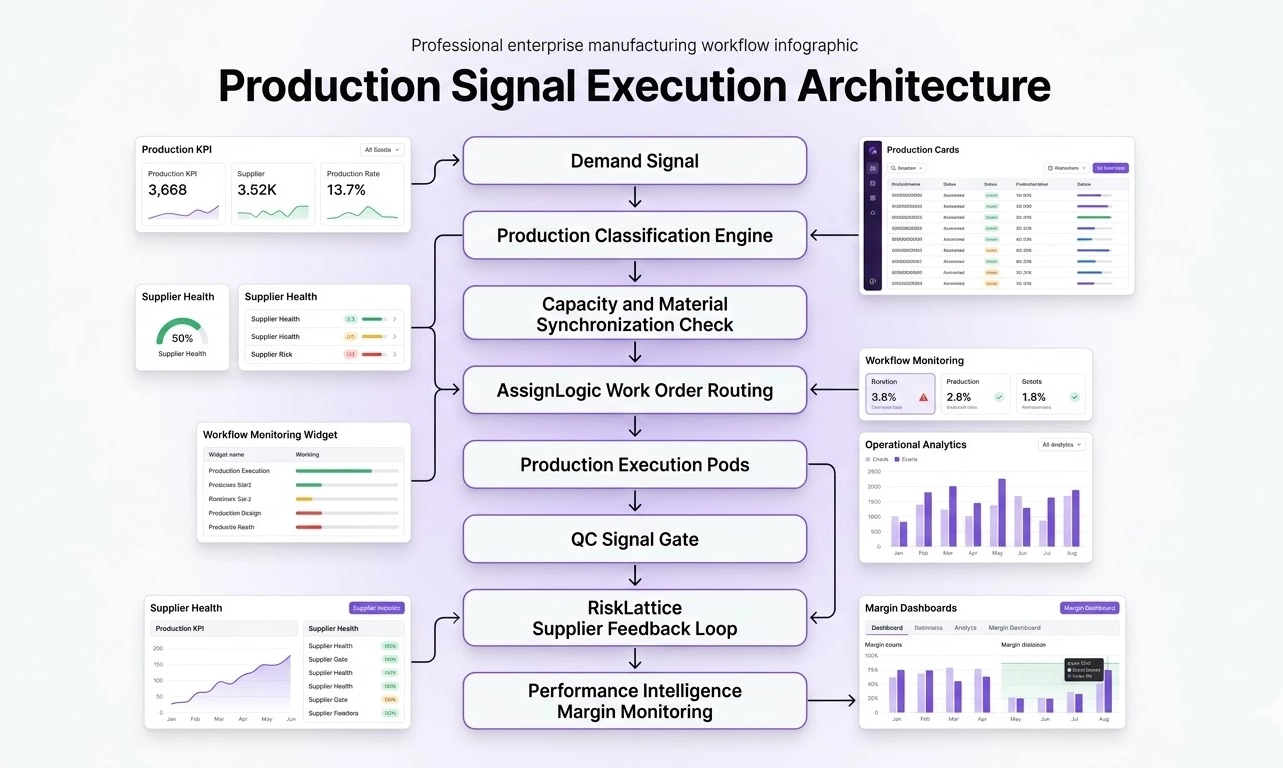
The intervention was designed to ensure every workflow was encoded, every escalation was structured, and every financial impact was immediately traceable back to its operational trigger.
Core Structural Components
We eliminated the "variance" culture by embedding five core structural components into the manufacturing lifecycle.
1. Process Ownership Encoding
Variance could no longer float unassigned between departments. Each stage of execution was encoded with a defined owner, a specific escalation authority, a strict SLA boundary, and a direct link to financial impact. Ownership shifted from a cultural expectation to a structural requirement.
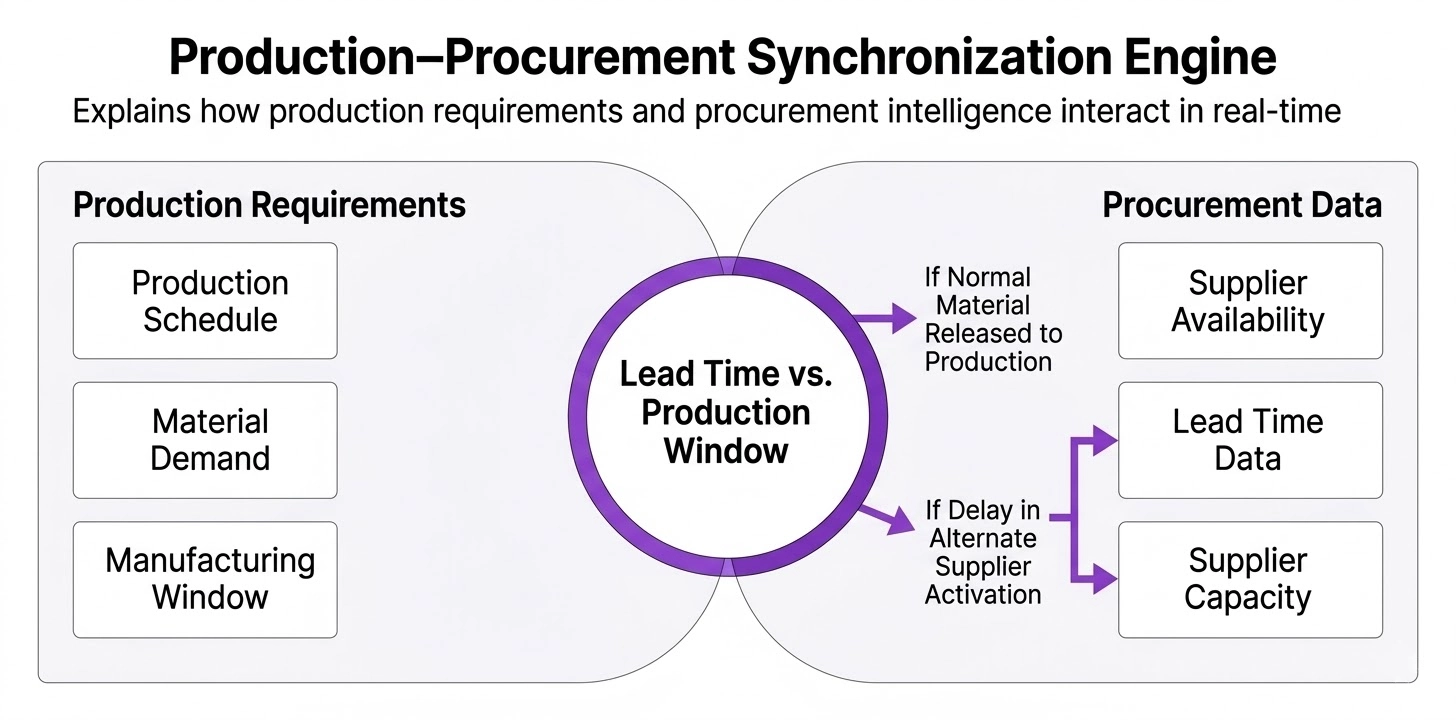
2. Production-Procurement Synchronization
Previously, material delays were only discovered after they had already impacted the production schedule. We introduced automated synchronization logic. If procurement lead times exceeded the required production window, the system automatically generated a planning escalation trigger and activated alternate supplier routing, drastically reducing material-driven downtime.
3. QC Feedback Integration (RiskLattice™)
Quality control was transformed from a reactive endpoint to a proactive feedback loop. QC signals were directly tied to supplier risk scoring. If a defect rate breached the encoded threshold, the system mandated an engineering review, updated the supplier's risk score, and triggered an automated alert to procurement, reducing defect cycles at the root source.
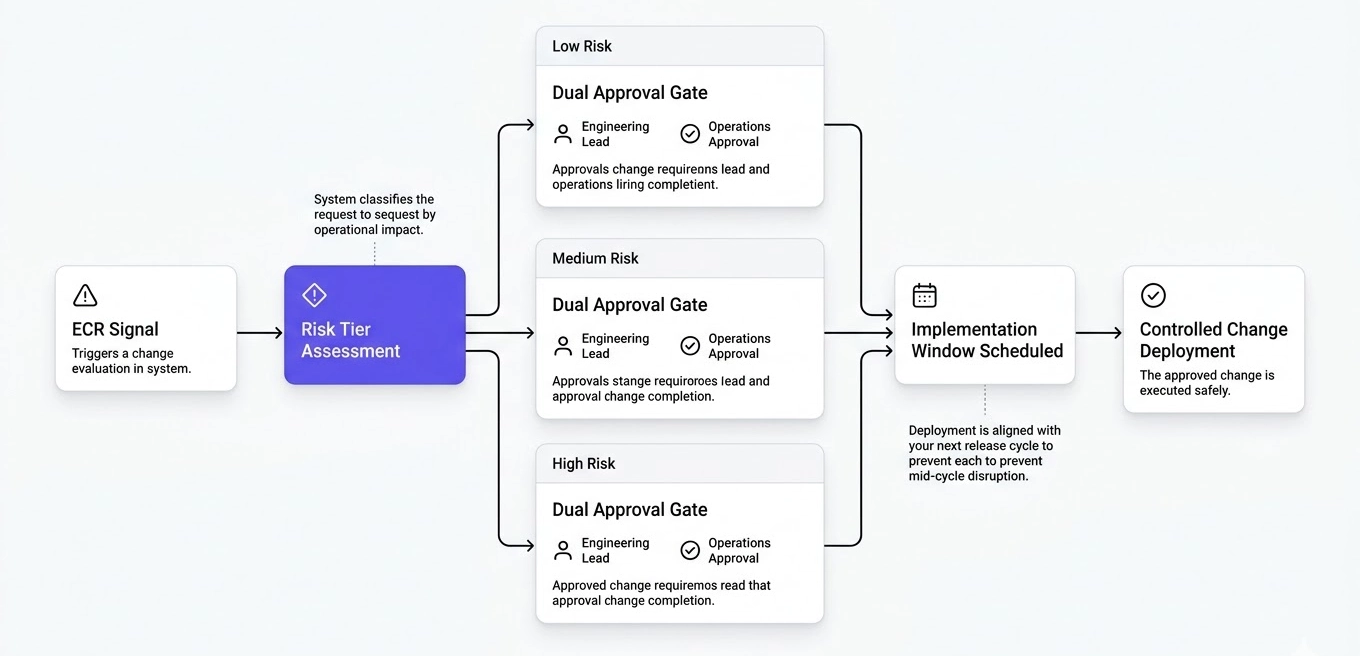
4. Engineering Change Routing
Unstructured, email-driven engineering changes were a primary cause of production chaos. Using our AI Ops Layer, change requests were converted into a structured workflow requiring risk-tiering, a dual approval gate, and strict implementation scheduling, thereby shielding active production runs from mid-cycle disruption.
5. Margin Visibility & Write-Off Prevention
Through Margin Intelligence, financial exposure became visible in real-time. The organization could now actively track rework cost per work order, scrap frequency by line, downtime cost impacts, and expedited freight triggers. Margin erosion was detected before the financial close.
Operational Implementation
Deploying structural accountability required a methodical implementation to preserve ongoing output.
| Implementation Phase | Focus Area | Outcome Delivered |
|---|---|---|
| Phase 1: Diagnostics | Identifying unmapped gaps between ERP and floor execution | Baseline documentation of "hidden" margin leakage |
| Phase 2: Logic Encoding | Deploying defined process ownership per stage | Elimination of cross-departmental blame cycles |
| Phase 3: Synchronization | Linking Procurement lead times to Production scheduling | Automated alternate supplier routing activated |
| Phase 4: Visibility | Deploying Margin Intelligence real-time financial tracking | Live dashboarding of scrap, rework, and freight costs |
Performance Measurement
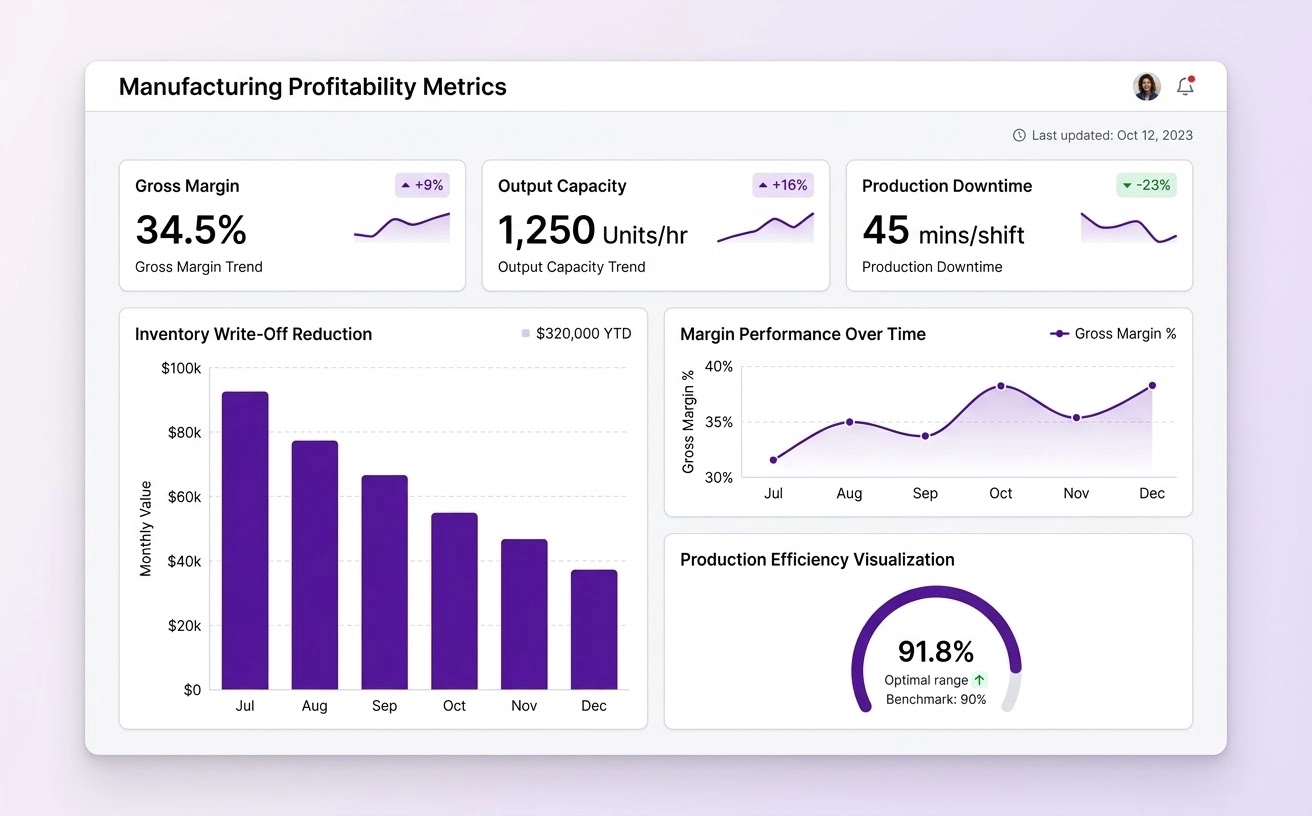
Following a 9–12 month stabilization period, the organization experienced a dramatic shift in both operational fluidity and bottom-line performance, measurable directly through Revenue Leak Tracker and the Margin Intelligence dashboard.
| Operational Efficiency Metric | Measured Impact |
|---|---|
| Production Downtime | Reduced by 19–23% via material synchronization |
| QC Rework Cycles | Reduced by 18% through root-cause supplier integration |
| Engineering Change Cycle Time | Reduced by 26% via structured approval routing |
| Work Order Latency | Reduced by 21% |
| Escalation Response Time | Reduced by 35% |
| Financial Performance Metric | Measured Impact |
|---|---|
| Inventory Write-Offs | Reduced by 17% |
| Expedited Freight Cost | Reduced by 22% |
| Gross Margin | Improved by 6–9% |
| On-Time Delivery | Improved by 14% |
| Output Capacity | Increased by 12–16% (with zero additional hires) |
Measured Outcomes
Revenue increased substantially, but not because of aggressive sales expansion. It grew because more orders were fulfilled on schedule, rework waste was mitigated, margin leakage was plugged, and supplier alignment was structurally enforced.
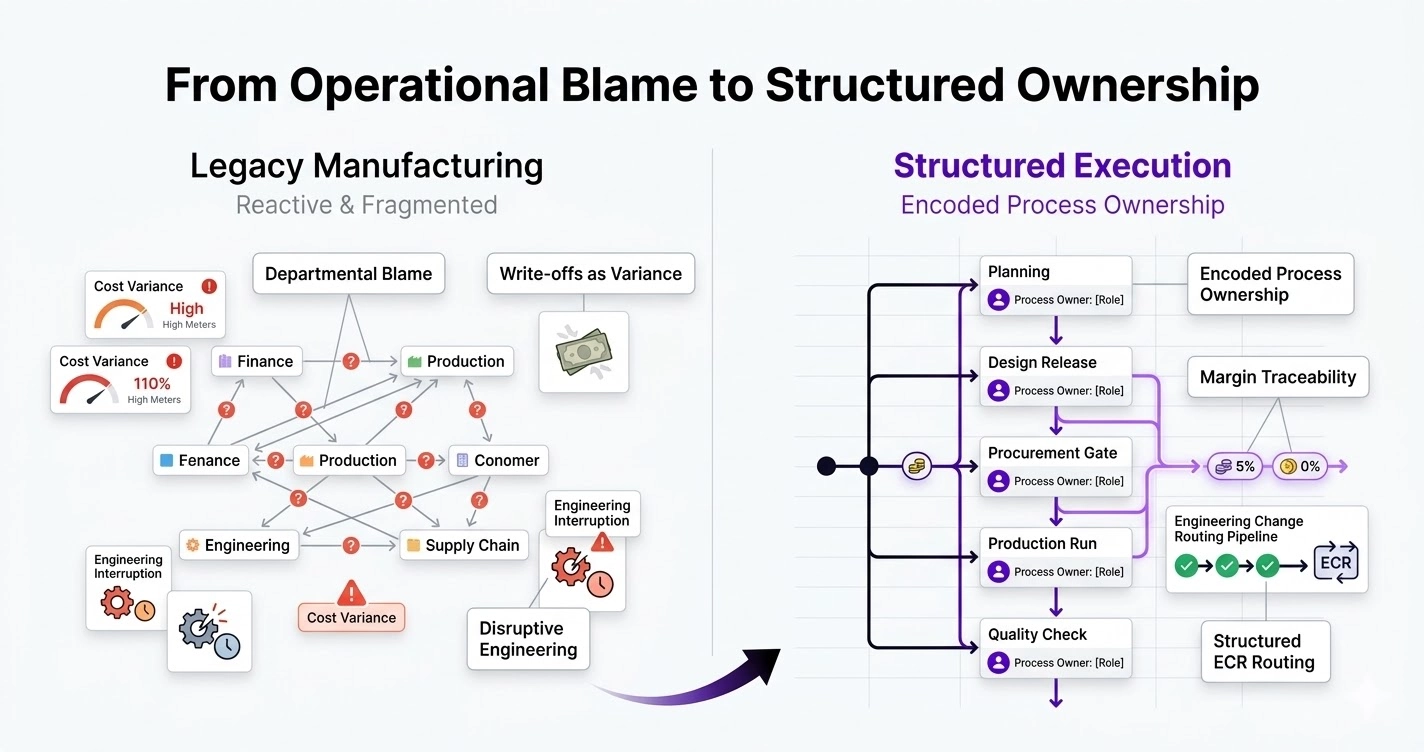
| Operational Vector | Legacy State | Structured State |
|---|---|---|
| Variance Culture | Write-offs accepted as routine variance | Margin traceability structurally enforced |
| Accountability | Departmental blame cycles | Encoded, absolute process ownership |
| System Usage | Multi-software fragmentation | Execution orchestration layer |
| Quality Control | Reactive defect detection | Risk-integrated supplier feedback loops |
| Engineering | Disruptive, ad-hoc changes | Structured ECR routing windows |
Strategic Insights
This engagement validates several fundamental truths about deploying Margin Intelligence in physical production environments.
1. Silos Create Variance
Manufacturing profitability deteriorates rapidly when process ownership is undefined. Blame cycles are the ultimate indicator of missing architectural logic.
2. Data Without Logic is Noise
Connecting software systems is useless if the execution logic between them is unstructured. Data must trigger predefined action.
3. Local Optimization Fails
Allowing individual departments to optimize for their specific KPIs (e.g., Procurement optimizing for cost at the expense of lead time) creates global inefficiency.
4. Escalations Need Structure
Personality-driven escalations create operational chaos. Exception handling must be encoded into automated, objective routing paths.
5. Write-Offs Are Not Normal
When labor overruns and material waste become normalized as "operational costs," margin erosion becomes systemic. Traceability prevents normalization.
6. Resilience is Encoded
Throughput is engineered, margin recovery is structured, and resilience must be mathematically encoded into the workflow.
Where This Applies
The Quanzar Manufacturing Execution Architecture™ is specifically designed for environments where complex scheduling, physical materials, and multi-department coordination intersect. It is highly effective for:
- Mid-market discrete manufacturers suffering from margin compression
- Multi-line production facilities experiencing high rework and scrap rates
- Operations highly dependent on unstable or complex supply chains
- Organizations struggling to unify data between legacy ERPs and floor operations
Secure Your Manufacturing Margins
Is fragmented execution logic destroying your gross margin?
Book a Diagnostic Run Free Margin Audit Explore Margin Intelligence